On 9 July 2026, a small group of self-advocates, allies, and representatives from the media and education sectors sat down in the Warsaw office of the Polish Ombudsman, to do something Poland had never formally attempted before: define what disability pride actually means in the Polish context.
The seminar, “Duma osób z niepełnosprawnościami. Samorzecznicy o tożsamości, doświadczeniu i obecności” (“Pride of People with Disabilities. Self-advocates on identity, experience and presence”), was co-organised by members of the Social Council of People with Disabilities operating at the Ombudsman’s Office.
One of its co-organisers described the experience the next day, in a reflection that doubled as an attempt to define the term herself: what does disability pride mean, and just as importantly what does it not mean. Her answer was pointedly unglamorous:
Disability pride, she wrote, is not being happy every single day of the year, and it is not the same as self-confidence. It is an ongoing process of self-discovery, full of contradictions and dilemmas, interspersed with genuinely good moments rather than defined by constant ones. What the movement had given her, she added, was a shift in perspective, greater self-awareness, new relationships that now matter deeply, and the courage to set goals she would not have imagined a few years earlier.
That mix of caution and hope that shows Pride as a slow, uneven process rather than a slogan, is a useful lens for the question this article wants to sit with.
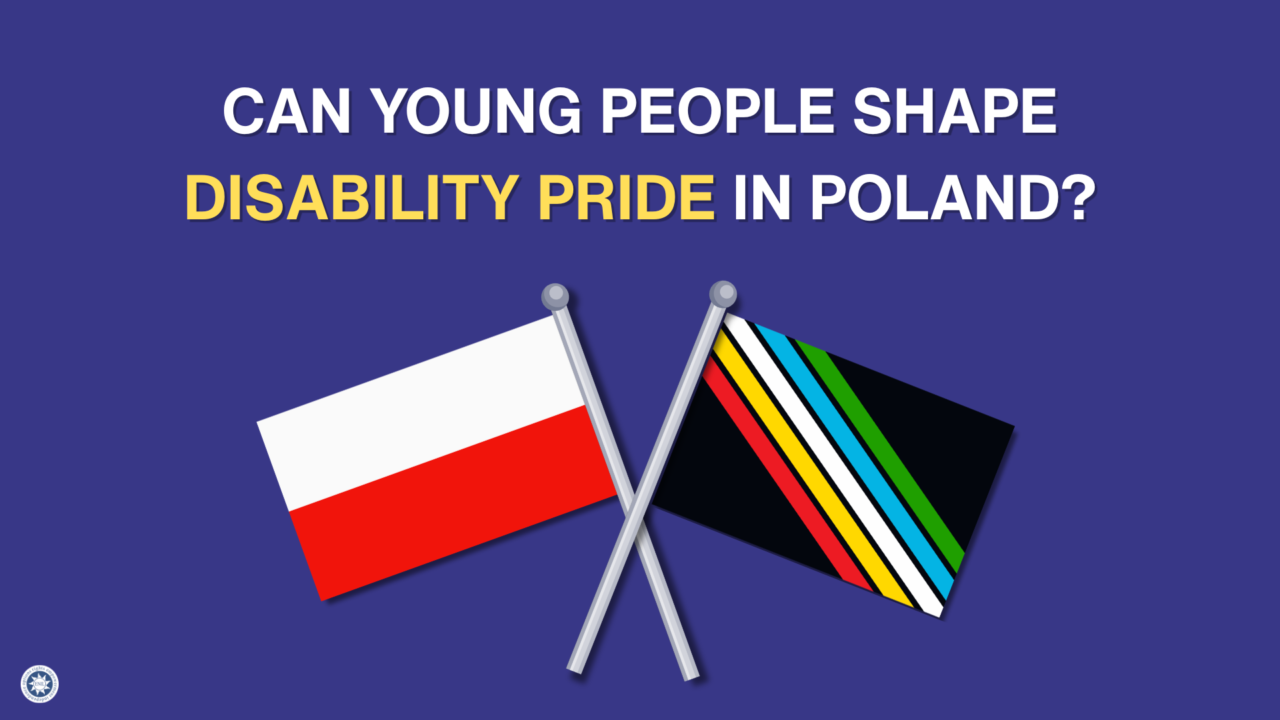
On 18 July, Poland held its first ever Disability Pride March through the streets of Warsaw. In the nine days between a seminar defining the terms and a march claiming the streets, a real public conversation about disability pride has begun in Poland for the first time.
A borrowed word looking for a home
To understand why that seminar was needed in the first place, it helps to understand the linguistic problem it was trying to solve. Research into the sociolinguistics of disability pride in Central and Eastern Europe points to something simple but consequential: Polish does not have a good word for “pride” in the English sense of the term. English “pride” comfortably holds both its positive and negative senses in a single word. Polish splits the concept in two duma (positive, self-respecting pride) and pycha (negative, closer to arrogance). It offers no neutral. When “Disability Pride” is translated directly, it risks landing on ears already tuned to two very different, and largely unrelated, associations: nationalist “duma” and the English language “LGBTQI+ Pride,” a phrase many Poles still read as foreign.
The vocabulary problem is not just a translation quirk; it sits on top of a deeper, structural one. Polish disability policy and public attitudes have historically been shaped by the medical model: The one that frames disability primarily as an individual deficit to be diagnosed, certified and compensated for, and people with disabilities as recipients of care rather than as rights-holders or full civic subjects. Support, in that framing, is something the state or family provides out of duty or compassion, not something owed as a matter of equality. This model, built around diagnosis and dependency rather than identity and self-determination, leaves little conceptual room for the idea that disability could be a source of community or pride.
That is precisely the ground the medical approach does not prepare people to stand on, and it is why the events of July matter beyond symbolic value.
A seminar that insists on separating pride of people with disabilities from pity for their condition, a march that turns private experience into public, collective visibility, and social media posts that document pride as an ongoing, imperfect process rather than a fixed diagnosis – each of these, in its own register, pushes back against the archaic logic that has dominated disability discourse for decades. None of them replaces that rationale overnight, but together they represent Poland’s first sustained, public attempt to shift the underlying framework itself – from disability as something to be managed toward disability as something lived, claimed and, at least some of the time, celebrated.
That gap is exactly what the 9 July seminar tried to close. It was about the pride of people with disabilities, not pride in disability itself. A subtle but important difference between celebrating people as full subjects and romanticising the condition they live with.
Why the answer might be generational
Within little more than a week, Poland got a public seminar defining the terms and a public march claiming the streets. Both events are new. Both are, in a real sense, experiments – nobody in Poland has run this playbook before. The question of who sustains this momentum matters more than usual. So, who will carry it forward?
Here the evidence points fairly clearly toward young people. A nationwide study on rights awareness among people with disabilities in Poland, prepared for the Ombudsman’s Office and published in 2026, found a marked generational split in how disability rights are understood and talked about. Younger respondents, particularly those active online and connected to disability organisations, were far more likely to use the language of human rights, equality and self-determination, and to see the UN Convention on the Rights of Persons with Disabilities as a genuine tool for systemic change, even while pointing out the gap between its promises and practice. Older respondents, by contrast, tended to frame support in terms of care and assistance, something granted by the state and given “out of grace” rather than a right to be claimed and enforced.
That split line up with the broader history of Disability Pride as an idea. The concept did not originate as an abstract philosophical proposal; it began as a political, collective act, deliberately modelled on other identity based liberation movements: The first Disability Pride Day was held in Boston in 1990, days after the Americans with Disabilities Act was signed. The practice of framing disability publicly and proudly rather than privately and apologetically has spread and evolved for over three decades since.
Poland is only now writing its first chapter of that story, and the people who are already fluent in the vocabulary of rights, equality, and online organising, are young.
If the Ombudsman’s seminar is where the concept gets defined and the march is where it gets performed publicly, social media is where it gets worked through on a daily, unglamorous basis. Polish disability activists and organisations have already begun adopting hashtags such as #dumazniepełnosprawnością and #niepełnosprawnidumni, alongside the internationally circulating #DisabilityPride, to describe personal stories, achievements and everyday moments of visibility.
This is grassroots definitional work happening in real time, arguably faster than academic or legal discourse can move, and it’s changing the public lens towards more positive celebration for years to come.