
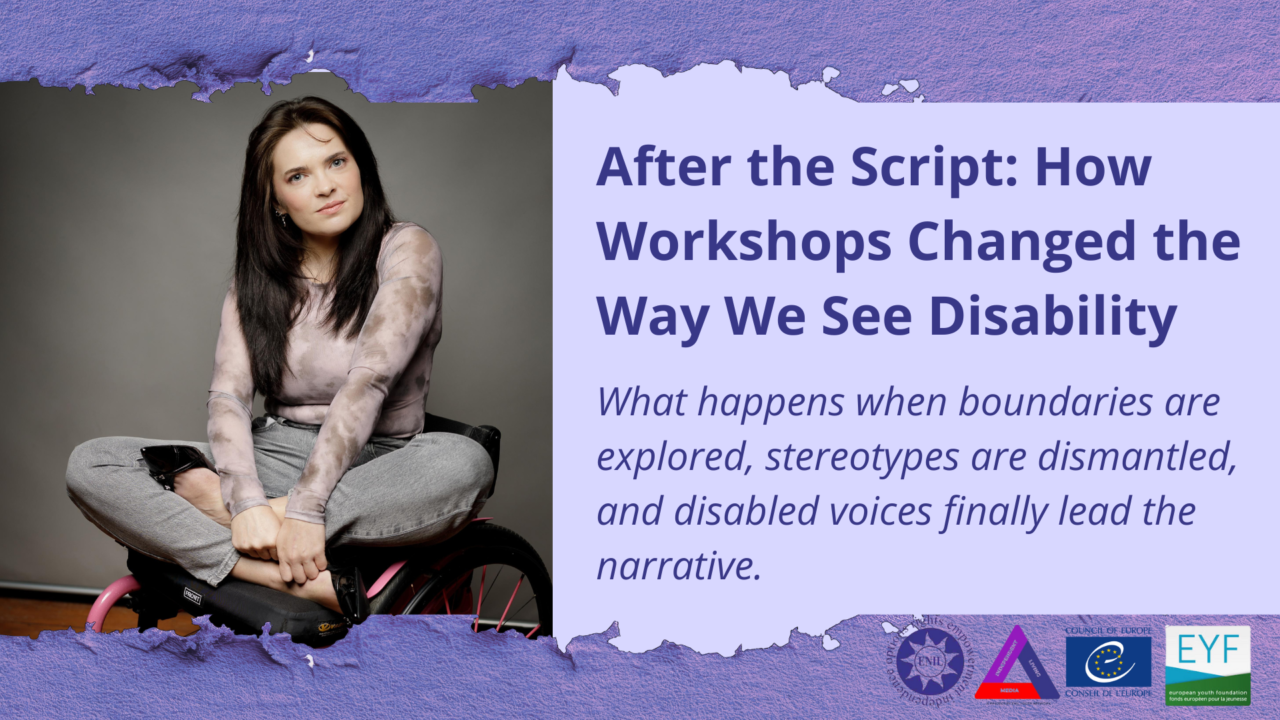
What happens when boundaries are explored, stereotypes are dismantled, and disabled voices finally lead the narrative.
“…I could see, in real time, the lesson the workshops had instilled: authentic boundaries, self-expression, and unapologetic individuality are not abstract ideals; they are survival tools.”
– Written by Philippa Cooper on behalf of the Independent (Living) Media” project, implemented by the ENIL Youth Network and funded by the European Youth Foundation of the Council of Europe.
The “Bound To The Script” workshops were three concerted meetings of minds (both disabled and not) gathered under the ENIL Youth Network’s Independent (Living) Media project, which launched earlier in 2025 with the quiet confidence of people who knew the media landscape needed a hard reset. Across three online sessions on April 22, April 29, and May 6, facilitators steered participants straight into the task of dissecting and dismantling the aging garden trellis that has been cosplaying as a trusty wheel for disability narratives far longer than anyone asked it to. And trust us, we’re disabled; we know wheels.
These workshops existed because ENIL recognised the obvious problem hiding in plain sight: media keeps insisting on telling stories about disabled people without ever letting disabled people hold the pen. So, the project set out to change that, giving young disabled creators and future media professionals, room to interrogate stereotypes, challenge lazy tropes, and rebuild language and representation from the inside out. With a strong foundation of accessibility, there was streamlined integration of sing language interpreters and live captioning, and this is the outcome of what happens when it really is about us, with us. You get wheels that get you places.
The series opened on Tuesday the 22nd of April, 2025 , with a session on “Disability in Media,” led first by Simona Aginskaitė. With her background in radio journalism and her work in communications and advocacy for the Lithuanian Disability Forum, she came equipped with a finely tuned sense of how disabled people are framed, cropped, or misrepresented in public storytelling. She spoke openly about the constant difficulty of reporting disabled people’s experiences with accuracy while dodging the same stereotypes the media keeps dragging out of storage.
Her aim was to identify the most recognisable disability stereotypes and expose why they still cling on. Much of it, she argued, comes down to unconscious bias: internal assumptions about a person’s life that get treated as fact simply because there is no alternative language offered. When you don’t have the vocabulary to build a different picture, an assumption quietly becomes a statement. Leave that statement unchallenged long enough, and it starts posing as truth.
Participants didn’t hesitate to supply examples. Across countries and platforms, disabled people are still cast as objects of pity, charity, or violence; the inspirational superhero; the villain; the burden; the mystery figure; the curiosity. Simona emphasised that even the “positive” stereotypes carry a sour undertow. Step outside one of these roles, and you risk becoming invisible or, worse, mocked for failing to play along. The message from the group was clear: anyone who has the stamina to push against this tide should, because shaping the language around disability matters far more than being trapped inside it.
There was agreement that the media landscape is improving, slowly shedding the most obvious clichés and making space for more nuanced portrayals. But the appetite for “more” was loud: more accuracy, more range, more ordinary reality—not just sensational stories designed to provoke or comfort a non-disabled audience’s narrow expectations of what being disabled supposedly means.
The second facilitator, Niamh Ní Hoireabhaird, a disability advocate, activist, and internationally published journalist, picked up this thread with her segment, “Language Matters.” With her academic and professional background, she treats language like her natural terrain, and she opened by asking participants what “common language” is used to frame disabled experiences, and how both disabled and non-disabled people interpret those words. Even the word “disabled” split the room: clean and factual to some, misused and dirtied by others.
What followed was a remarkably candid exchange across continents. Someone shared that news broadcasters regularly liken “disabled, in a wheelchair” as being “worse than dead.” Others debated person-first versus identity-first language, who prefers which, and where. Some participants described the persistence of “softened terms” such as “special educational needs,” as well as the absurdity of naming disabled people after heavenly bodies. In one case, disabled citizens were referred to collectively as “The [Disabled],” a label that managed to be both dehumanising and vaguely mystical, neatly mirroring the stereotypes Simona had unpacked minutes earlier.
Across these stories, a pattern emerged: this isn’t a cultural quirk; it’s systemic. The vocabulary might shift from country to country, but the habit of generalising disabled people into neat, tokenised categories remains widespread. And these broad labels rarely make room for the actual multitudes within each disabled person.
What struck me most was the urgency of representing the gloriously unexceptional: the disabled morning-person irritating their night-owl roommate; the disabled plant-lover who lets the sage die because they fussed over the petunias instead; the disabled crafter thrilled with five sales at the Christmas market. The small, ordinary spills of milk; that no one cries over—you just wipe them up and carry on. The point isn’t to reassure non-disabled audiences that we function, or how; that part is self-evident. The value lies in showing the very normal, human whys that shape our days.
Because real disability representation isn’t ‘gym-spiration’; a motivational poster telling average weight-lifters they “have no excuse” because the disabled guy does it. It’s the everyday reality that doesn’t need to prove anything to anyone.
Tuesday, 29th April’s workshop with Milica Veljković was titled “Not Your Inspiration.”
Her approach, built on years of disability and mental health advocacy, translated perfectly. Her style was engaging, playful, and sharply analytical, turning the session into a set of interactive thought experiments that made everything feel more actively… ‘think-y’. Her aim: look at common media portrayals, rethink how those portrayals shape how disabled people are seen and how we see ourselves. Then imagine fresher, truer versions that actually honour authenticity.
She invited participants to re-imagine a favourite non-disabled character as disabled—her pick was Chandler from Friends—and the submissions spanned anime, novels, and film. The collective conclusion was wonderfully ordinary: adding disability didn’t reduce anyone’s enjoyment or admiration for the character. If anything, it deepened them. Naturally, many people immediately thought of disabled characters or public figures too, which only reinforced a personal view I’ll happily die defending: disabled representation should appear everywhere from birth. Diaper packs, cartoons, book covers, snack labels. Saturate the landscape!
From that shared insight—that disability does not corrupt a character but enriches them—the workshop turned to the bigger question: why isn’t media embracing authentic disabled narratives as much as it could? The answer circled back to the same rigid stereotypes that flatten disabled experience into something easy to digest and easy to regurgitate for a non-disabled audience.
This is where Milica added nuance that tapped directly into my child development instincts. Introduce a “positive” stereotype early enough, for example, inspiration porn, and it sticks.
If you continuously praise a four-year-old with one hand for catching a ball as if she’s performing a miracle every time, it teaches her that her worth lies in inspiring others, not in simply being a child. Children thrive on praise and pride; positive reinforcement is enriching, and improves well-being. But if that disability-specific praise is continuous, it grows-up with her. By adulthood, mundane acts are still treated as motivational content, and she’s reduced to a tool for someone else’s emotional uplift, conditioned to believe that this is her purpose and the source of her self-esteem: something entirely outside of the self.
Participants also raised another layer: inspiration porn conveniently excuses a lack of effort in adapting environments. If the only stories told are exceptional ones, there’s no space for disabled people to be unremarkably human in unremarkable places. Not every disabled person in fitness is chasing Paralympic glory. Some of us just like the burn of quad muscles, or in my case, enjoy doing balcony laps while wondering when the neighbour’s kid will finally develop object constancy—he did. Also, his favourite colour of my canes is the blue one.
Milica pushed the discussion beyond semantics and into intention. She encouraged participants to explore disability as one facet of a whole human being, one with goals, boredom, humour, messiness, and ambition, rather than the defining headline. Accessibility, representation, and identity all interact, yes, but the disability itself is incidental, not the plot twist.
Her final activity was my favourite: collaboratively designing a character, a champion computer gamer who happened to be disabled but whose entire existence didn’t revolve around it. There was a flicker of hesitation in the room, or maybe that was just me confronting my own internalised ableist defaults, the ones that want characters to be diplomatic, gentle, and “safe.” But that hesitation made the exercise even more valuable. It was a reminder that building authentic representation isn’t about sanitising disabled people; it’s about letting them exist fully, with edges, flavour, and agency.
Then someone chipped in that perhaps he couldn’t cook eggs. In fact, he couldn’t cook at all. The type of person who could, somehow, succeed at burning cold breakfast cereal.
And just like that, in my mind, he drifted toward a more appeasing approach to his personal life because conflict was something he preferred to save for the computer. He’d already nearly tanked his relationship after missing one dinner date thanks to his competitive streak at work, so now he was aiming for balance. He even shoehorned gaming into his volunteering, teaching agriculture economics to school-kids through Farmville, still unsure if it counted as charity or just sanctioned screen time. His go-to meal was a potato chip sandwich, a defensive strategy against his total lack of cooking skills and the ever-present risk of burning down the flat. The milk consumption, two litres in two days, worried him for reasons even he couldn’t explain.
If you’re lost, so was I. He was an amputee, ambulatory wheelchair user with severe astigmatism, committed to y2k hipster glasses, worn originally to impress a girl who never noticed anything but how his beard was coming in pretty badly.
The question is, and was: did you even notice the ABSENCE of the exceptionalism that would have been centring his disability?
The final workshop on the 6th of May was on ‘Portraying Authentic Characters and Stories.’ It was facilitated by Romel Belcher (storyteller, educator, invigorator in the creative Black Deaf community), and myself.
Our workshops were essentially a live demonstration of how authentic narratives and characters are reinforced by learning, practicing, and expanding on knowledge, fundamental skills, and fundamental language.
Now I was the opening act on this day, but I feel the urge and the responsibility to give us both a respite from my rambling.
Romel Belcher’s session laid bare the constant negotiation of identity for Black Deaf people. He shared his journey from being labelled “Deaf first” to recognising his Blackness as central to who he is, and how that shift led him to co-found “Saved By The Sign”. The organisation exists to reclaim narratives, create visibility, and provide Black Deaf people a platform to tell their own stories rather than having them defined by others.
He outlined four pillars: representation, access to information, confronting taboo topics like racism in predominantly white Deaf spaces, and celebrating the diversity of Black Deaf experiences globally. He reflected on a striking moment in 2021 when he realised, he couldn’t name a single Black Deaf role model over fifty in Europe, revealing how systemic erasure limits inspiration and visibility.
Audience participation deepened the discussion. Questions explored layered marginalisation for Deaf people with additional impairments, those acquiring deafness later in life, and the difficulty of accessing information and services without sign language support. Romel emphasised how the experience changes depending on the space, within Deaf communities, Black communities, or the wider hearing world, and the constant negotiation required to be recognised in each.
Participants connected his points to broader media representation, noting how AI and popular culture often misrepresent or erase Deaf and Black identities. Romel highlighted the frustration of being told he “doesn’t look deaf,” underscoring why narrative control matters: without it, visibility is hollow and misleading.
He concluded with a call to action: oppressed communities must become their own examples, resisting the sanitised “inspirational” stories imposed by outsiders. Real storytelling, he argued, is survival, healing, and resistance. It is through these narratives that Black Deaf people, and all minoritised voices, can claim space, assert agency, and inspire others without compromise.
Bringing us to myself to round up the roster, only I was second to last. If I am honest, writing a report of my own words gives me a similar anxiety and mistrust as writing my own resume. So let us begin in a familiar way:
Hi. I’m Philippa Cooper. I have Motor Neuron Disease and I am now, and always have been, “a character.” Mum always said so. And since 2022, I became a full-time content creator and today, your cautionary tale:
In my title-less Storytime, I shared how quickly disabled people get flattened into stock roles, especially with ALS/MND, where society expects only tragedy, inspiration, or medical spectacle. I talked about how even AI reduced a vibrant photo of me into “The Patient,” stripping life and personality from the image.
Participants contributed insights, describing moments when their autonomy had been reframed or overwritten. There was a real sense of collective honesty as we explored what boundaries might look like for each of us. One participant shared how wearing a hearing aid triggered assumptions about their entire identity, while another described being valued only for success as a para-athlete.
These contributions illustrated how small markers, three letters, a device, a diagnosis, can compress complex selves into digestible narratives for others.
I used my own experience with a friend to show how swiftly disabled autonomy can be dismissed. Denied access, ridiculed for asserting independence, and having my needs reframed as inconvenient or irritating, I realized how easily boundaries can be treated as optional and how fast ableism can erase years of personal growth.
The room’s energy felt like a container; people were holding space as I walked through the messiness of asserting boundaries and the relief that comes from enforcing them. Audience members nodded, shared, and typed affirmations in the chat, resonating with the experience of being boxed, misread, or misrepresented.
I concluded by emphasizing that disabled people don’t owe anyone tragedy, inspiration, or neat narratives. We get to exist as whole, contradictory humans. Boundaries are one of the few tools that let us protect our own stories, maintain autonomy, and preserve complexity.
Hearing participants reflect on their own experiences, acknowledging long journeys to recognize and assert their needs, reinforced the power of shared vulnerability. Laughter, nods, and moments of discomfort surfaced as people admitted how often their boundaries were misunderstood or ignored.
And on reflection, I have to admit my own duplicity: after passionately advocating for boundaries, I often fail to practice what I preach.
Being a whole other chronic, non-disability-centric, universally human stereotype: the hypocrite.
Not all the time. Definitely more than I would like to admit. But comprehending that flaw is profoundly authentic to me as a person, because even since that workshop I have subconsciously continued to allow boundaries to be pushed and, in one profound event, completely obliterated.
Someone centralising my disability on behalf of themselves, their agenda, and their sense of moral justice. Assuming my experience and my perspective on it. Arguing that a profound healing journey was, in fact, not healing at all. It escalated to the point of psychologically endangering myself (and physically given my blood-pressure dropping), not to mention others. This is something someone felt entitled to do under one 7-second reel on Instagram.
But at the same time, life leaned in with irony. At the very moment my boundaries were being demolished, I was writing this very report.
I was reviewing the dangers, pitfalls, and issues with stereotyping disability in media: the lack of person-first language, inauthentic representation of experiences, generalised portrayals of disabled lives, exceptionalism, performative strength, and polarized character. I walked myself through it all, with the support and understanding the workshop had provided.
No one expected me to swallow the script this person was shoving down my throat, but I could see, in real time, the lesson the workshops had instilled: authentic boundaries, self-expression, and unapologetic individuality are not abstract ideals; they are survival tools.
Fueled by that clarity, I did what felt utterly me: expelled their toxic narrative, set it on fire, and blocked them. The aftermath is messy: screen glare, reflection, writing it all down, but I haven’t felt this representative of myself in a long time.
These workshops weren’t just theory; they were living proof that carving space for unique voice, perspective, and agency is radical, necessary, and transformative.
Philippa Cooper is a life-style content creator under the name @hotcripkitty across most social media. Her main litter-tray is Instagram, but you can also find her feral hot-takes on Substack: https://open.substack.com/pub/hotcripkitty?utm_source=share&utm_medium=android&r=5c56o0
*The language and opinions expressed in this article are those of the author, protected under their right to freedom of expression, and they do not necessarily represent attitudes and opinions of ENIL, the Council of Europe, or EYF.


