
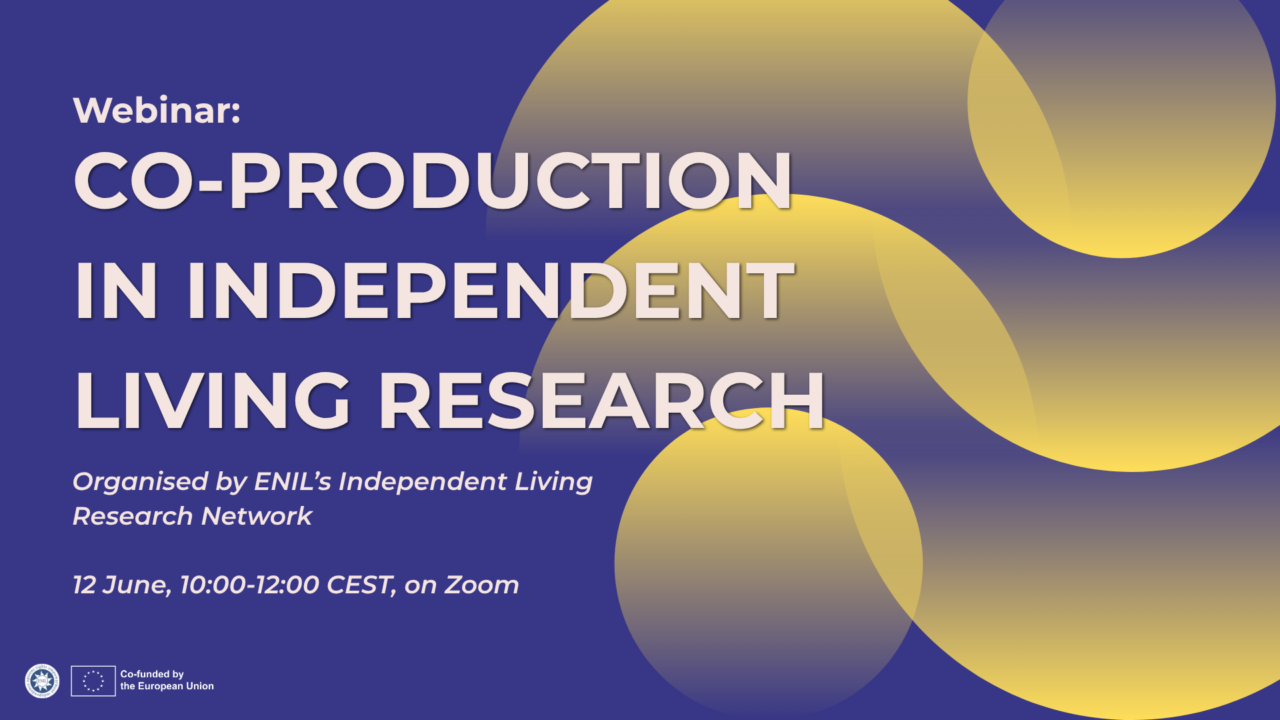
Organised by ENIL’s Independent Living Research Network
Date: 12 June
Time: 10:00 – 12:00 CEST
Location: Online via Zoom
Register: https://shorturl.at/YPmcv
This webinar will explore how research can be shaped by disabled people leading as experts, rather than being treated only as research subjects.
The discussion will look at key principles such as “Nothing about us without us”, co-production in research, and the importance of recognising lived experience as a form of expertise. It will also address how to prevent exploitation in disability research and how to promote research practices that are accountable, inclusive, and grounded in the priorities of disabled people.
We will hear from three members of ENIL’s Independent Living Research Network:
• Magdalena Kocejko
• Dilmurad Yusupov
• Rados Keravica
The webinar will be chaired by Teodor Mladenov and Kamil Goungor.
Presentations and speakers
• When research meets activism: Co-producing independent living research on supported housing in Poland
Magdalena Kocejko, Warsaw School of Economics, Poland
This presentation introduces “Tenant or care recipient?”, a co-produced independent living study on supported housing in Poland, carried out jointly by the SGH Warsaw School of Economics and the Polish Disability Forum. The presentation will explore when supported housing schemes meet the requirements of Article 19 of the CRPD, where evidence may clash with advocacy, and how accessible, shared fieldwork can help redistribute power in the research process.
Magdalena Kocejko, PhD, is a social policy scholar at the Warsaw School of Economics and a long-standing ally of the disability rights movement in Poland. Her research focuses on disability policy, particularly the right to independent living and the situation of women with disabilities. Her work combines academic research with close collaboration with disabled people’s organisations.
• Using participatory video in a co-operative inquiry and advocacy with disabled people in Uzbekistan
Dilmurad Yusupov, Tokyo College, Institute for Advanced Study, The University of Tokyo, Japan
This presentation will explore how participatory video, used as part of a co-operative inquiry with members of the disabled people’s organisation NGO Sharoit Plus in Tashkent City, can lead to practical and sustainable outcomes. The project examines social exclusion, discrimination, and marginalisation of disabled people at state, community, and family level.
The presentation will offer practical insights into how co-produced participatory video can support grassroots disability action and strengthen the capacity of disabled people and their organisations for self-representation and advocacy.
Dilmurad Yusupov, PhD, is a researcher, activist, and consultant working on disability-inclusive development in Uzbekistan. He is currently a Postdoctoral Fellow at Tokyo College. He is also the co-founder of NGO Sharoit Plus, which promotes a barrier-free and inclusive society for all in Tashkent City. His current research focuses on disability-inclusive employment through the specialised recruitment platform IshPlus.uz, developed and implemented together with NGO Sharoit Plus.
• Research co-production with disabled people in qualitative health research
Rados Keravica, Bradford Institute for Health Research, United Kingdom
This presentation will explore research co-production with disabled people across two qualitative health research projects situated within disability studies and the participatory research paradigm.
Drawing on his doctoral research at the University of Leeds and his current work within the Born in Bradford programme, Rados Keravica will reflect on the benefits, challenges, and ethical commitments involved in embedding the lived experience of disabled people throughout the research process.
The first case study focuses on his doctoral project examining disabled children’s participation in healthcare decision-making. The second case study discusses EQUITY-MS, a qualitative study exploring inequalities in timely access to Disease Modifying Treatments for people with relapsing-remitting multiple sclerosis in Leeds and Bradford.
Rados Keravica holds a PhD from the University of Leeds, Centre for Disability Studies, School of Sociology and Social Policy. He currently works as a Qualitative Research Fellow on applied health research projects focused on health inequalities at the Bradford Institute for Health Research. Previously, he worked as an EU Marie Skłodowska-Curie Early-Stage Researcher within the Disability Advocacy Research in Europe project, conducting his doctoral research from 2019 to 2022. He also holds a master’s degree in human rights law from the Central European University and a master’s degree in international economics from the University of Novi Sad.
Register: https://shorturl.at/YPmcv