
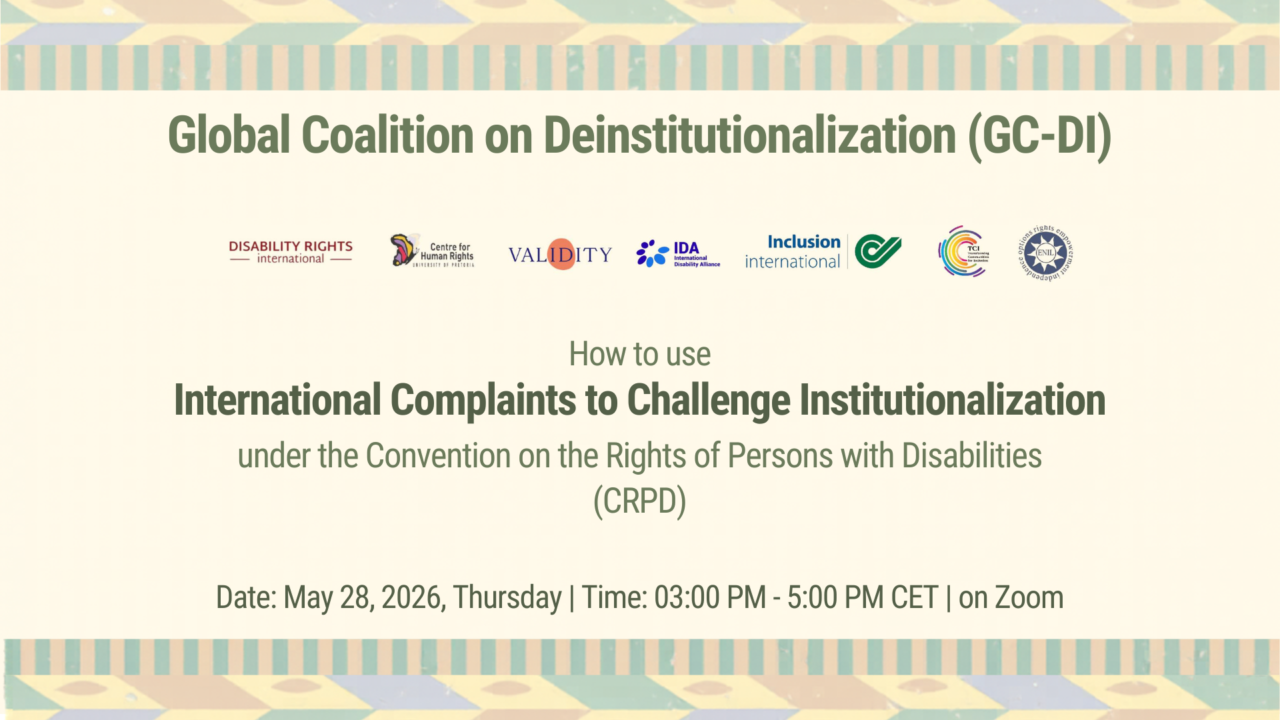
Date: Thursday, 28 May 2026
Time: 15:00 – 17:00 CET
Location: Online via Zoom
Register: https://shorturl.at/Ljeaa
Accessibility: Captioning, International Sign Language and Mandarin interpretation will be provided.
Institutionalization continues to impact the lives, autonomy, legal capacity and community inclusion of persons with disabilities across the world.
This webinar will explore how international complaints mechanisms under the Convention on the Rights of Persons with Disabilities (CRPD) can be used as tools for advocacy, accountability and systemic change towards deinstitutionalization and community living.
The session will bring together disability rights advocates, Organisations of Persons with Disabilities, legal experts and civil society representatives to discuss practical pathways for engaging with CRPD mechanisms and strengthening rights-based advocacy efforts at national, regional and global levels.
The webinar will discuss different procedures, complaints and review pathways under the CRPD that can be used to challenge institutionalization and advance deinstitutionalization advocacy. Through examples from inquiries, individual communications, requests for further information, follow-up processes and domestic CRPD-like review mechanisms, the session will highlight how OPDs, civil society actors and advocates have used these mechanisms in practice, what opportunities they create, and how their outcomes can support national-level advocacy for independent living in the community and freedom from institutionalization and coercive practices.
We are honoured to organise this discussion together with partners from the Global Coalition on Deinstitutionalization (GC-DI), including the International Disability Alliance, Inclusion International, ENIL, Disability Rights International, the Centre for Human Rights, and Validity Foundation.
Agenda
| Time | Topic | Presenter |
|---|---|---|
| 15:00 – 15:10 | Welcome and introductions | Richa Sharma, Transforming Communities for Inclusion |
| 15:10 – 15:15 | Housekeeping guidelines | Sabeeha Majid, University of Pretoria |
| 15:15 – 15:25 | Overview of CRPD mechanisms for challenging institutionalization | Mirriam Nthenge, International Disability Alliance |
| 15:25 – 15:30 | How the webinar will flow | Moderator |
| 15:30 – 15:40 | Using the inquiry procedure: lessons from Mexico | Disability Rights International |
| 15:40 – 15:50 | Using the inquiry procedure: lessons from the UK | European Network on Independent Living |
| 15:50 – 16:00 | Using the inquiry procedure: lessons from Hungary | Sándor Gurbai, Validity Foundation |
| 16:00 – 16:10 | Article 36(1): requesting further information from States | Dorothy Gould, Liberation, UK |
| 16:10 – 16:20 | Individual communications: case example from Australia/Slovakia | Validity Foundation |
| 16:20 – 16:30 | Overview of domestic CRPD-like review mechanisms for non-UN member States | Nagase Osamu, Inclusion International |
| 16:30 – 16:40 | OPD experience of using domestic CRPD-like review for deinstitutionalization advocacy | Wang Shiou-Wu, Taiwan Mad Alliance |
| 16:40 – 16:55 | Questions and discussion | Moderator with GC-DI support |
| 16:55 – 17:00 | Closing remarks and wrap-up |
About the webinar
The webinar will focus on how CRPD procedures and related review mechanisms can be used to challenge institutionalization and strengthen advocacy for deinstitutionalization.
Speakers will discuss:
• how OPDs, advocates and civil society groups can use CRPD procedures to challenge institutionalization
• how inquiry procedures have been used in Mexico, the UK and Hungary
• how Article 36(1) can help raise concerns with the CRPD Committee
• what individual communications can show about challenging institutionalization
• why domestic CRPD-like review mechanisms matter for non-UN member States
• how OPDs have used review processes to advocate for deinstitutionalization
Register here: https://shorturl.at/Ljeaa