Commenting on the upcoming EU Gender Equality Strategy 2026–2030
8 March 2026
Written by Antonella Candiago, ENIL Policy Officer
You can download the full statement as a pdf here and as a word file here
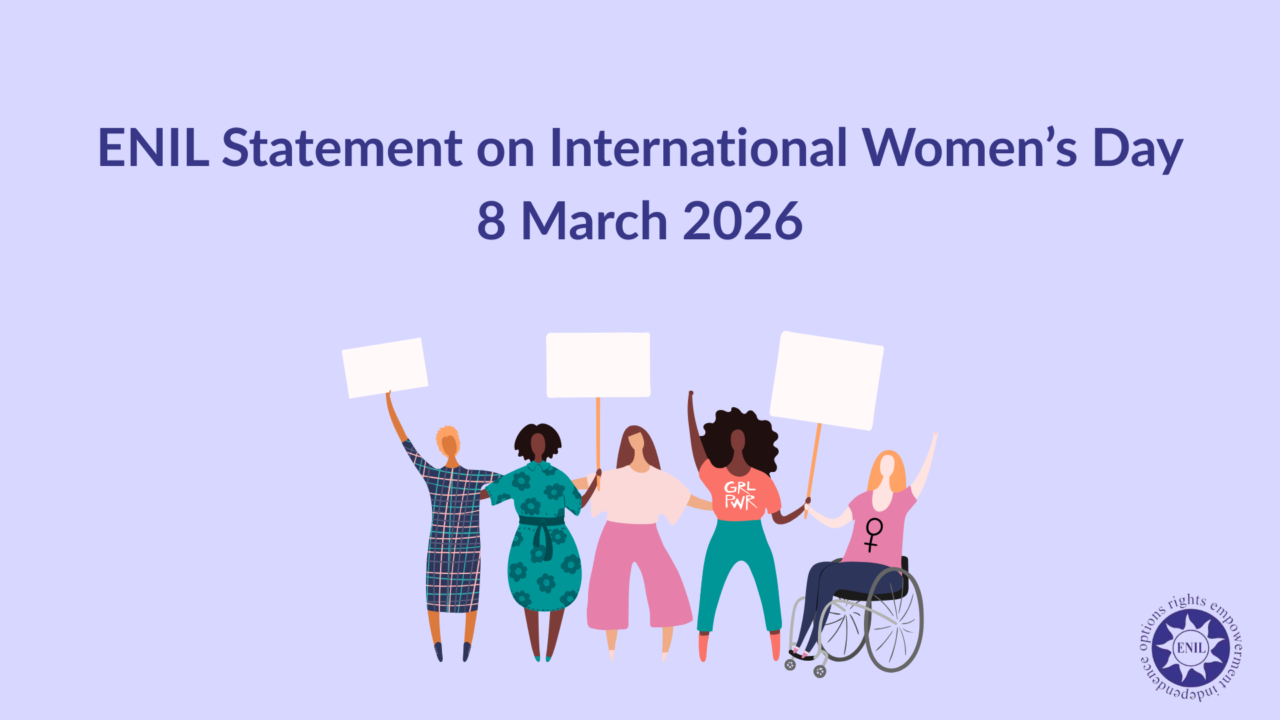
On 8 March 2026, International Women’s Day, under the United Nations global theme “Rights. Justice. Action. For ALL Women and Girls”, the European Network on Independent Living (ENIL) chooses to mark this day by looking at gender equality through the lens of Independent Living.
With the publication of the European Commission’s EU Gender Equality Strategy 2026–2030, this is a decisive political moment. If the Strategy is to deliver on rights, justice and action, it must confront the structural barriers that deny disabled women and girls equal power, participation rights, and access to justice across the European Union.
While the Strategy recognises intersectionality and the need to address multiple and intersecting forms of discrimination, the realities of disabled women’s lives remain insufficiently addressed in European gender equality policy.
Within the Independent Living movement, leadership and visibility have historically been dominated by men, who have led the fight for disabled people’s rights. On the other hand, mainstream feminism has largely failed to include the realities, experiences, and bodies of disabled women. Consequently, disabled women often find themselves excluded from the feminist agenda, and even more so when intersecting with other marginalized identities (e.g., racialized and LGBTQIA+ communities).
ENIL firmly believes that there can be no gender equality without Independent Living. The other way around is also true: there can be no Independent Living without gender equality.
Independent Living, as enshrined in Article 19 of the UN Convention on the Rights of Persons with Disabilities (CRPD), is a precondition for exercising all other rights. Without control over where and with whom to live, without control over their bodies, without access to user-controlled support, without legal capacity and economic independence, disabled women cannot fully enjoy equality.
Rights
Across the EU, many disabled women are still denied their most basic rights.
Some remain institutionalised or in segregated residential settings, where they face heightened risks of violence, neglect, and reproductive control. Others are forced to live with family members due to the absence of accessible housing, adequate income and community-based services. In many Member States, personal assistance remains underfunded, medically controlled or unavailable, limiting women’s right to make everyday choices about their own lives.
Guardianship and substituted decision-making regimes continue to restrict the legal capacity of women with intellectual and psychosocial disabilities. These systems undermine their right to vote, to sign contracts, to manage finances and to make decisions about their own bodies and health.
Sexuality is one of the most overlooked aspects of disabled women’s lives, including their right to pleasure and free access to their bodies, often lacking privacy, adequate support, and self-determination.
Such restrictions are not isolated policy gaps. They represent structural discrimination at the intersection of gender and disability.
For the EU Gender Equality Strategy 2026–2030 to be credible, it must explicitly recognise that institutionalisation, denial of personal assistance and substituted decision-making are incompatible with gender equality. Gender policy cannot focus solely on labour market participation or representation while ignoring whether disabled women have the fundamental freedom to live in the community as equal citizens.
To avoid equality remains theoretical, rights must begin with Independent Living.
Justice
Women with disabilities experience disproportionately high levels of gender-based violence, particularly in institutional and segregated settings. Yet access to justice remains deeply unequal.
The absence of inclusive, empowering sexual education that represents the lived experiences of disabled women further deepens their lack of knowledge about their bodies, understanding of boundaries, and the right to consent. Given their specific needs, they are constantly being held and touched, which blurs the line between necessary contact and abuse. As a result, defining, identifying, and recognizing abusive behavior becomes profoundly challenging.Barriers include inaccessible shelters and crisis services, lack of procedural accommodations in courts, absence of accessible information, and reporting mechanisms that do not take diverse communication needs into account. Data on disability and gender-based violence remains insufficient, rendering many forms of abuse invisible in policymaking.
In some Member States, disabled women are still exposed to forced sterilisation, forced contraception or other non-consensual medical interventions. These practices constitute grave violations of bodily autonomy and human dignity, besides reflecting persistent stereotypes that disabled women are incapable of making decisions about their own lives.
Justice requires more than protective language. It requires structural guarantees.
To fully deliver on its commitments, the EU Gender Equality Strategy 2026–2030 must therefore:
- Explicitly address and work toward the elimination of forced sterilisation and all forms of non-consensual medical treatment.
- Ensure that gender-based violence prevention and response services are accessible and inclusive across all Member States.
- Promote an inclusive, representative, empowering sexuality education that includes full diversity of experiences, including disabled bodies,
- Address violence in institutional and segregated settings and support independent monitoring mechanisms.
- Promote the transition from substituted to supported decision-making in line with international human rights standards.
Justice means recognising disabled women as rights-holders, not passive objects of protection. It means ensuring their voice is heard, their decisions respected and their autonomy upheld.
Action
Action requires political will, resources and accountability.
Disabled women are disproportionately affected by poverty, labour market exclusion and precarious employment. Many are channelled into segregated employment schemes or remain outside the labour market due to lack of reasonable accommodation and accessible training. Economic dependence can trap women in abusive environments and limit their participation in public life.
At the same time, women, including mothers, sisters and daughters, predominantly from ethnic and racial minorities, provide unpaid care to relatives with disabilities. This unpaid care work reinforces gendered economic inequalities and often leaves women without adequate social protection. Our lives must not depend on the structural oppression of other socially marginalized groups. Beyond being recipients of care, disabled women also provide it, but adequate support must be guaranteed.
Political representation is crucial to ensuring that disabled women are included in decision-making processes, enabling them to fight for their rights, influence policies, and promote societal change. Their experiences and perspectives are essential to the development of public policies that are truly aligned with the real needs of disabled people. Furthermore, the presence of disabled women in political spaces serves as a powerful model for young disabled people, encouraging greater participation in civic and public life.
The EU Gender Equality Strategy 2026–2030 must move beyond symbolic references to disability and commit to structural measures. This includes:
- Investing EU funds in community-based services and user-controlled personal assistance.
- Rethinking care policies through an ethical and emancipatory perspective, placing disabled people both as recipients and providers of care in the EU Care Strategy.
- Ensuring access to adequate minimum income and social protection schemes.
- Enforcing reasonable accommodation obligations in employment.
- Guaranteeing accessible vocational training and lifelong learning.
- Improving disaggregated data collection on gender and disability across employment, poverty, violence and political participation.
Without economic independence, disabled women cannot leave violence, pursue education, build careers or engage fully in civic and political life.
Action must also mean participation. Disabled women and girls and their representative organisations must be meaningfully involved in the design, implementation and monitoring of the Strategy. Consultation must be structured, ongoing and adequately resourced.
Independent Living: The Missing Link
On this International Women’s Day, ENIL deliberately frames the discussion of “Rights. Justice. Action.” through Independent Living because it is the missing link in European gender equality policy.
Independent Living includes control over one’s body, support, home, income, political voice and future. It transforms disabled women from passive recipients of care into active subjects of rights.
When disabled women are institutionalised, denied legal capacity, economically dependent or excluded from decision-making, gender equality remains incomplete. A Gender Equality Strategy that does not address these realities will fail to reach those most at risk of exclusion.
There can be no rights, justice, and real action without independent living, accessibility, and structural change. Women are not truly free until disabled women are free. Intersectional feminism is not complete without disabled women. There is no feminism without anti-ableism!
On 8 March 2026, ENIL calls on the European Union and its Member States to ensure the full implementation of the EU Gender Equality Strategy 2026–2030 so that it truly embodies the promise of “Rights. Justice. Action. For ALL Women and Girls” by placing Independent Living at its core.
About the European Network on Independent Living
The European Network on Independent Living (ENIL) is a disabled-led, cross-disability network of disabled people and their representative organisations. ENIL promotes the right to independent living, as set out in Article 19 of the UN Convention on the Rights of Persons with Disabilities (CRPD), its General Comments and the Guidelines on deinstitutionalisation, including in emergencies. ENIL’s work is guided by the CRPD and the Independent Living principles, enshrined in the Independent Living Pillars. ENIL is active at the European level, and internationally, through cooperation with Centres for Independent Living from around the globe. ENIL’s actions and activities are based on the social and the human rights models of disability, and on the principles of inclusive equality, self-determination, solidarity and intersectionality.
ENIL has participatory status with the Council of Europe (i.e. is a member of the Conference of INGOs) and consultative status with ECOSOC.
Contact us
European Network on Independent Living (ENIL)
6thFloor – Mundo J
Rue de l’Industrie 10
1000 Brussels
Belgium
E-mail: secretariat@enil.eu
Website: www.enil.eu
Written by: Antonella Candiago
© European Network on Independent Living, 2025

Co-funded by the European Union. Views and opinions expressed are however those of the author(s) only and do not necessarily reflect those of the European Union or the European Commission. Neither the European Union nor the granting authority can be held responsible for them.