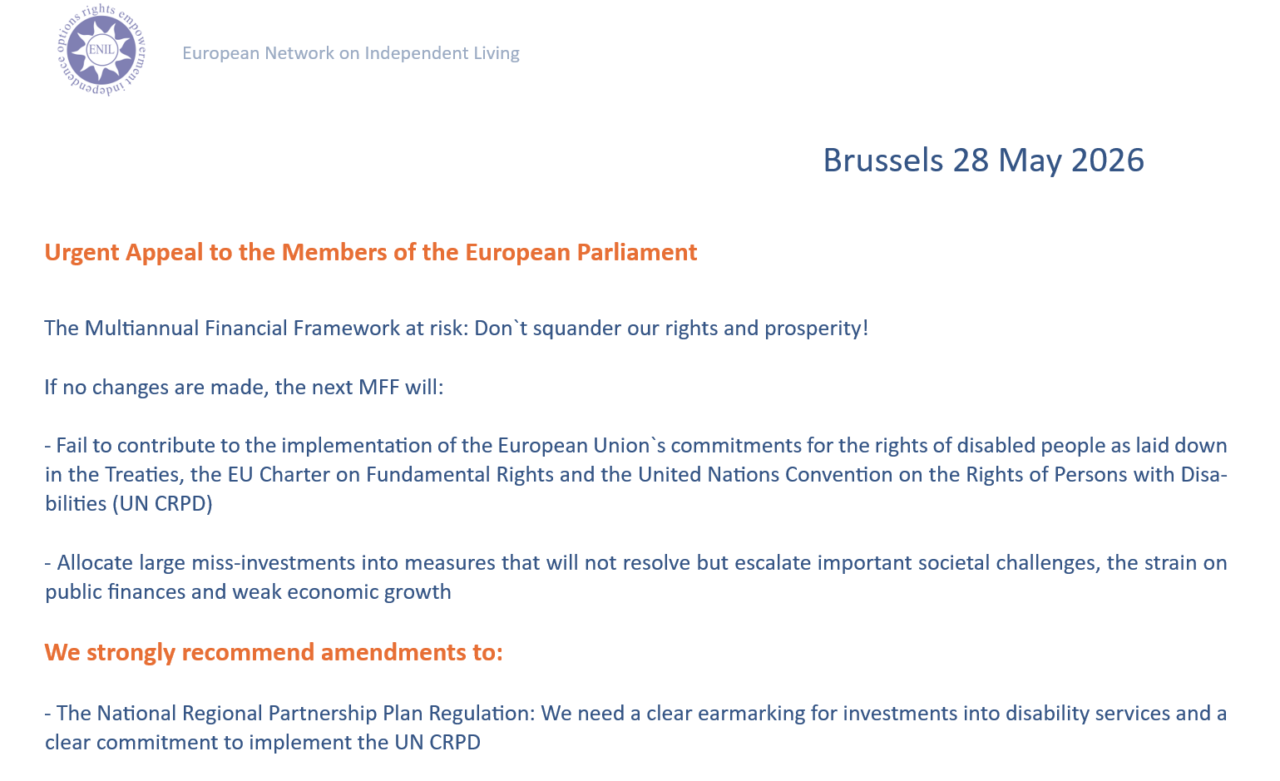
The Multiannual Financial Framework at risk: Don`t squander our rights and prosperity!
Together with the EUFunds4IL Coalition, ENIL has produced detailed amendments to the MFF which are available here.
Brussels 28 May 2026
If no changes are made, the next MFF will:
– Fail to contribute to the implementation of the European Union`s commitments for the rights of disabled people as laid down in the Treaties, the EU Charter on Fundamental Rights and the United Nations Convention on the Rights of Persons with Disabilities (UN CRPD)
– Allocate large miss-investments into measures that will not resolve but escalate important societal challenges, the strain on public finances and weak economic growth
We strongly recommend amendments to:
– The National Regional Partnership Plan Regulation: We need a clear earmarking for investments into disability services and a clear commitment to implement the UN CRPD
– The Budgetary Tracking and Performance Framework: Without indicators telling us where funding is going, rights negating and financially inefficient miss-investments will continue
– Global Europe: It is within our power to help disabled people to live in dignity globally, so we have a responsibility to do it
Europe is challenged by growing disrespect for human rights, increasing societal challenges, unsustainable public finances and weak economic competitiveness. There is a very real risk that the next Multiannual Financial Framework might finance an escalation of all our problems. We are urging the rapporteurs and shadow rapporteurs to amend the MFF-regulations, to avoid a senseless burning of taxpayer`s money.
Human Rights abuse hurts public finances
Spending on disability services which are not in line with fundamental rights, are driving up the costs and undermining prosperity.
- Long-term care and institutions
According to the OECD, EU-countries are spending up to 4,4% of their GDP on long-term care. Nursing homes can account for 80% of these expenses.[1] According to the European Commission, the cost of long-term care is projected to raise from 1,7% of GDP to 2,5% in the next decades.[2] These are considerable expenses, considering public budgets are under strain. This spending is also financing the institutionalisation of disabled people.
According to Eurofound, the number of disabled people confined to institutions has increased by 29% in the last decade[3]. Institutions are not in line with the United Nations Convention on the Rights of Persons with Disabilities (UN CRPD). The increase in institutionalisations, is fuelling the rising costs of long-term care.
2. Employment, income and social protection
According to Eurostat, between 2015 and 2024, the cost of social protection in the EU has increased from EUR 3.485 bn to EUR 4.801 bn.[4] This cost increase is threatening the long-term sustainability of the system.
Our economy is suffering from skills shortages. In the EU, ten occupations report vacancy rates between 5%-8,4%.[5]
In this context, we are stilly excluding disabled people from regular employment on a large scale. Not only do we bar disabled people from their right to employment, income and housing, we are also depriving the economy of talent and driving them into poverty, homelessness and dependency on social benefits:
- Between 2010 and 2023 the disability employment gap has increased from 18,6% to 24,5%[6]
- According to Eurostat, in 2024 28,8% were at risk of poverty, compared to 17.9% of non-disabled people[7]
- In 2024, 68,2% of disabled people were at risk of poverty before social transfers and 20,7% after.[8]
- In some EU member states a quarter of the homeless population report to have physical impairments and up to 60% to have a psychosocial impairment.[9]
3. Mutually reinforcing problems
Institutionalisation, poverty and homelessness are often driven by insufficient access to person-centred services, employment and accessible housing. Access to employment is barred due to a lack of supported employment programmes.
For the entire EU, the OECD calculated the loss of GDP to stand at EUR 0,84-1,42 billion per year, causing losses in tax revenue of EUR 302-493 million.[10]
The solutions are available
Better access to person-centred services, especially personal assistance, personal budgets, Centres for Independent Living but also supported employment and supported decision-making could improve the situation.
These services are rights affirming. By signing the UN CRPD, all EU member states have committed themselves to provide person-centred services to enable disabled people to leave institutions and the meet support needs.
There is growing evidence that those services are also more sustainable financially.
A study published in 2010 found that personal budgets can be economically advantageous compared to traditional supply-driven policies. Due to lower overhead costs, cost savings can be achieved.[11]
There is new evidence from economics research according to which personal assistance produces productivity gains of EUR 535 million and EUR 405 million of budget savings within a ten-year period.[12]
Across the EU, there are severe implementation gaps when it comes to Independent Living Services.
- According to the ENIL Independent Living Surveys 2022 and 2024, the quality of personal assistance schemes is low[13]
- According to the ENIL Independent Living Roadmap, few countries have nation-wide personal budget schemes[14]
The current MFF-proposals are likely to deepen the problem
Ample evidence has been provided that a comprehensive implementation of the UN CRPD in the EU, would not only allow disabled people to enjoy the rights they are entitled to. It would also support our economy and public finances.
The current MFF proposals fall short of providing the needed framework conditions.
– The National Regional Partnership Plan Regulation contains no commitment to implement the UN CRPD in the EU, no budgetary earmarking for the equal treatment and social inclusion of disabled people and no commitment to boost investments in person-centred services, supported employment and accessible housing
– The Budgetary Tracking and Performance Framework does not foresee indicators to monitor EU spending on institutions, person-centred services, supported employment and accessible housing
– The Global Europe programme has the objective to promote human rights world-wide but lacks any commitment to promote the UN CRPD. Better access to person-centred services, employment and housing globally could reduce poverty, increase prosperity and stability
If those programs are left as they are, there is a high risk of:
– No investments in person-centred services which will continue to drive people into institutions out of employment and into poverty, simultaneously driving up the costs the for long-term care and social protection, while deepening our skills shortages
– No investments in supported employment, pushing disabled people into poverty and homelessness, reducing spending power, providing downwards pressure on GDP
– If EU funds are used to build social and non-profit housing which is not accessible, a large portion of the homeless population will not able to use them, making the investment redundant
We urge all Members of the European Parliament to support the following changes to the regulations:
The National and Regional Partnership Plan Regulation
The National and Regional Partnership Plans should make an active contribution to the implementation of the adopted legislation, especially the UN CRPD.
We recommend for example:
- Amending Article 7(1)(c new) on Horizontal principles stating that “Member States shall design the NRP Plan … in a way that ensures respect of … (c new) the norms and principles set out in the United Nations Convention on the Rights of Persons with Disabilities and the authoritative documents issued by the UN Committee on the Rights of Persons with Disabilities”.
- Amending Article 8(1)(1a new) on Respect for the Charter of Fundamental Rights stating that “Member States shall put in place and maintain effective mechanisms to ensure compliance … with the relevant provisions of the Charter of Fundamental Rights and of the United Nations Convention on the Rights of Persons with Disabilities and authoritative documents issued by the UN Committee on the Rights of Persons with Disabilities”.
- Amending article 10(5) on Budget by 1. Increasing the envelope for spending on the Union`s social objectives from 14% to 25%, 2. Adding that this spending is also available for “equal treatment and fundamental rights objectives” and that “At least 10% of the Unions’ social spending shall be dedicated to the implementation of the UN CRPD in the EU.”
The Budgetary Tracking and Performance Framework
EU disability policy is suffering from an insufficient evidence base. We recommend initiating regular data collection for example on:
- The amount of EU Funds going into institutions and the number of people in institutions
- The amount of EU Funds going into personal assistance, personal budgets and Centres for Independent Living and the amount of users of these services
- The amount of EU Funds going into housing that is affordable and accessible for persons with disabilities and the amount of people benefiting from affordable and accessible housing
- The amount of EU Funds going into supported employment and the amount of people benefiting from such measures
The Global Europe programme
We recommend for example:
- Amend article 4, 1b “Objectives of the instrument” and include the United Nations Convention on the Rights of Persons with Disabilities (UN CRPD). Article 4, 1b states that Global Europe should contribute to the promotion of multilateralism and lists various international agreements the EU has concluded and whose implementation the programme should support. The UN CRPD is not listed. That is a missed opportunity which should be corrected.
- Amend Article 9 (4) “General Principles” and list “equal treatment and social inclusion”, “Independent Living”, “personal assistance” and “deinstitutionalisation” as actions to be promoted
- Amend articles 9 – General Principles – 5 and 6 by stating that “the instrument shall promote gender equality and girls` and women´s empowerment with a particular focus on the equal treatment of women with disabilities”
We are ready to meet Members of the European Parliament to provide further information.
About the European Network on Independent Living
The European Network on Independent Living (ENIL) is a disabled-led, cross-disability network of disabled people and their representative organisations. ENIL promotes the right to independent living, as set out in Article 19 of the UN Convention on the Rights of Persons with Disabilities (CRPD), its General Comments and the Guidelines on deinstitutionalisation, including in emergencies. ENIL’s work is guided by the CRPD and the Independent Living principles, enshrined in the Independent Living Pillars. ENIL is active at the European level, and internationally, through cooperation with Centres for Independent Living from around the globe. ENIL’s actions and activities are based on the social and the human rights models of disability, and on the principles of inclusive equality, self-determination, solidarity and intersectionality.
ENIL has participatory status with the Council of Europe (i.e. is a member of the Conference of INGOs) and consultative status with ECOSOC.
Contact us
European Network on Independent Living (ENIL)
6thFloor – Mundo J
Rue de l’Industrie 10
1000 Brussels
Belgium
E-mail: secretariat@enil.eu
Website: www.enil.eu

Co-funded by the European Union. Views and opinions expressed are however those of the author(s) only and do not necessarily reflect those of the European Union or the European Commission. Neither the European Union nor the granting authority can be held responsible for them.
[1] OECD, https://www.oecd.org/en/publications/health-at-a-glance-2023_7a7afb35-en/full-report/long-term-care-spending-and-unit-costs_cc989a20.html#indicator-d1e36161-5548160ee5
[2] European Commission 2021. The 2021 Ageing Report. https://employment-social-affairs.ec.europa.eu/policies-and-activities/social-protection-social-inclusion/social-protection/long-term-care_en
[3] Eurofound 2021. Paths towards Independent Living. https://www.eurofound.europa.eu/en/publications/all/paths-towards-independent-living-and-social-inclusion-europe
[4] Eurostat 2026. Expenditure on social protection by type of expenditure. https://ec.europa.eu/eurostat/databrowser/view/spr_exp_type/default/table?lang=en&category=spr.spr_exp
[5] Eurostat 2026. Job vacancy statistics. https://ec.europa.eu/eurostat/statistics-explained/index.php?title=Job_vacancy_statistics
[6] ENIL 2025. Advocacy Campaign for inclusive employment takes shape. https://enil.eu/advocacy-campaign-for-inclusive-employment-takes-shape/
[7] Eurostat 2025. Disability statistics – poverty and income inequalities. https://ec.europa.eu/eurostat/statistics-explained/index.php?title=Disability_statistics_-_poverty_and_income_inequalities
[8] Eurostat 2025. Disability statistics – poverty and income inequalities. https://ec.europa.eu/eurostat/statistics-explained/index.php?title=Disability_statistics_-_poverty_and_income_inequalities
[9] OECD 2021. A crisis on the horizon: Ensuring affordable, accessible housing for people with disabilities. https://www.oecd.org/content/dam/oecd/en/publications/reports/2021/09/a-crisis-on-the-horizon_f5739419/306e6993-en.pdf
[10] OECD 2025. Combatting Discrimination in the European Union.https://www.oecd.org/en/publications/combatting-discrimination-in-the-european-union_29c2c36a-en.html
[11] Da Roit, B. and Le Bihan, B., ‘Similar and yet so different: Cash-for-care in six European Countries’ long-term care policies’, The Milbank Quarterly, Vol. 88, No 3, 2010, pp. 286-309.
[12] Rasmussen et al. 2025: Samfunnsøkonomisk analyse av BPA-ordningen. https://www.vista-analyse.no/no/publikasjoner/samfunnsokonomisk-analyse-av-bpa-ordningen/
[13] Comp. ENIL 2022. Independent Living Survey. https://enil.eu/wp-content/uploads/2023/04/IL-Survey_Summary-report_Dec2022.pdf; ENIL 2024. Independent Living Survey 2024. https://enil.eu/wp-content/uploads/2025/05/Independent-Living-Survey-2024_WEB.pdf
[14] ENIL 2025. Independent Living Roadmap. https://enil.eu/wp-content/uploads/2026/01/A-roadmap-on-Independent-Living.pdf