For two days in Ljubljana, the discussion was not about whether disabled people can live independently. The starting point was that we can. The real question was what needs to be in place to make Independent Living possible in practice.
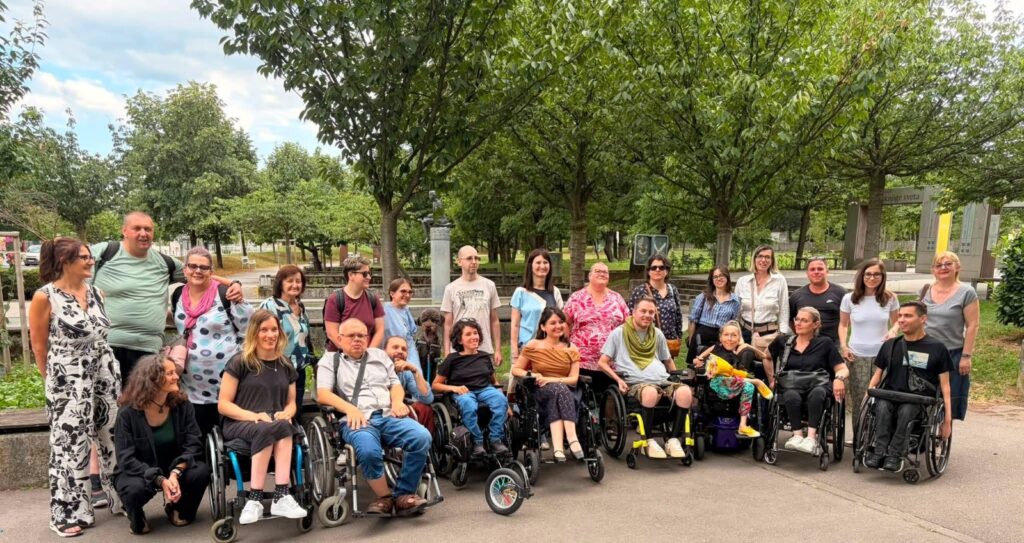
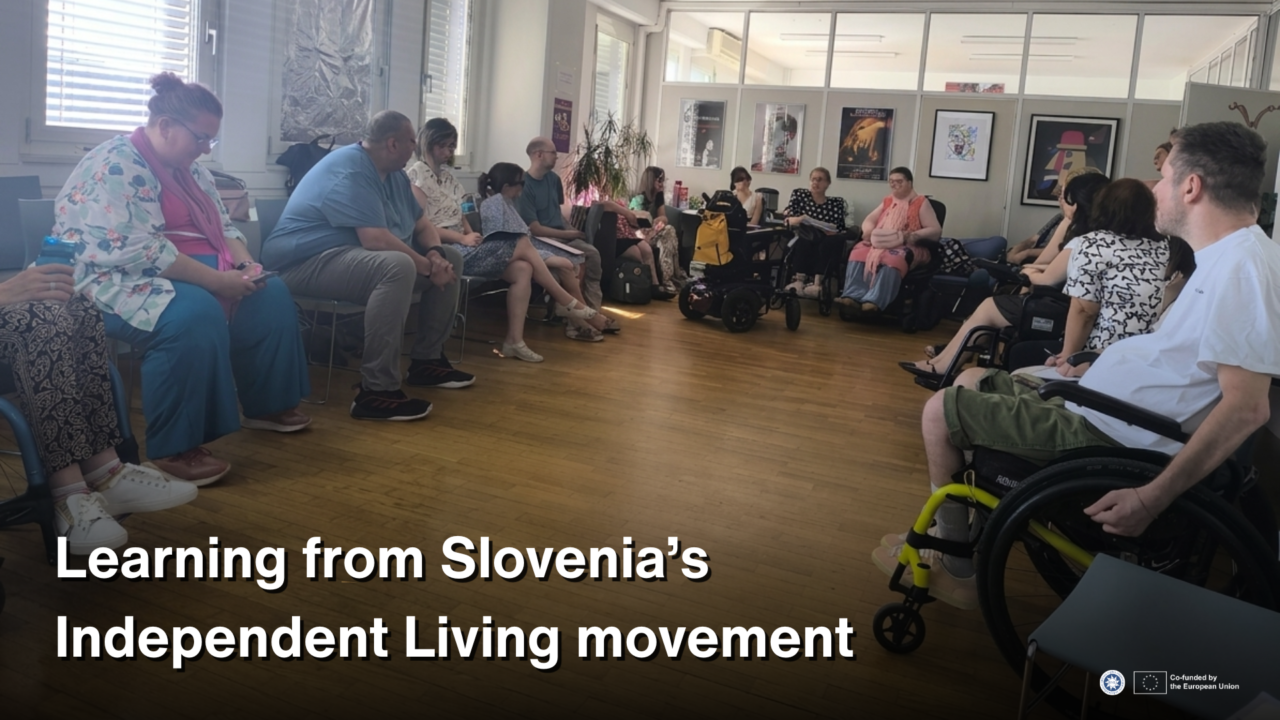
On 1–2 July 2026, ENIL members and staff met in Ljubljana, Slovenia, for a study visit hosted by YHD – Association for Theory and Culture of Handicap. The visit was co-funded by the European Union, and brought together disabled people, activists and representatives of member organisations for exchange and learning within the Independent Living movement.
The programme focused on personal assistance, deinstitutionalisation, community-based services and accessible housing. It included an introduction to YHD, discussions on the Slovenian personal assistance system, a session with Andreja Rafaelič from the Institute of the Republic of Slovenia for Social Protection, an ENIL session on the EU Affordable Housing Plan, and field visits to transitional apartments and private homes.
Personal assistance built from lived experience
The first day began at YHD, where participants heard about the organisation’s long history of advocacy for personal assistance in Slovenia from Elena Pečarič, Klaudija Poropat, Sonja Korelc-Kotur and the rest of the YHD team.
YHD’s story is not one of a service designed from above. It started from disabled people’s own lives. As shared during the visit, YHD’s founders had left institutions, finished secondary school and wanted to study and live like other students. For people with severe disabilities, this was almost impossible at the time. So they began to organise the support they needed themselves.
This was one of the strongest messages of the visit: personal assistance was not created because someone decided to “provide care”. It was created because disabled people wanted freedom, education, relationships, work, political life and ordinary everyday choices.
YHD explained that its approach was shaped by people using personal assistance themselves. The organisation’s board is made up of disabled members, and its early work was rooted in the belief that the user must decide about their own support.
Personal assistance is not home care
A recurring point during the discussions was the difference between personal assistance and caregiving.
Personal assistance is not only about receiving help with tasks. It is about choice and control. It is about deciding who supports you, when, where and how. It is also about responsibility, communication and training.
Participants discussed how users need to be supported to direct their assistants, give clear instructions and build working relationships based on trust and boundaries. YHD also stressed the importance of training users and assistants so that both understand what personal assistance is – and what it is not.
This distinction matters. In many countries, services are still described as “support” while keeping disabled people dependent on fixed schedules, family care, home care or institutions. The Slovenian experience showed why language alone is not enough. A service can be called personal assistance, but it must follow Independent Living principles to actually support freedom.
A law is not enough
Slovenia has made important progress by recognising personal assistance in law through the Personal Assistance Act. But the visit also showed that legal recognition is only the beginning.
YHD explained that after the law was adopted, many new service providers entered the system. Some did not have the same experience or commitment to Independent Living. This created a risk that personal assistance could become just another service label, instead of a tool for self-determination.
Participants also heard about funding challenges. YHD shared that the funding rate for personal assistance has not always covered the real costs of the service, even though the law says the costs should be covered. As explained during the discussion, a right can exist on paper, but if the funding is too low to pay personal assistants properly, then the right becomes fragile.
This was one of the clearest lessons from the visit: implementation matters. A personal assistance law must be backed by adequate funding, quality standards, user control, peer support and monitoring. Without these, disabled people may still be left without the support they need to live independently.
Independent Living also means decent work
The discussion also touched on the working conditions of personal assistants.
YHD stressed that personal assistance should be treated as real employment. Most assistants should be able to have it as a regular job, with security and fair conditions. Independent Living should not depend on unstable or underpaid labour. Good support for users and decent conditions for assistants must go together.
This point is often missing from debates on personal assistance. But it is important. If systems do not value personal assistants, users will struggle to find and keep the people they need. If users are not in control, personal assistance can easily become another form of care management. A strong system needs both: user control and decent employment conditions.
Deinstitutionalisation needs more than moving people out
The session with Andreja Raffaelič focused on deinstitutionalisation in Slovenia, including progress, current barriers and the work of the DI Coordination Centre. The discussion made clear that deinstitutionalisation is not only about closing institutions or moving people from one building to another.
To leave an institution and stay out, people need accessible housing, personal assistance, support for decision-making, income, community-based services and time to rebuild confidence.
This was also reflected in the field visits on the second day. Participants visited transitional apartments and private homes of personal assistance users. These visits brought the discussion back to everyday life: how people organise support, how they move from institutions or family homes, how much assistance they receive, what works, and what still needs to change. The groups were kept small because these were people’s actual homes, not public study sites.
The visits showed that transitional housing can be part of a path towards Independent Living, but it cannot become the final destination. The goal must always be living in the community, with choice and control.
Housing is part of Independent Living
ENIL also presented its work on the EU Affordable Housing Plan. The discussion highlighted a simple but often ignored point: affordable housing must also be accessible.
If housing is affordable but inaccessible, disabled people are still excluded. If housing is accessible but there is no personal assistance or community support, people may still be pushed into dependence, family care or institutions.
For ENIL, housing must be understood as part of the Independent Living ecosystem. Disabled people need housing that is affordable, accessible and connected to the support required to live in the community.
A shared struggle across countries
The study visit also created space for exchange between participants from different countries. People shared experiences from Armenia, Albania, Bosnia and Herzegovina, Montenegro, Hungary, Finland, France, Germany, Italy, Georgia and other places.
Some participants spoke about the lack of personal assistance in their countries. Others described limited hours, underfunded services, institutions that remain open, or systems that still confuse care with Independent Living. The problems were not identical everywhere, but many of the patterns were familiar.
This exchange was one of the most valuable parts of the visit. It showed that members are not only looking for information. They are looking for tools, allies, examples and political energy.
At the beginning of the meeting, one of the hosts said that the time together should be used to strengthen cooperation and discover what can be done together. That spirit stayed through the two days.
What we take from Ljubljana
The study visit did not present Slovenia as a perfect model. Instead, it showed something more important: progress is possible, but it has to be defended. Personal assistance can be built from the demands of disabled people themselves. A law can change lives, but only if it is properly funded and implemented. Deinstitutionalisation needs housing, support and legal capacity. And Independent Living principles must stay at the centre, even when systems grow, funding changes or new providers enter the field.
ENIL is very thankful to YHD for hosting the study visit and for sharing its experience openly, including the achievements, the tensions and the challenges that remain.
The visit was a reminder that Independent Living is not built by one law, one project or one organisation. It is built through disabled people organising, learning from each other and refusing to accept segregation as normal.