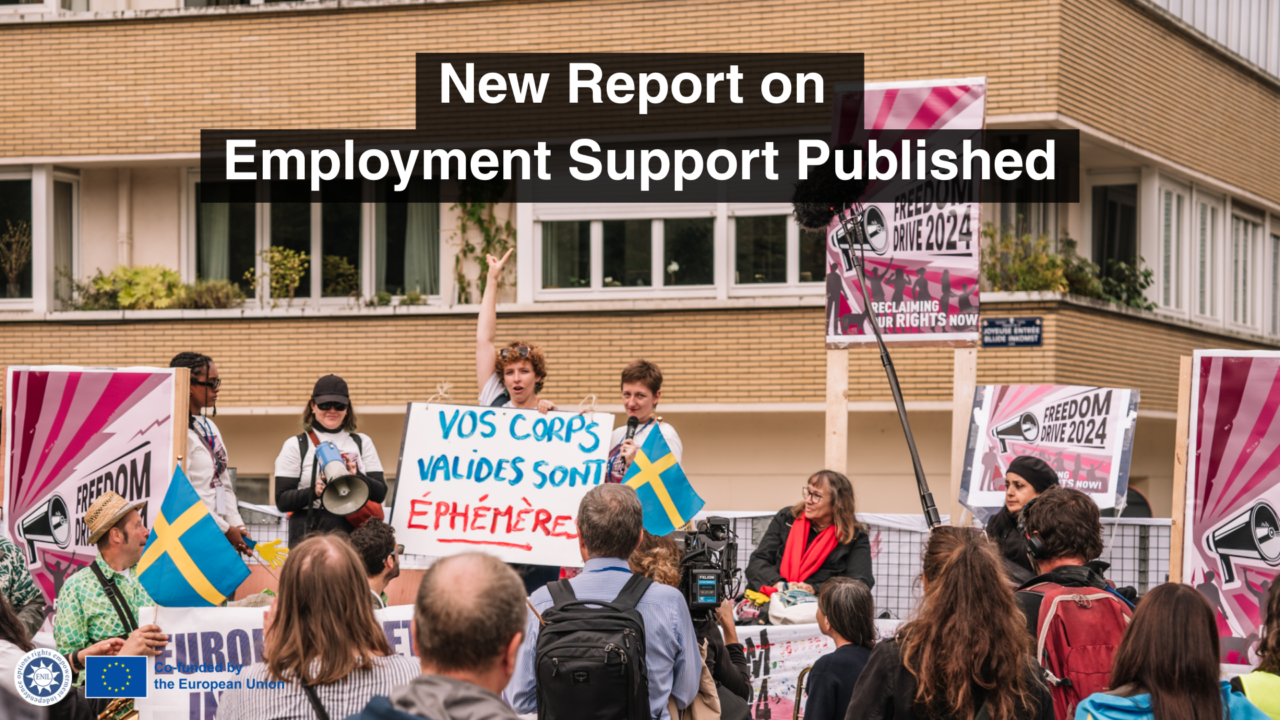
How can the inclusion of disabled people into the open labour market be improved? ENIL has undertaken research to identify examples of promising practice. Our new report on employment support presents the examples we could identify in detail. Wherever available, statistical evidence on effectiveness is provided.
The report calls on the European Union to use its competition law competences to improve access to funding for employment support measures.
The complete report can be downloaded as a pdf file here and as a word file here
ENIL is campaigning for a better inclusion of disabled people into the first labour market. Throughout the last decade the disability employment gap has increased from 18,6% to 24%. Being barred from access to proper work, usually means being barred from a decent income which can cause poverty, homelessness and institutionalization.
What is less well known are the deleterious effects on the economy and public finances. The reduced buying power of a substantial part of the population and the non-use in the labour force in the midst of skills shortages, reduce GDP and tax revenue. Also institutions are a very unsustainable support form financially.
Does segregated employment work?
Evidence is accumulating showing that segregated employment is very ineffective in producing transitions into regular employment. Studies show that Sweden achieves the highest success rates by far, reaching 6,25%. In most countries, transition rates are not higher than 1%. Some studies show that higher spending on segregated employment, increases the disability employment gap.
How can the labour market participation of disabled people be improved?
General Comment No 8 outlines a variety of possible measures that can be used. Those comprise:
- Awareness raising among public and private sector employees
- Targeted funding, for example wage subsidies
- Reasonable accommodations in the form of for example individualised modifications
- Supported employment
ENIL defines the entirety of measures and instruments that enable disabled people to access and maintain work in the open labour market as employment support.
Supported employment is a concept that warrants a more detailed introduction due to the fact that there is strong empirical evidence for its effectiveness.
The Association for Supported Employment Europe (ASEE) defines supported employment as:
“Providing support to people with disabilities or other disadvantaged groups to secure and maintain paid employment in the open labour market”
According to ASEE supported employment has five stages:
1. Client engagement
The client, e.g. the disabled job seeker, is provided with information about supported employment to be able to make an informed choice about participating.
2. Vocational profiling
The employment support worker produces a detailed profile, using insights about the persons` skills, interests and expectations.
3. Job finding
The employment support worker finds employers that match the profile.
4. Employer Engagement
The employment support worker needs to do detailed research about the local labour market and seek to establish contacts to employers.
5. On the job support
The hired disabled worker should ideally receive continuous job coaching while working.
In summary: Supported employment relies heavily on producing an alignment between vocational profiles of disabled job seekers and the job profiles sought out by employers.
Is employment support effective?
There is evidence showing that employment support and supported employment are very effective.
The Emergo Plan of the City of Milan is a comprehensive plan involving a variety of skills trainings, job orientation and employer engagement measures. The Emergo Plan achieves transition rates into the open labour market of 29,8%.
Diversicom providers supported employment services in Belgium. In 2025 62% of all participants were working in the open labour market.
Also, personal assistance is an instrument that can allow disabled workers to enter or remain in employment. In Austria personal assistance at work is available when accommodations and adaptations are not sufficient. The personal assistants perform a variety of functions, for example enabling the commute and business trips but also helping to carry documents or operate equipment. In Austria, the number of disabled people who had access to personal assistance at the workplace increased by 28% between the years of 2017 and 2023, from 510 in 2017 to 652 in 2023.
Increasing funding
Like in Austria, employment support programs are often small. In many countries, segregated employment receives the bulk of resources, despite its ineffectiveness.
The European Union could support Member States to make more funding available for instruments like personal assistance at work.
State aid legislation regulates which private undertakings, organisations or companies, member states may subsidise. The General Block Exemption Regulation permits the funding of a variety of instruments. The European Union often reforms state aid legislation to increase the availability of funding for social purposes.
We recommend to amend:
- Article 2 – 108 to add a definition of employment support
- Articles 48, (a) and (c) to ensure the costs for adapting the premises and the purchasing of equipment can be financed to an extent that allows to meet the full needs of the disabled worker
- Article 48 (b) by adding the term “personal assistance at work” into the regulation
- Article 48 (f) to ensure only employers that employ disabled workers in the open labour market can receive financial support for renovations and construction activities