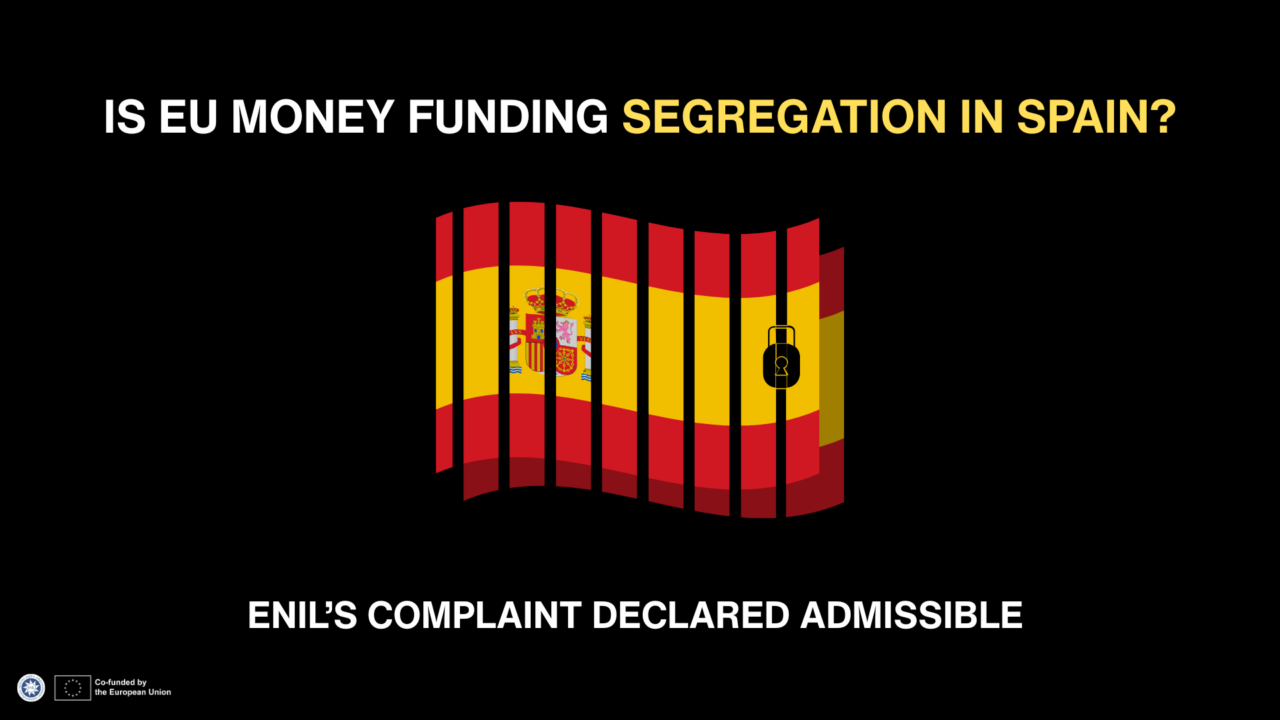
The complaint raises concerns about EU-funded investments that will reinforce segregation instead of supporting disabled people to live independently in the community.
On 28 July 2026, the European Ombudsman informed ENIL that our complaint concerning the use of EU funds in Spain is admissible.
This is an important first step. The Ombudsman will now assess whether there are grounds to open a formal inquiry. We expect to receive further information on the next steps within approximately two months.
Why did ENIL submit the complaint?
ENIL has been examining how EU funding is being used in Spain. We focused on investments under the Recovery and Resilience Facility linked to long-term care and support services.
These investments are often presented as part of the modernisation of social services. However, building or renovating residential facilities does not support independent living.
Our concern is that large investments are going into collective and residential forms of care instead of helping people to live in their own homes, choose where and with whom they live, and receive personalised support such as personal assistance.
A service is not community-based simply because it is located in an ordinary neighbourhood or because fewer people live in the same building. What matters is how people live there: whether they have a genuine choice about where to live, whether they have privacy, choice and control over their daily lives, or whether decisions are still shaped by the routines of the service.
EU funding must support independent living
Article 19 of the UN Convention on the Rights of Persons with Disabilities recognises the right of disabled people to live independently and be included in the community.
Independent living does not mean living alone or without support. It means having the same choices as other people and being able to decide where to live, who to live with and how support is provided.
Funding decisions can determine whether those choices exist in practice. Money invested today in residential infrastructure can shape support systems for many years and make it harder to move resources towards personal assistance, accessible housing and support in people’s own homes.
For this reason, EU funds should not be used simply to make institutional services newer or more comfortable. They should help replace them with support that allows people to live as part of their communities.
Why does the complaint concern the European Commission?
The European Ombudsman examines the work of EU institutions. ENIL’s complaint therefore concerns the European Commission’s role in approving Spain’s Recovery and Resilience Plan, assessing its implementation and authorising payments.
ENIL has asked whether the Commission has properly considered the impact of these investments on the rights of disabled people and whether its monitoring is sufficient to identify risks of institutionalisation. As party to the UN Convention on the Rights of Persons with Disabilities, the Commission is under obligation to do this.
Monitoring should not be limited to checking whether a building has been completed or whether money has been spent. It should also examine what has actually been created and whether disabled people have gained real alternatives to institutional care, as required by the CRPD.
Although this is only the beginning of the process, the admissibility decision allows ENIL’s concerns to receive further consideration at European level.
EU funding should expand people’s choices, not create new forms of segregation. ENIL will continue following the complaint and will provide further updates as the case progresses.