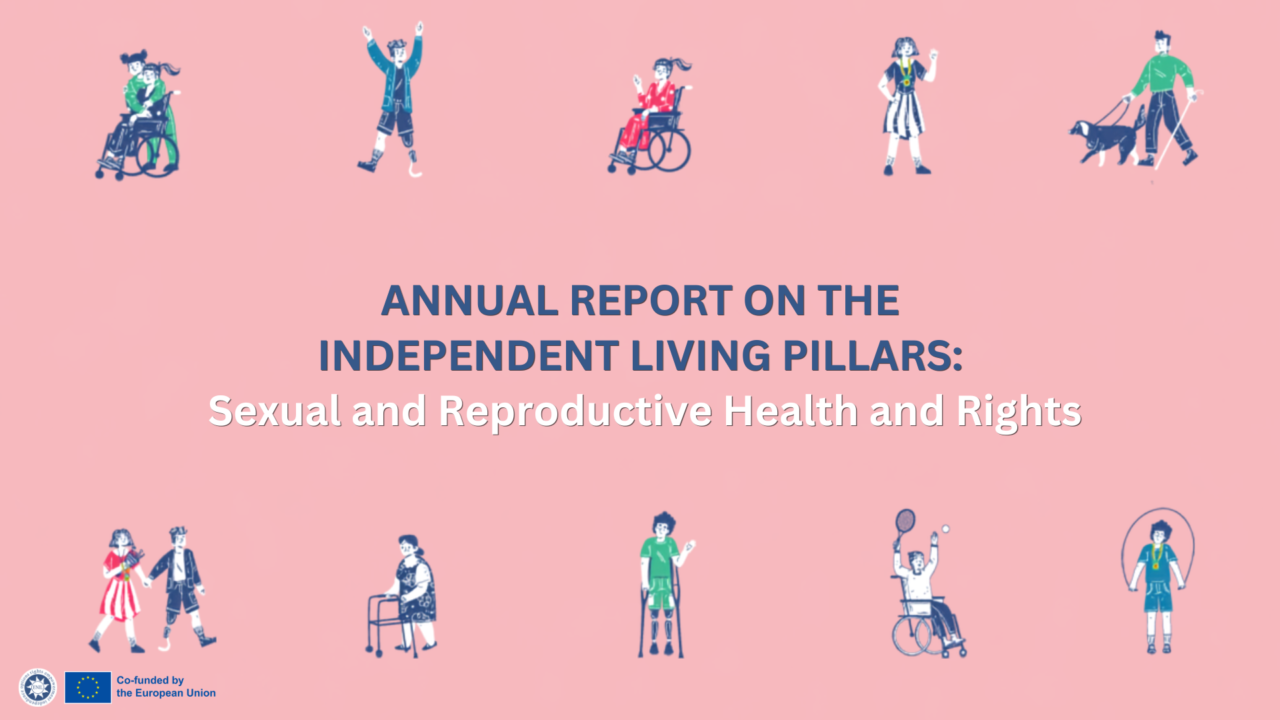
The European Network on Independent Living (ENIL) has published its new report, Annual Report on the Independent Living Pillars: Sexual and Reproductive Health and Rights (SRHR). The publication marks the launch of ENIL’s new annual series dedicated to the Independent Living Pillars and aims to monitor progress, improve access to information, and raise awareness of the conditions necessary for disabled people to live independently and participate fully in society.
Click here to view and download the Report.
As the first report in this new series, it focuses on sexual and reproductive health and rights (SRHR), one of the eighteen Independent Living Pillars. Drawing on consultations with Disabled People’s Organisations (DPOs), disabled individuals, academics, activists and ENIL members and partners across Europe, the report provides a deep and comprehensive analysis of the barriers that continue to prevent disabled people from fully enjoying their sexual and reproductive rights.
The report highlights the discriminatory barriers, stigma and intersecting forms of discrimination experienced by disabled people in accessing SRHR. It examines issues including inaccessible healthcare and information, lack of inclusive sexuality education, denial of legal capacity and supported decision-making, barriers to parenthood, gender-based violence, forced sterilisation and reproductive coercion, financial obstacles, and the lack of disability-inclusive and intersectional training among professionals.
Adopting an intersectional approach, the report pays particular attention to the experiences of disabled women, LGBTIQ+ people, migrants, people from racialised and minority communities, people with psychosocial or intellectual disabilities, and others facing multiple and overlapping forms of discrimination.
In addition to identifying barriers, the report presents an accurate collection of good practices from across Europe and beyond. These include initiatives promoting peer support, accessible and inclusive healthcare services, professional training, community advocacy, parenting support, participatory research, youth-led advocacy, and awareness-raising. Examples featured in the report come from countries including Moldova, Norway, Georgia, Albania, France, Iceland, Ireland, Lithuania and Kyrgyzstan, demonstrating how rights-based and community-led approaches can advance Independent Living and sexual and reproductive rights.
The publication also underlines the close relationship between sexual and reproductive health and rights and Independent Living. Control over one’s body, relationships and reproductive choices is fundamental to autonomy, self-determination and full participation in society. Ensuring equal access to SRHR is therefore not only a matter of healthcare and gender equality, but an essential requirement for the full inclusion of disabled people.
ENIL hopes that this first report in the Independent Living Pillars series will support policymakers, disability organisations, service providers and advocates in developing more inclusive policies and practices, and contribute to greater recognition of sexual and reproductive health and rights as fundamental human rights.
A plain language summary of the report is also available here.