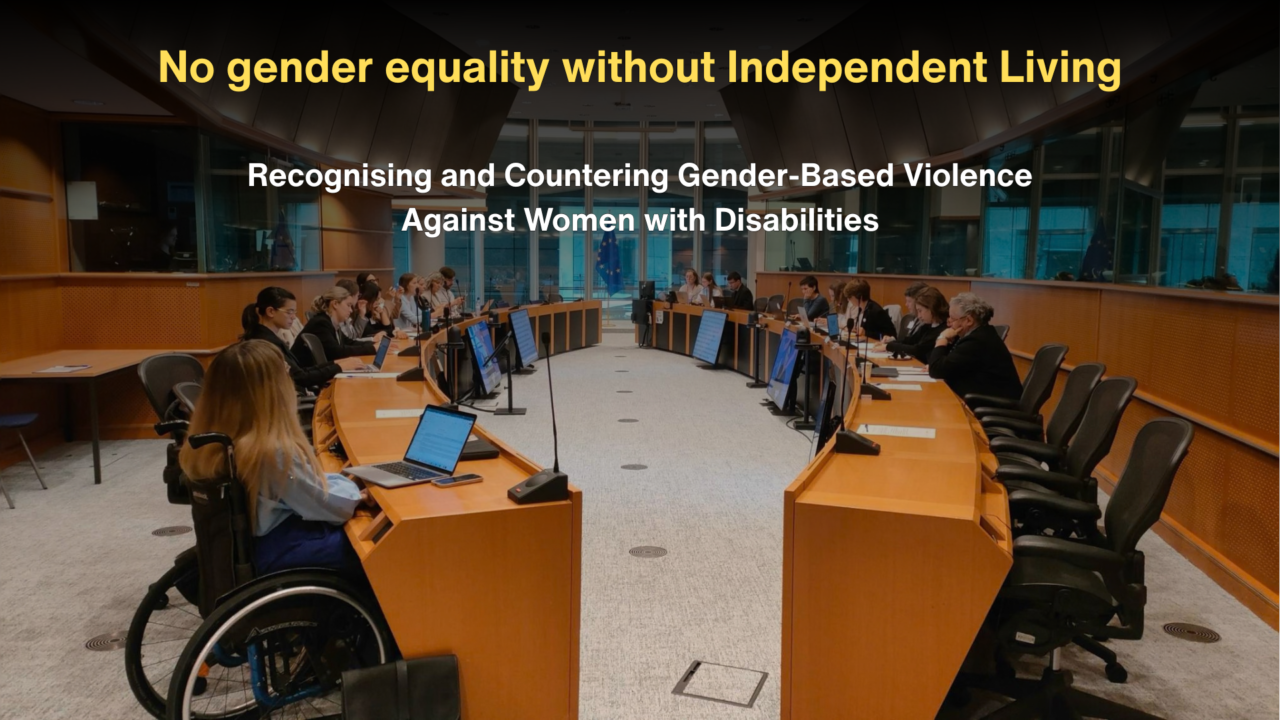
A closing event for the European project CARE-INT, dedicated to professionals working in care and training settings, to explore tools and approaches for recognising and countering gender-based violence and intersectional discrimination against women with disabilities.
At the webinar organised by @Fondazione Libellula and @CBM Italia, Antonella Candiago, Policy Officer at ENIL (European Network on Independent Living), addressed the fact that data on violence against disabled women remain massively underreported, since disability-disaggregated data is not systematically collected. She reminded that what happens inside institutions, psychiatric hospitals, or asylum centres often stays invisible. Antonella explained how institutionalisation and forced dependency on a partner or family member for housing, transport, or daily care increase the risk of violence, and why community-based services, independent housing, and user-controlled personal assistance are not side issues to violence prevention, but violence prevention itself.
She also addressed the risk of secondary victimisation, where disabled women – particularly those with intellectual or psychosocial disabilities – are disbelieved or made to “prove” their experience to professionals working from a narrow, stereotyped image of a victim. She stressed the importance of centering survivors’ agency, of an intersectional approach that accounts for migration status, sexual orientation and gender identity, and rural isolation, and of accessibility running through every step of the pathway: not just the shelter, but the police station, the courtroom, the hotline, the reporting form.
She closed by recalling that there is no gender equality without Independent Living, and no Independent Living without gender equality: ending violence against women with disabilities means giving them control over their own body, their own home, their own choices, and their own life.