By Veronika Kovacs – ENIL Co-production Officer
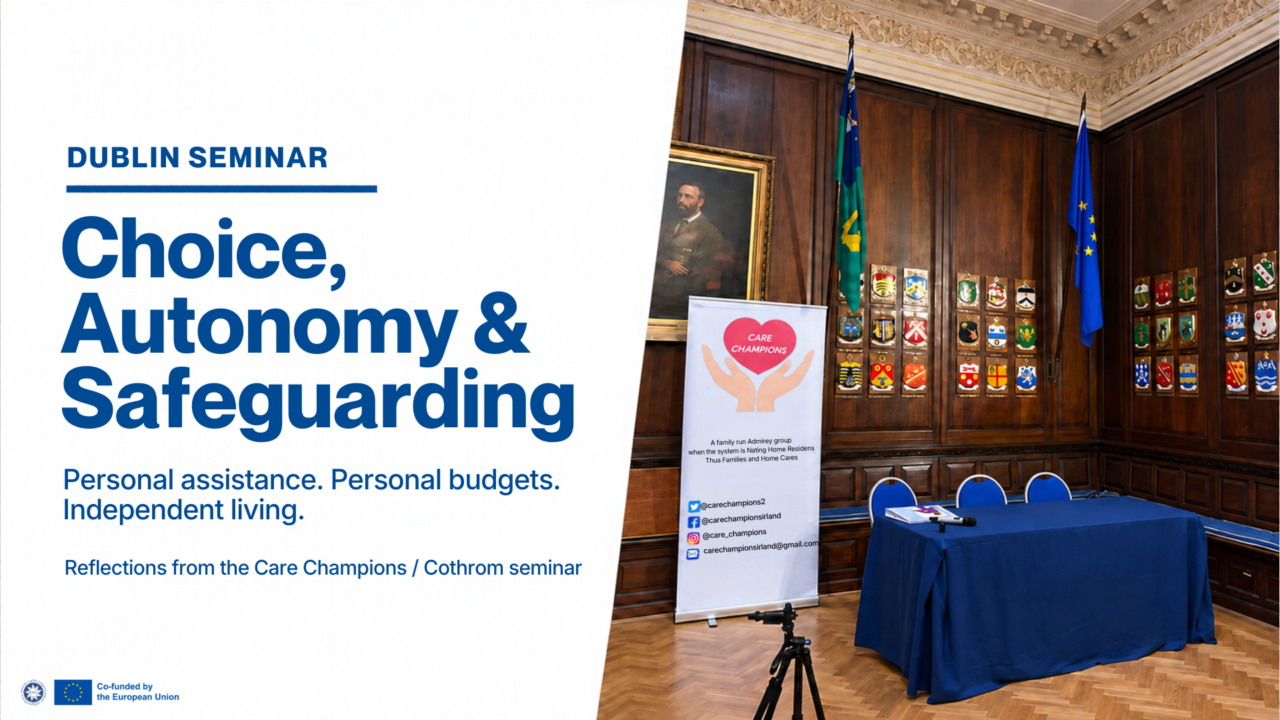
Recently, I had the honor to speak on behalf of ENIL at Cothrom and Care Champions organization’s joint seminar on “Choice, Autonomy and Safeguarding,” in Dublin. The event was organized by Michael O’Dowd, and included speakers from The Economic and Social Institute (ESRI), ADM Specialism,The Irish Association of Social Workers (IASW) and individual activists to share their lived experiences with the Irish system. The seminar focused on supported decision making – based on the legal framework called “Assisted Decision-Making (Capacity) Act 2015”, and Personal Assistance.
At the time of the seminar, Personal Assistance in Ireland was primarily delivered through the HSE disability services framework. The discussions highlighted concerns that, despite the availability of services and a legal framework for supported decision-making, people do not always experience the choice, control and flexibility needed to live independently.
During my speech, I introduced ENIL’s work, and highlighted the 18 pillars of independent living, emphasizing on deinstitutionalisation as a precondition to Independent Living. I also spoke about ENIL’s work monitoring the use of European Union funds to ensure that public money supports independent living rather than maintaining institutions or reproducing institutional practices in community settings.
Our research has documented concrete examples of this problem. In Bulgaria, the transition from large institutions to smaller residential settings has not always resulted in genuine independent living. Our study visit, “I’m Here for Life,” highlighted how smaller group homes can continue to reproduce institutional practices, with residents having limited choice and control over their daily lives.
This illustrates a fundamental problem: closing a large institution and moving people into smaller buildings does not necessarily mean that deinstitutionalisation has been achieved. EU funding must support genuine community living, Personal Assistance and people’s right to decide how and where they live.
The goal is not simply to replace one type of building with another. It is to ensure that disabled people have the rights, resources and support to decide how they want to live their lives.
I focused on two important elements of this wider picture: Personal Assistance and Personal Budgets.
I talked about the difference between personal assistance and traditional home care. The difference is choice and control. With personal assistance, the disabled person should have meaningful control over who provides the assistance, what tasks are performed, when and where the support takes place, and how it is delivered, who is the assistance – their control over choosing the person.
The support should fit around the person’s life, rather than requiring the person to organise their life around the service.
Personal assistants need fair wages, appropriate employment conditions and support in their work. Disabled people, in turn, need sufficient flexibility and control to organise their assistance in a way that works for them.
I brought up the Slovenian Personal Assistance Act (2017), as a good example but also highlighted the challenges disabled people face there, which was shared with me by our member organization YHD.
ENIL’s Personal Assistance Myth Buster addresses some of the misconceptions that can prevent this approach from being understood or implemented.
Then I continued to talk about personal budgets schemes in Europe. A personal budget is public funding allocated according to an individual’s assessed needs and controlled by that individual.
The funding can be paid directly to the person, or an organisation can manage the administrative responsibilities on their behalf while the person retains control over how the money is used.
The underlying principle is simple: the budget should follow the person, rather than the person having to adapt to the services that happen to be available.
A personal budget can give someone greater flexibility to employ their own assistants, choose when assistance is provided and organise support around their working hours, family responsibilities and social life.
ENIL’s consultation paper on the Roadmap on Independent Living argues that budgets should be based on assessed needs and rights, rather than simply on what the public system can currently afford. This is an important distinction. The question should not only be how much money is available, but also what people need to exercise their rights and live independently.
Finally, I concluded my speech with a statistics that Eurostat reported that in 2024, 28.8% of people with disabilities in the EU were at risk of poverty or social exclusion, compared with 17.9% of people without disabilities. That is a difference of 10.9 percentage points.
The indicator includes people at risk of poverty, severe material and social deprivation, or living in households with very low work intensity. These figures illustrate the scale of inequality and why access to Personal Assistance and personal budgets must be understood as part of a broader effort to make independent living a reality. This principle should guide the development of independent living policies across Europe.
After my presentation, I had the chance to hear from other organizations and activists from Ireland.
Dr Margaret Kennedy, a sociologist, leadership consultant and founder of Kennedy Insights, disability activist and co-founder of Cothrom, shared her experiences with the Personal Assistance system. She described repeated failures in the provision of support, including long waits for assistance and services that did not meet her individual needs. When she raised concerns with the HSE and asked for support tailored to her disability-related needs, she felt that her concerns were not adequately addressed. She described being told that she had to accept the service offered or consider moving into a nursing home, which is an unacceptable option according to Margaret. I found her presentation very emotional, but at the same time motivating to advocate for change.
After Margaret’s presentation, we heard other lived experiences, a woman sharing a story about her grandmother’s hospital stay during COVID, where families were not allowed to visit. Another story about a father, who also passed away during the pandemic and continuously being let down by the system, his son now spreads awareness about his story, in hope of making a change.
These experiences shed light to the importance of safeguarding and of recognising the role of family members and other care partners. Safeguarding should protect people’s rights, dignity and autonomy, rather than simply treating abuse or neglect as clinical failures.
During the break, I spoke with parents involved with the organisation Before We Die, who shared their concerns about what would happen to their children with intellectual disabilities when they were no longer able to support them. We discussed the limited options available to families and the importance of developing alternatives that enable disabled people to live independently while remaining part of their communities.
Their concerns reflect a broader need for community-based support, adequate services and long-term planning, so that adults with intellectual disabilities can live with dignity, security and independence.
The seminar also highlighted two important calls for legislative change from Care Champions and Cothrom: the introduction of adult safeguarding legislation, including an independent safeguarding authority, and standalone legislation recognising care partners. Such legislation should establish enforceable Access rights for care partners and ensure that they are appropriately trained and integrated into care.
The seminar finally mentioned the importance of ensuring that independent living policies translate into practical support, giving disabled people greater choice and control over their lives and enabling them to live in the community.