Last week, I attended two conferences in two different European capitals, Brussels and Dublin. Both were about technology and its potential to improve people’s lives. However, despite some similarities, I felt sometimes as if I had travelled between two very different worlds. And I am not talking about the weather, as this was similar!
The first event took place in Brussels, organised by the European Commission. The “Mutual Learning Workshop on Digitalisation in Long-Term Care” brought together representatives of ministries and international organisations to discuss how technology could improve services for older and disabled people. I was the only visibly disabled participant, at least as far as I could tell.
And already from the title, I was wondering: What exactly do we mean by long-term care? I am a disabled person with high support needs. I need personal assistance in my everyday life, and I will probably need it for the rest of my life. But I am not sick. I don’t need someone to take care of me. I need support to live my life, make decisions, work, travel and even make mistakes. Of course, many people (disabled or not) need healthcare or nursing support. But should we put everything under the same umbrella of long-term care?
Listening to the presentations, I also had the impression that one of humanity’s biggest challenges was finding a technological solution to prevent older people from falling! I’m exaggerating a little, of course. Falls can have serious consequences, and preventing them is important. But I was feeling that we were missing the bigger picture, which is sometimes the case in such events.
Another concern was the discussion about digitalising residential care facilities and institutions, improving connectivity and providing staff with better technological tools. Yes, these improvements can benefit people living in such settings. But shouldn’t we ask how technology can support deinstitutionalisation and community-based living?
From an Independent Living and UN CRPD perspective, technology should help people gain more choice, control and independence. A modern, well-equipped facility does not guarantee any of these things. I tried to raise these issues, but I sometimes felt that my perspective wasn’t really understood or taken seriously. Much of the discussion focused on services, efficiency, safety and systems, while I was trying to bring attention to rights, co-design, choice and control.
Of course, there were also interesting presentations, valuable ideas and good discussions in this event. And I appreciate that the European Commission invited ENIL to contribute an Independent Living perspective. Having these conversations is important, even if we do not always fully agree. But still, at times, I felt like we were not speaking the same language.
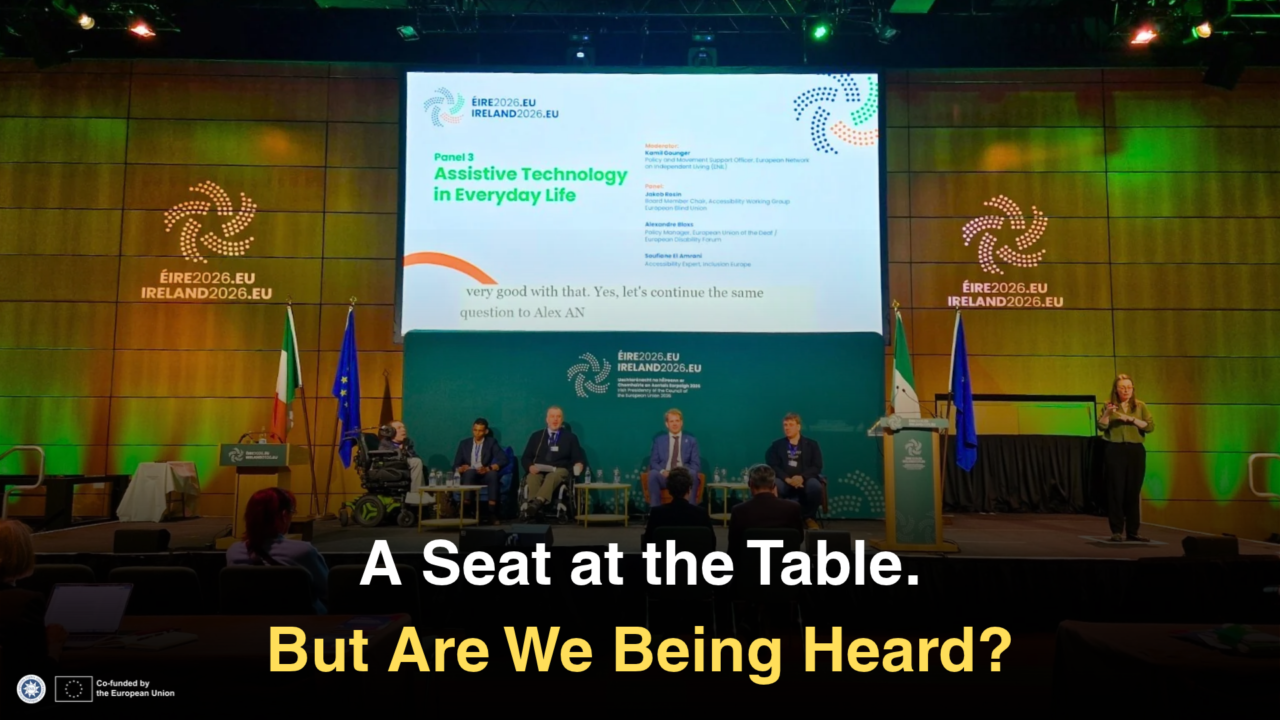
A few days later, I travelled to Dublin for the “High-Level Conference on Disability: Assistive Technology and Accessible Digital Technology – Empowering Participation”, organised by the Irish EU Presidency. A really different event!
First of all, the conference was fully accessible, with many disabled people participating (which should be normal and not necessary for mentioning). I had the pleasure of moderating a panel made up entirely of disabled people, discussing our experiences with assistive technology. We talked about how technology can support independence, participation and everyday life, but also about the barriers that still exist.
What I liked was the general approach of the conference. Even some ministers and officials speaking on other panels, referred to the CRPD, emphasised Independent Living as a priority and discussed technology in relation to rights and participation. Of course, mentioning the CRPD doesn’t mean governments are always implementing it. We all know the big gap between political commitments and reality. But at least I felt we were speaking the same language, and that changes the conversation.
When you start from the idea that people are recipients of care, you ask how to make care systems more efficient and safer, how to protect people by using technology (in this case). When you start from the understanding that people are rights holders, you ask (after involving them) how technology and support can enable them to live the lives they choose.
Safety and autonomy are not opposing goals, and technology has enormous potential for both older and disabled people, as well as for everyone else. I am a big believer of its potential. But we need to be clear about what we are trying to improve, and for who. Are we using technology to give people more independence, or simply to make existing systems run more smoothly? Are we investing enough in community-based support? And are the people concerned really involved in these discussions and decisions?
I don’t want to suggest that everyone in Brussels shared the same views, or that everyone in Dublin understood disability rights perfectly. But the contrast reminded me how differently we can approach the same issues, even when sitting around the same table. And maybe that is one of the biggest challenges for our movement: it is positive to be invited into the room, but we also need our perspectives to be understood and taken seriously. We need to speak the same language.