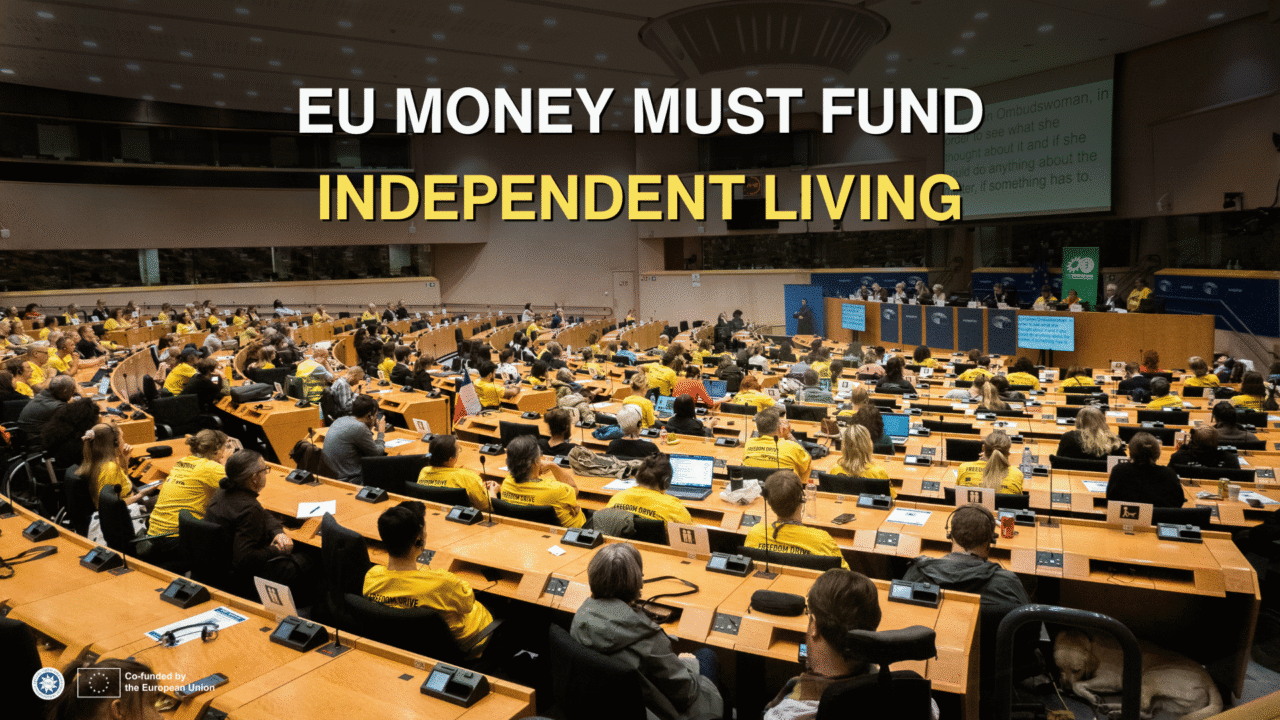
After marching through Brussels, Freedom Drive participants brought their demands into the European Parliament: EU money must support disabled people’s choice, control and participation in society, and stop sustaining segregation.
You can watch the full EU Parliament hearing here.
The Freedom Drive 2026 hearing brought disabled activists, policymakers and human rights experts together to discuss the EU’s next long-term budget, known as the Multiannual Financial Framework (MFF). Behind the technical language was a question with direct consequences for people’s lives: will public funding make Independent Living possible, or continue financing systems that deny it?
Hosted by MEPs Katrin Langensiepen, Krzysztof Śmiszek and Catarina Martins, and moderated by ENIL Board member Dr Ingrid Thunem, the hearing examined existing funding practices and the changes needed in the next budget.
Opening the discussion, Thunem reminded participants why they had come to Brussels: disabled people want to be part of Europe’s future, and public money must support their inclusion. Langensiepen challenged the familiar argument that accessibility costs too much, asking what exclusion costs instead. She also highlighted the role of the disability movement in securing rights and the continued need for collective action to defend them.
The practical meaning of Independent Living came through in the contributions of Emma Astrand and Ulrika Norelius from STIL, the Swedish personal-assistance cooperative.
Astrand described how personal assistance enables her to work, travel, meet people and make everyday choices. The decisions about what she does, when and with whom remain hers. Her account showed why assistance must respond to the person’s life, rather than requiring the person to fit around a service’s routines.
Norelius explained how STIL puts this principle into practice. Its members own the cooperative and supervise their own assistance, recruiting and training assistants with support available when needed. This model gives disabled people control over support that enables employment, relationships, parenting and participation in their communities.
European Parliament President Roberta Metsola joined the hearing and acknowledged the message participants had brought from the morning’s march. She emphasised that funding is essential to turn commitments into services people can access, and that the next budget must make Independent Living a real option for more people. She also encouraged participants to keep holding decision-makers accountable.
However, the hearing exposed a continuing gap between commitments and spending.
Cesar Gimenez, a self-advocate from the Independent Living Association of Andalucia, described his investigation into the use of EU recovery funding in Spain. He raised concerns about money being directed towards building and refurbishing residential institutions, despite commitments to support inclusion. He called for clear definitions of Independent Living and institutionalisation, and for funding to be conditional on compliance with disabled people’s rights.
Markus Schefer, a member of the UN Committee on the Rights of Persons with Disabilities, explained why responsibility also rests with the EU. Drawing on the Committee’s review of the European Union, he stressed that financing activities carried out by Member States does not remove the EU’s obligations under the UN Convention on the Rights of Persons with Disabilities (CRPD).
Schefer called for specific, legally binding funding requirements, backed by effective monitoring and remedies when money is misused. Organisations of disabled people must participate in monitoring, have access to relevant documents and be able to challenge violations through the courts. As he put it: “The CRPD is law.”
ENIL Policy Coordinator Florian Sanden presented proposals to bring these principles into the next funding framework. He warned that changes to existing safeguards could weaken accountability, and called for explicit CRPD requirements in national and regional spending plans.
ENIL’s proposals include measurable implementation goals, an independent complaints mechanism, timely investigations and corrective action, including the suspension of payments. Sanden also called for funding rules to identify the support that enables Independent Living, including personal assistance, personal budgets, Centres for Independent Living and accessible housing.
Knowing where money goes is equally important. ENIL wants disability equality to be explicitly included in the EU’s spending and performance monitoring, with indicators showing how much funding reaches Independent Living services and whether people are able to leave institutions.
The responses from decision-makers revealed both support for these aims and differences over whether the proposed budget would deliver them.
European Parliament Vice-President Nicolae Ștefănuță argued that personal assistance should be treated as an investment in participation. He called for disability rights to be supported across Parliament, beyond the small number of MEPs who regularly champion them.
MEP Estelle Ceulemans raised concerns about the resources available for social policies under the proposed framework. She described work in Parliament’s Employment and Social Affairs Committee to strengthen disability-rights provisions and introduce indicators on accessible housing and the transition from institutions to community living. These changes, she explained, were part of a committee opinion, with further negotiations still ahead.
Franck Conrad, representing the European Commission’s Directorate-General for Budget, outlined the Commission’s approach. He pointed to proposed links between funding and reforms, the participation of disability organisations in monitoring committees, and measures to improve the tracking of expenditure. He also stressed that the proposed social-spending target was a minimum, rather than a ceiling.
MEP Catarina Martins warned that pressure on social budgets could further undermine Independent Living. She called for stronger rules, meaningful involvement of disabled people’s organisations in monitoring expenditure, and co-production of services. She also credited the movement’s organising and research with forcing these issues onto the political agenda.
Closing contributions returned to what implementation must mean in practice. Śmiszek called for disability rights to inform legislation across policy areas. ENIL Co-Chair Jamie Bolling reiterated the need for enforceable safeguards, effective monitoring and access to justice, and suggested renewing the demand for an EU directive on personal assistance.
The hearing brought recognition and expressions of support, but the decisions that determine future funding remain crucial. For ENIL and Freedom Drivers, the test will be whether the next EU budget enables disabled people to choose where and with whom they live, access the support they need and participate fully in their communities.
The demand carried from the streets into Parliament remains: “No more excuses – Our time is now.”