What does it mean to be a young person in Europe today? Is it all fun and care-free as those older than us say, or is it worse than ever, with the world on fire, like many of us feel?
Either way, being young has never meant being detached from the world around us. Young people experience the consequences of political decisions, economic uncertainty, discrimination, conflict and social change, often without having much influence over the decisions that shape their lives. But what happens when young people are actually given a seat at the table, and what does it take to make sure that all young people can participate?
Council of Europe and its Youth sector
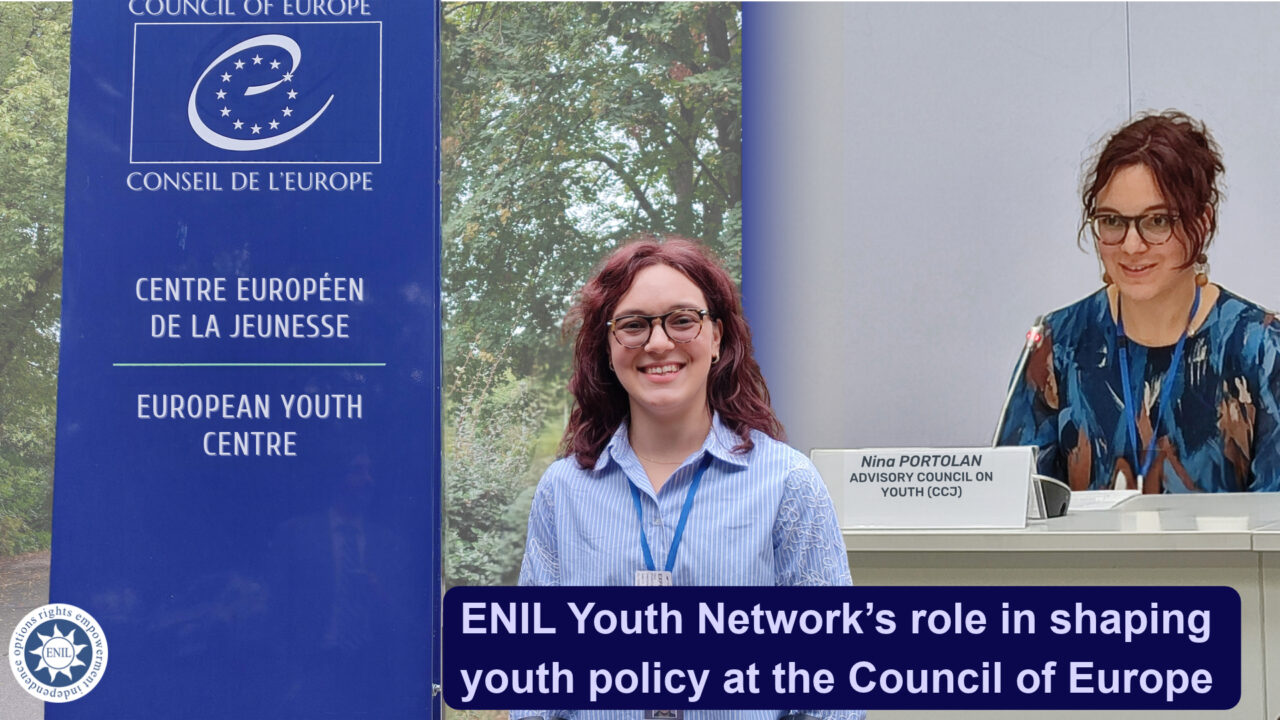
In 2025, ENIL trusted me with the opportunity to apply to represent the ENIL Youth Network in the Advisory Council on Youth (CCJ), for its 2026-2027 term.
For those unfamiliar with it, the Council of Europe is an international organisation bringing together 46 member states, working to uphold human rights, democracy and the rule of law in Europe. Its work covers many areas of life, including youth policy, and the way the Council of Europe operates when it comes to young people is especially interesting:
The Council of Europe’s youth sector operates through a system called co-management. Rather than leaving youth policy in the hands of governments, it brings together representatives of youth organisations and governments, to jointly shape the direction of its work.
The Advisory Council on Youth (CCJ) is the non-governmental partner in this arrangement. Composed of 30 representatives from national youth councils, organisations and networks across Europe, it brings the perspectives youth civil society into decision-making processes. Its responsibilities include advising the Committee of Ministers on youth-related matters, proposing priorities and contributing to the development of youth policies, programmes and budgets.
Its governmental counterpart is the European Steering Committee for Youth (CDEJ), which brings together representatives of national authorities responsible for youth. The two bodies meet, forming the Joint Council on Youth (CMJ), which is the co-decision-making body that establishes the priorities, objectives and budgets of the Council of Europe’s youth sector.
In other words, young people and governments sit at the same decision-making table, with an equal say in shaping the youth sector’s direction.
Of course, this does not mean that every idea automatically becomes a policy, or that reaching agreement is always straightforward. What is decided has to fit within the wider political and budgetary framework established by the Committee of Ministers, decisions have to be negotiated, priorities balanced, and agreements reached through consensus. But that is what makes the model unique: young people in it are not simply advisors, they are participants in decision-making that shapes the continent.
What happens when the doors close?
For me, joining the Advisory Council on Youth as a representative of the ENIL Youth Network is about carrying the experience, expertise and political demands of a disability-led movement into a space where decisions about European youth policy are shaped. This matters because young disabled people are not a separate category whose rights can be addressed in isolation. We are students, workers, activists, voters, artists, organisers and members of communities who experience the same political, economic and social realities, while also encountering barriers that are frequently overlooked in mainstream youth policy.
The Council of Europe’s youth sector recognises disability rights as one of the perspectives that must be mainstreamed throughout its work. The Joint Council has a dedicated Rapporteur for the Rights of Persons with Disabilities, and I have the privilege and responsibility of holding that role for this year and the next. It is my responsibility to make sure disability is not only mentioned when a specific disability-related topic appears on the agenda, but considered whenever decisions affect young people’s lives.
So, what is that like? As it can be imagined when we say „international policy “, this work is long agendas, complex discussions, and serious considerations of meaning and interpretation, from who is protected and how, to how exactly a certain phrase can be interpreted. However, while the mountain of paperwork ahead of the two yearly statutory meetings is always there, and the inbox is overflowing, this role is anything but boring.
This year alone in the Joint Council (CMJ), we have discussed peace education, rural youth, climate action, artificial intelligence, meaningful youth participation, accessibility, funding or youth-led projects, access to social rights, migration, bioethics, and more. Sometimes, discussions took an unexpected turn, or the room erupted with eager responses to a particularly insightful comment, and sometimes we couldn’t move forward at all, because none of the decisions brought to the table were acceptable to everyone. A lot of the time, the best discussions and alliances were made over coffee, over shared laughter, and in the quiet moments at the end of the day, when we all realised, civil society representatives or government officials, at the end of the day we are all busy humans who want to do better, even when we don’t agree on how to get there.
The meaning of a seat at the table
Decision making and democracy aren’t only what we see on the news. In fact, more of it happens in spaces that do not get seen by the public. For young disabled people and for the disability rights movement, this means creating a sometimes quiet change, starting with reshaping how agendas are structured, how information is delivered, or even how social events happen. Then it moves on to seeing what is missing. Reading draft decisions not for approval, but for a chance to make sure the decision includes us. Human Rights are universal, but their enjoyment, in our complex world, sometimes lies in the details.
As the first year of my mandate draws to a close, with a few more “missions” on behalf of the Advisory Council still ahead, I will save the details of our work for another article. For now, this is a reflection on a year spent learning what youth participation looks like in practice: the opportunities, the challenges, and the people who make it possible.
Most importantly, it is an invitation to all of us to be active citizens, to take an interest in the decisions that shape our lives, and to remember that democracy and enjoyment of human rights is not something we simply inherit or observe from the sidelines. It is something we build and protect, by showing up, speaking up and making space for others to do the same.
Written by:
Nina Portolan
ENIL Youth Coordinator
Member of the Advisory Council on Youth to the Council of Europe 2026-2027
Rapporteur on the Rights of Persons with Disabilities to the Joint Council on Youth 2026-2027