Brussels 1 June 2026
Subject: Concretising the implementation of the European Disability Strategy 2026-2030, delivering on the Independent Living, equal treatment and social inclusion of disabled people
Dear Commissioner Lahbib,
Disabled people in the EU face serious challenges and rights restrictions:
- According to Eurofound, the number of disabled people confined to institutions has increased by 29% in the last decade[1]
- Between 2010 and 2023 the disability employment gap has increased from 18,6% to 24,5%[2]
- According to Eurostat, in 2024 28,8% were at risk of poverty, compared to 17.9% of non disabled people[3]
Better access to Independent Living Services, especially personal assistance, personal budgets, Centres for Independent Living but also supported employment and supported decision-making could improve the situation.
Across the EU, there are severe implementation gaps when it comes to Independent Living Services.
- According to the ENIL Independent Living Surveys 2022 and 2024, the quality of personal assistance schemes is low[4]
- According to the ENIL Independent Living Roadmap, few countries have nation-wide personal budget schemes[5]
Initiatives proposed by the European Disability Strategy up to 2030
In its communication “Enhancing the strategy for the rights of persons with disabilities up to 2030” the European Commission is proposing several new initiatives which could lead to tangible improvements:
- An “EU Alliance for independent living” which will 1. Facilitate the creation of Centres for Independent Living, 2. “Monitoring deinstitutionalisation processes, 3. “An independent living implementation dialogue”
- “A proposal to reform the existing EU UN CRPD monitoring framework”
- “Disability at the intersection: boosting voice and choice”
- “Accessible and affordable housing”
ENIL’s recommendations for concretisation and implementation:
We want the enhanced strategy to become a success. To that end, we would like to propose measures that would concretise the proposed initiative and lead to a successful implementation.
- On the “EU Alliance for Independent Living”
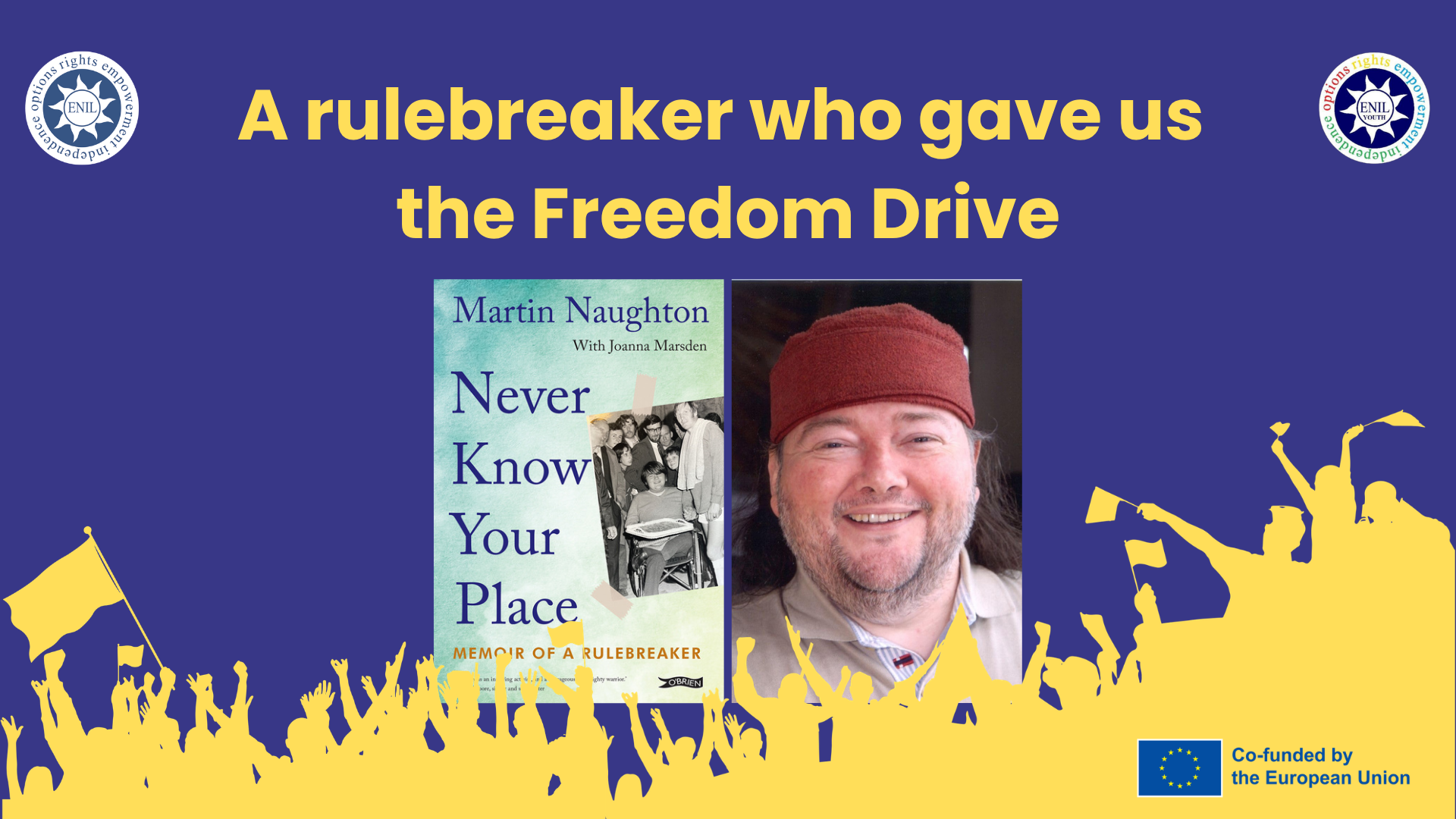
We must avoid a tick the box exercise consisting of superficial exchanges of good practices. Actions should lead to the actual creation of Centres for Independent Living, better monitoring practices and improved service provision. All these topics belong to the core competence of the Independent Living Movement, which for example founded the first Centre for Independent Living in 1972 in Berkeley, California.
To that end, ENIL calls for:
- Co-opt the European Network as the civil society lead into the implementation and further design of the initiative
- The alliance should entail work processes that lead to the production of blue prints for the creation of Centres for Independent Living, personal assistance and personal budget schemes and to the implementation of said blue prints in member states which are willing to commit
- Underpin the civil society leadership and the implementation of the blueprints with funding from AgoraEU and the National and Regional Partnership Plans
- Include comprehensive training activities for national administrations and managing authorities provided by DPOs
- On the “proposal to reform the existing EU UN CRPD monitoring framework”
The current EU monitoring framework is ineffective in reviewing legislation and policy proposals to assess conformity with the UN CPRD.
To that end, ENIL calls for:
- Ensure and full compliance with article 33 of the UN CRPD which states that “State Parties shall … maintain, strengthen, designate or establish … a framework, including one or more independent mechanisms, as appropriate, to promote, protect and monitor implementation of the present Convention” and that “Civil society, in particular persons with disabilities and their representative organizations, shall be involved and participate fully in the monitoring process”
- Ensure the monitoring framework is independent, well structured and adequately funded
- All EU Institutions and all agencies must be legally obliged to cooperate with the framework, to respond to its queries and justify courses of action
- There must be a clear mandate to review all legislation and policy to assess conformity with the UN CRPD
- Representative organisations of persons with disabilities shall receive full membership of the monitoring framework
- On intersectionality, equal treatment and the full participation of disabled women, girls and LGBTQI+ persons with disabilities
The European Disability Strategy 2026–2030 must fully integrate intersectionality as a core principle in line with the UN CRPD and EU equality commitments. Disabled people are not a homogeneous group, and those facing multiple forms of discrimination, particularly disabled women, girls, and LGBTQI+ disabled people, experience significant barriers. Current EU policies still fail to adequately address these intersecting inequalities, resulting in reduced access to Independent Living, protection from violence, healthcare, SRHR services, and participation in political and public life.
To that end, ENIL calls for:
- Ensure the systematic integration of intersectionality across all EU disability and equality policies, including targeted measures for disabled women, girls and LGBTQI+ disabled people, and intersectional requirements in EU funding programes
- Ensure that Independent Living and community-based services, in particular personal assistance, are recognised as essential for preventing and responding to gender-based violence, with guaranteed access for disabled women and girls in crisis situations
- Ensure the full and meaningful participation of disabled women, girls and LGBTQI+ disabled people in all EU decision-making and Article 33 CRPD monitoring frameworks, with adequate accessibility, reasonable accommodation and funding for representative organisations
- Ensure full and non-discriminatory access to SRHR services and fully accessible gender-based violence services, including shelters, crisis centres and hotlines, for disabled women, girls and LGBTQI+ disabled people
- Ensure the systematic collection and use of disaggregated intersectional data and the inclusion of disability in all EU migration and asylum policies, including accessible procedures and protection from violence and institutionalisation
- On accessible and affordable housing as a precondition for Independent Living
Access to adequate housing remains a major challenge for many disabled people across the EU. Limited availability of affordable and accessible housing, inaccessible environments, discriminatory practices in the housing market, and the lack of community-based housing options continue to undermine the right to Independent Living and increase the risk of institutionalisation. Housing should be recognised not merely as physical infrastructure, but as an essential to social inclusion and equal participation in society.
“To that end, ENIL calls for”:
- Ensure the systematic inclusion of disability and Independent Living principles in all EU housing initiatives, including the European Affordable Housing Plan and related housing and anti-poverty measures.
- Ensure that simplification measures do not weaken accessibility requirements, universal design principles and reasonable accommodation obligations in housing policies and investments.
- Recognise accessible and affordable housing as a key element of successful deinstitutionalisation and prohibit EU funding from supporting institutional settings.
- Ensure access to reasonable accommodation in housing and housing-related services to enable disabled people to exercise choice and live independently in the community.
- Strengthen the collection and use of disaggregated data on housing exclusion, homelessness, accessibility barriers, energy poverty and institutionalisation risks among disabled people.
- Support Member States in developing accessible and affordable housing alongside personal assistance and other forms of individualised support.
We would gladly cooperate closely with your cabinet and the Commission services to implement our recommendations and ensure that the enhanced European Strategy on the Rights of Persons with Disabilities will be a smashing success.
With kind regards,
Ines Bulic-Cojocariu
Director of the European Network on Independent Living
The complete letter is available in word here and in pdf here
About the European Network on Independent Living
The European Network on Independent Living (ENIL) is a disabled-led, cross-disability network of disabled people and their representative organisations. ENIL promotes the right to independent living, as set out in Article 19 of the UN Convention on the Rights of Persons with Disabilities (CRPD), its General Comments and the Guidelines on deinstitutionalisation, including in emergencies. ENIL’s work is guided by the CRPD and the Independent Living principles, enshrined in the Independent Living Pillars. ENIL is active at the European level, and internationally, through cooperation with Centres for Independent Living from around the globe. ENIL’s actions and activities are based on the social and the human rights models of disability, and on the principles of inclusive equality, self-determination, solidarity and intersectionality.
ENIL has participatory status with the Council of Europe (i.e. is a member of the Conference of INGOs) and consultative status with ECOSOC.
Contact us
European Network on Independent Living (ENIL)
6thFloor – Mundo J
Rue de l’Industrie 10
1000 Brussels
Belgium
E-mail: secretariat@enil.eu
Website: www.enil.eu

Co-funded by the European Union. Views and opinions expressed are however those of the author(s) only and do not necessarily reflect those of the European Union or the European Commission. Neither the European Union nor the granting authority can be held responsible for them.
[1] Eurofound 2021. Paths towards Independent Living. https://www.eurofound.europa.eu/en/publications/all/paths-towards-independent-living-and-social-inclusion-europe
[2] ENIL 2025. Advocacy Campaign for inclusive employment takes shape. https://enil.eu/advocacy-campaign-for-inclusive-employment-takes-shape/
[3] Eurostat 2025. Disability statistics – poverty and income inequalities. https://ec.europa.eu/eurostat/statistics-explained/index.php?title=Disability_statistics_-_poverty_and_income_inequalities
[4] Comp. ENIL 2022. Independent Living Survey. https://enil.eu/wp-content/uploads/2023/04/IL-Survey_Summary-report_Dec2022.pdf; ENIL 2024. Independent Living Survey 2024. https://enil.eu/wp-content/uploads/2025/05/Independent-Living-Survey-2024_WEB.pdf
[5] ENIL 2025. Independent Living Roadmap. https://enil.eu/wp-content/uploads/2026/01/A-roadmap-on-Independent-Living.pdf