The housing crisis is also an accessibility crisis
Around 90 million people in the EU live with a disability. In 2024, 28.8% of persons with disabilities were at risk of poverty or social exclusion, compared with 17.9% of persons without disabilities. Persons with disabilities also experienced higher housing cost overburden: 10.4%, compared with 7.8%.
Beyond affordability, accessibility remains a major challenge. Estimates suggest that 70–80% of the existing housing stock is unsuitable for people with mobility impairments. Additional costs for housing adaptations, personal assistance, accessible transport and energy can make housing even less affordable.
Without accessible housing, disabled people may have limited choice about where and with whom they live. This can undermine independent living, contribute to homelessness and housing exclusion, and make leaving institutions more difficult.
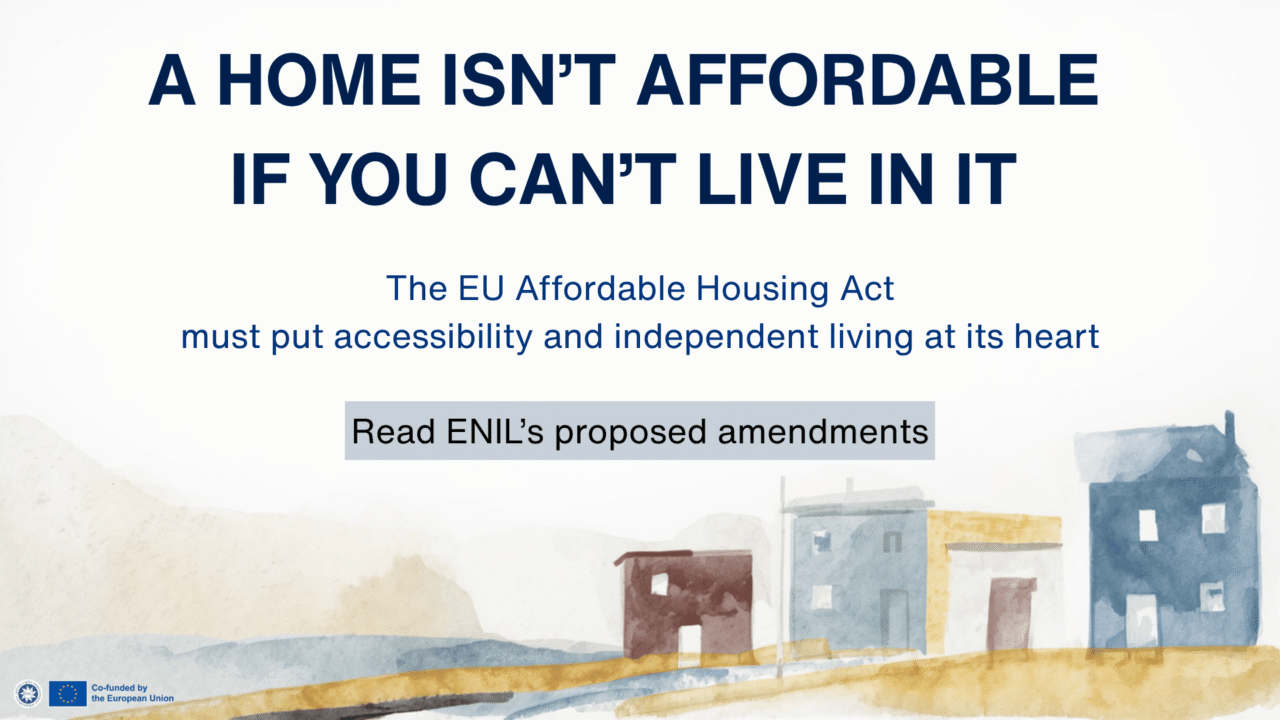
Increasing the number of available homes is not enough if those homes remain inaccessible to disabled people. The EU Affordable Housing Act must address both affordability and accessibility.
ENIL’s amendments aim to ensure that the housing needs of disabled people are considered throughout the proposed Act.
1. Recognising the housing rights of persons with disabilities
ENIL proposes new recitals recognising the housing barriers faced by persons with disabilities and the obligations of the EU and its Member States under the UNCRPD.
Articles 9, 19 and 28 of the UNCRPD address accessibility, the right to live independently and be included in the community, and the right to an adequate standard of living, including adequate housing. Housing measures must be consistent with these obligations and support disabled people’s right to independent living.
2. Making accessibility a fundamental part of housing policy
Accessibility should be considered from the outset of housing design and construction.
ENIL proposes that the Act recognise accessibility as a key consideration when increasing housing supply, including through the application of Universal Design principles in new construction and renovation. Existing housing should be progressively adapted, and individual adaptations should remain available where needed.
Accessibility must also extend to common areas and the surrounding environment, including transport and essential services.
3. Ensuring social and non-profit housing meets accessibility needs
Social housing is important for people at risk of poverty and housing exclusion, but it is not automatically accessible.
ENIL proposes measures to ensure that social and non-profit housing is accessible from the outset and responds to the needs of disabled people.
We also call for housing stress assessments to consider whether the local supply of accessible social and non-profit housing is sufficient to meet identified needs.
4. Assessing housing stress from the perspective of persons with disabilities
An area may have sufficient housing overall while lacking adequate, affordable and accessible homes for disabled people. General housing indicators may not capture these barriers.
ENIL proposes that authorities consider housing accessibility when assessing housing stress. We also propose yearly monitoring of housing stress and action without delay when a problem is identified, addressing both short-term and long-term needs.
5. Addressing discrimination and housing exclusion
Disabled people can face discrimination and additional barriers when looking for housing. ENIL proposes that authorities take these experiences into account when applying the Regulation.
The amendments also call for a sufficient supply of accessible emergency and temporary accommodation for people experiencing, or at risk of, homelessness, including disabled people.
Accessible housing is essential for independent living
Independent living means having the choice and control to decide where and with whom to live, with access to suitable housing and the support needed to participate in the community.
Without adequate, affordable and accessible housing, this right cannot be fully realised. Housing policy must therefore support community-based living and deinstitutionalisation. People cannot leave institutions if suitable homes and support are unavailable in the community.
An aging population and climate change further underline the need for safe, accessible housing. Universal Design and improvements to existing homes can help ensure that housing meets people’s needs throughout their lives.
Nothing about us, without us
As a disabled-led European network, ENIL calls for the meaningful involvement of persons with disabilities and their representative organisations in developing and implementing housing policies.
The EU Affordable Housing Act is an opportunity to address the barriers disabled people face and ensure that housing policy promotes inclusive communities rather than exclusion and segregation.
ENIL calls on EU policymakers to ensure that accessibility, affordability and the right to independent living are reflected throughout the EU Affordable Housing Act. Everyone should be able to choose where and with whom they live, in a home that meets their needs and enables community participation.
Read ENIL’s proposed amendments to the EU Affordable Housing Act: ENIL Proposed Amendments to the EU Affordable Housing Act.docx
Read ENIL’s briefing, Home is Where Independent Living Is: Briefing on the Role of Housing in Supporting Independent Living:https://enil.eu/wp-content/uploads/2026/09/Home-is-Where-Independent-Living-Is_web.pdf
About ENIL
The European Network on Independent Living (ENIL) is a disabled-led, cross-disability network of disabled people and their representative organisations. ENIL promotes the right to independent living under Article 19 of the UN Convention on the Rights of Persons with Disabilities and advocates for the full inclusion and participation of disabled people in society.
Written by Dr Veronika Kovacs