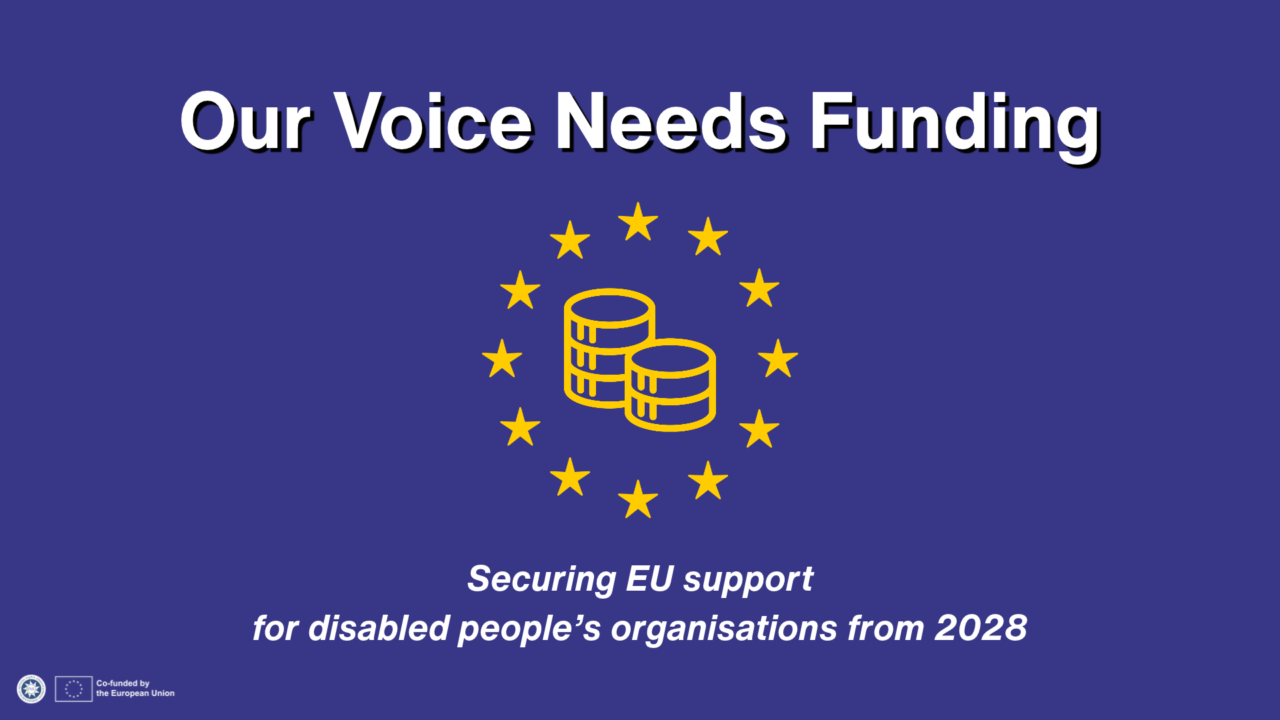
The European Parliament and the national governments are debating the programme that will provide grants to disabled people´s organisations from 2028. ENIL is presenting amendments to ensure our voice is heard and Independent Living organisation can receive funding.
Disabled people`s organisations can receive financial support from the European Union to fund their advocacy activities under the Citizens Equality Rights and Values programme (CERV). ENIL is receiving a grant under CERV.
The exclusion of disabled people from society
In today´s society, disabled people are still excluded from almost all key spheres of life, due to barriers and separation into segregated settings. Across the EU 1,4 million disabled people are confined to institutions, 24,8% of disabled young people leave school early compared to 8% of non-disabled persons, to employment rate of disabled people stands at 51% compared to 75% of non-disabled people.
An enormous challenge is the lack of access to person-centred support services. Personal assistance and personal budgets are only available to a very limited extent in most EU member states.
Due to this exclusion, disabled people face significant barriers to defending their interests in public life and in politics and government. The views and needs of the 89 million disabled citizens of the EU remain largely absent from debates about policy.
Organisations of persons with disabilities play a vital role in bridging this gap and providing disabled people with opportunities to participate in political life and shape the policies that affect them. We are giving a voice to the otherwise voiceless.
The economic means of grass-roots organisations
For grass-roots organisations like ENIL, the CERV funding is essential to continue our work. Our membership consists of disabled individuals and organisational members, the overwhelming majority of which are also small grass-roots organisations. Disabled individuals are very frequently excluded from employment and income. Independent Living organizations rarely receive public funding. Thus, the economic means of our membership to financially sustain us is limited.
Our recommendations for the CERV programme
From 2028, the CERV programme will be part of the new Agora EU funding programme which will have a budget of EUR 8,5 billion available. Agora EU is a merger programme that will unite Creative Europe, which provides funding for artists and the Media programme under one roof.
In the European Parliament it has been proposed to introduce a budget distribution between the various programme strands. It has been proposed that the CERV strand should receive 41,9% of the overall budget.
For the ongoing negotiations we recommend:
- To stand by the budgetary distribution proposed in the new paragraphs of article 11. The share for CERV should not fall below 41,9%. At the moment, 92% of funding applications are rejected, even if the quality is high. The application rate should be increased in the next period.
- Modifying articles 3 and 7 to strengthen the role of disability equality and the implementation of the United Nations Convention on the Rights of Persons with Disabilities as a horizontal priority of Agora EU
- Modify article 3 (2) to ensure the Daphne strand also focuses on combating violence against children with disabilities
The full amendments can be downloaded as a pdf here and as a word file here.