Response to the European Commission consultation on the subsidisation rules
Income from work provides the means to pay the bills and generate savings. We want every disabled person to have a quality job and a stable income.
Personal assistance at work, accessible buildings or assistive devices are often crucial to enable us to find and retain a job. These types of aids are called supported employment.
In sheltered employment we are defined as service users, not workers and therefore don’t receive a living wage. Sheltered employment is a trap. Once in, its impossible to leave.
Many countries subsidise sheltered employment employment with extensive resources and little is left for the aids that really help.
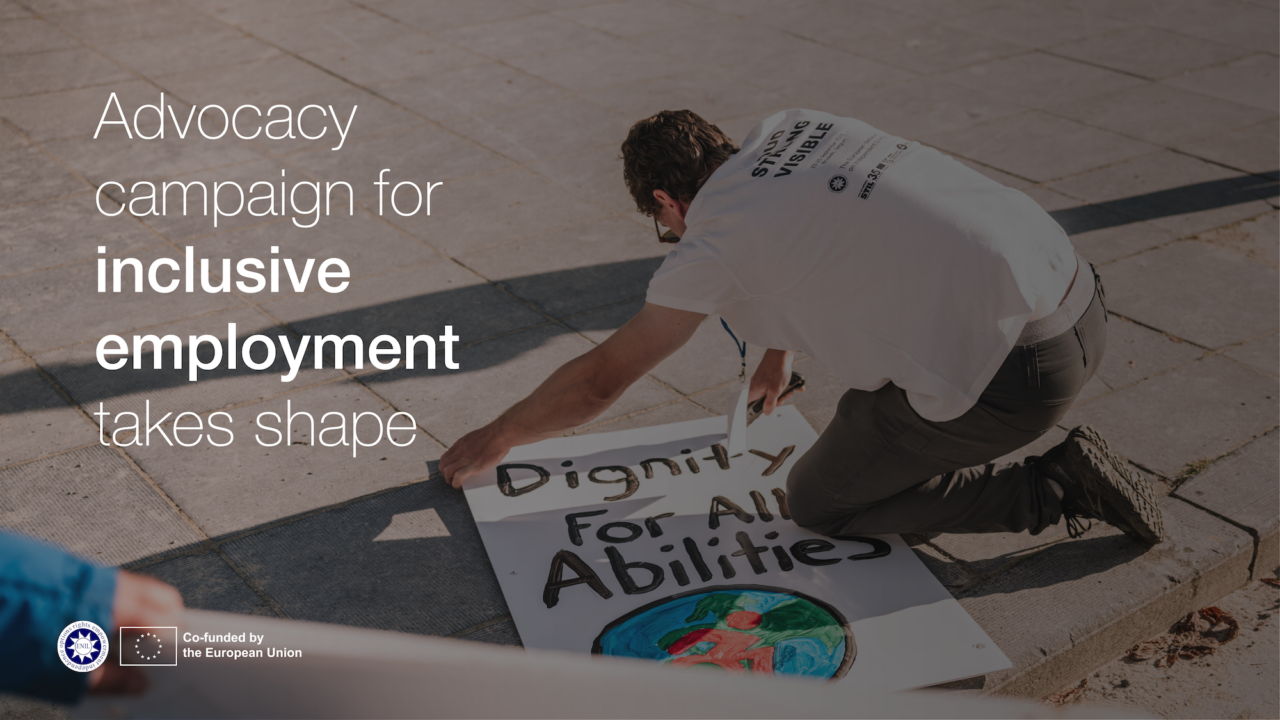
The European Union has the power to support a real change. ENIL has identified the option for a legal change, that would increase spending on supported employment.
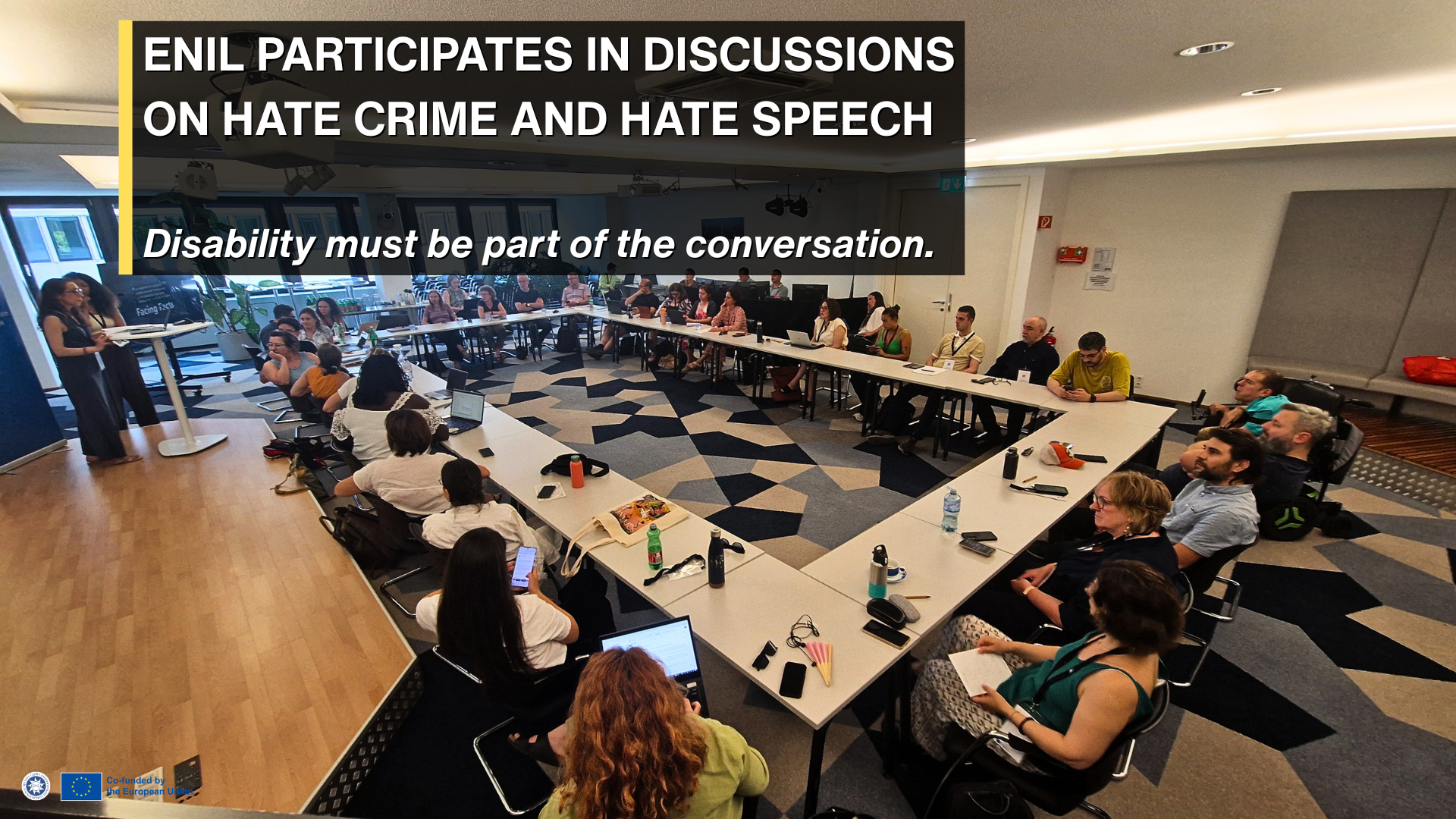
Last year, we organised a public event on our proposal.
We published a detailed report, including strong legal and empirical evidence which is available in word and in pdf.
We contributed to a European Commission consultation.
This month, the European Commission has published a first proposal. Our recommendation has not yet been taken onboard.
Therefore, we are going to provide input to this consultation, providing a summary of our original proposal:
The General Block Exemption Regulation (GBER) has the objective to support the employment of disabled people. Comparisons of sources and calculations show that the disability employment gap has increased from 18,6% in 2010 to 24,5% in 2023. In the same period the employment rate of non-disabled people increased 7,2% while the employment rate of disabled people gained 1,3%. There is no evidence that the General Block Exemption Regulation or any other EU policy has had any positive effect on the employment of disabled people.
Funding of sheltered employment through the GBER and its effects
The GBER (article 34,2,f) allows the financing of sheltered employment. Public financing of sheltered employment is commonly justified with the argument that it enables transitions into the regular labour market. The European Commission study on alternative employment models for persons with disabilities shows that sheltered employment is extremely ineffective in producing transitions into regular work, 6% to 7% are by far the highest. values reached. In Austria only 0,7% of persons working in sheltered workshops make the transition. For Germany studies indicate a transition rate of less than 1%. A study from 2023 by the Ministry of Social Affairs established a transition rate of 0,35%. For Spain it is 0,55%.
The exploitative nature of sheltered employment has been well documented, for example by the European Association of Service Providers for Persons with Disabilities (EASPD) study “Fostering employment through sheltered workshops: reality, trends and next steps”. The number of disabled people in sheltered employment has increased drastically in the last decade. For example, in Spain from 56.332 in 2009 to 98.551 in 2021.
As documented in our 2025 report on inclusive employment, governments spend enormous sums on sheltered employment. Sweden is subsidizing the provider Samhall with EUR 500 Mio. per year. The Belgium region Vlaanderen has announced to spend EUR 30 million on sheltered employment to create 1000 new places.
Europe is facing a shortage of skilled labour, impeding our competitiveness. Due to the policy choice in favour of sheltered and against supported employment, we are excluding a significant proportion of the population from contributing. When confronted with the options in the GBER, authorities overwhelmingly focus on financing sheltered employment because it is assumed disabled people are not capable of more.
The funding of supported employment
The GBER allows to fund wages of disabled workers, adapting the premises, assistance at work, equipment, transport and rehabilitation which are referred to as supported employment.
The European Commission study on alternative employment models shows that supported employment programs are very effective in achieving labour market inclusion: A study from Germany found 63% of participants were in employment in the open labour market six months after the end of the intervention, 62% 12 months later, 57% 24 months later. Another, older study followed up with 251 persons mainly with intellectual disabilities more than five years after they had transitioned from sheltered workshops to the open labour market via supported employment. Five years after the initial placement, 65% of the participants were still in employment.
Disabled people in regular work, have proper wages and thus increased buying power, reduced dependency on social benefits and the chance to contribute to society and economy which increased well-being.
Our decades long experiences at ENIL support these findings. We are a movement of disabled people with a human resource policy focused on employing disabled people. When given the chance we are capable of achieving socio-economic performances on a level-equal to others, a fact which is persistently being ignored. Due to Europe´s current economic situation and public finances we can no longer afford to use our resources to maintain structures creating a loss of skilled labour.
Our recommendation: Remove article 34(2)(f) to strengthen the use of articles 34(2)(a-e)
Supported employment programmes are small compared to sheltered employment. The available resources overwhelmingly go into sheltered employment. When it comes to supporting the employment of disabled people, authorities mostly focus on article 34(2)(f) of chapter III. Article 33 and articles 34(2)(a-e) are rarely used. We are recommending to remove article 34(2)(f). There is overwhelming evidence against sheltered employment.
The system will not collapse
Such a step would not lead to a collapse of sheltered employment in the EU. Germany also reduced federal funding for construction and maintenance of sheltered employment: https://www.bmas.de/DE/Service/Gesetze-und-Gesetzesvorhaben/gesetz-zur-foerderung-eines-inklusiven-arbeitsmarktes.html. The sheltered employment system still exists. When combined with strong awareness raising activities in favour of supported employment and comprehensive training activities, we consider that the removal of 34(2)(f) would create an incentive to increase to spending on supported employment.
Following international human rights norms
In addition, the EU has signed and ratified the United Nations Convention on the Rights of Persons with Disabilities (UN CRPD). Following TFEU art. 216(2), the UN CRPD is a part of the EU legal order. The UN Committee on the Rights of Persons with Disabilities is authorised to review the EU and issue authoritative recommendations.
On the 21st of March, the Concluding Observations to the combined second and third periodic review of the EU were published. The CRPD-Committee is calling for a reform of the General Block Exemption Regulation, and call on the EU to remove article 34(2)(f):
“Repeal legislation that allows public financing of segregated forms of employment for persons with disabilities, such as institutions and other segregated facilities … repeal article 34(2)(f) of the General Block Exemption Regulation … and prohibit state aid on segregated employment”.
About the European Network on Independent Living
The European Network on Independent Living (ENIL) is a disabled-led, cross-disability network of disabled people and their representative organisations. ENIL promotes the right to independent living, as set out in Article 19 of the UN Convention on the Rights of Persons with Disabilities (CRPD), its General Comments and the Guidelines on deinstitutionalisation, including in emergencies. ENIL’s work is guided by the CRPD and the Independent Living principles, enshrined in the Independent Living Pillars. ENIL is active at the European level, and internationally, through cooperation with Centres for Independent Living from around the globe. ENIL’s actions and activities are based on the social and the human rights models of disability, and on the principles of inclusive equality, self-determination, solidarity and intersectionality.
ENIL has participatory status with the Council of Europe (i.e. is a member of the Conference of INGOs) and consultative status with ECOSOC.
Contact us
European Network on Independent Living (ENIL)
6thFloor – Mundo J
Rue de l’Industrie 10
1000 Brussels
Belgium
E-mail: secretariat@enil.eu
Website: www.enil.eu
Written by: Florian Sanden
© European Network on Independent Living, 2025

Co-funded by the European Union. Views and opinions expressed are however those of the author(s) only and do not necessarily reflect those of the European Union or the European Commission. Neither the European Union nor the granting authority can be held responsible for them.