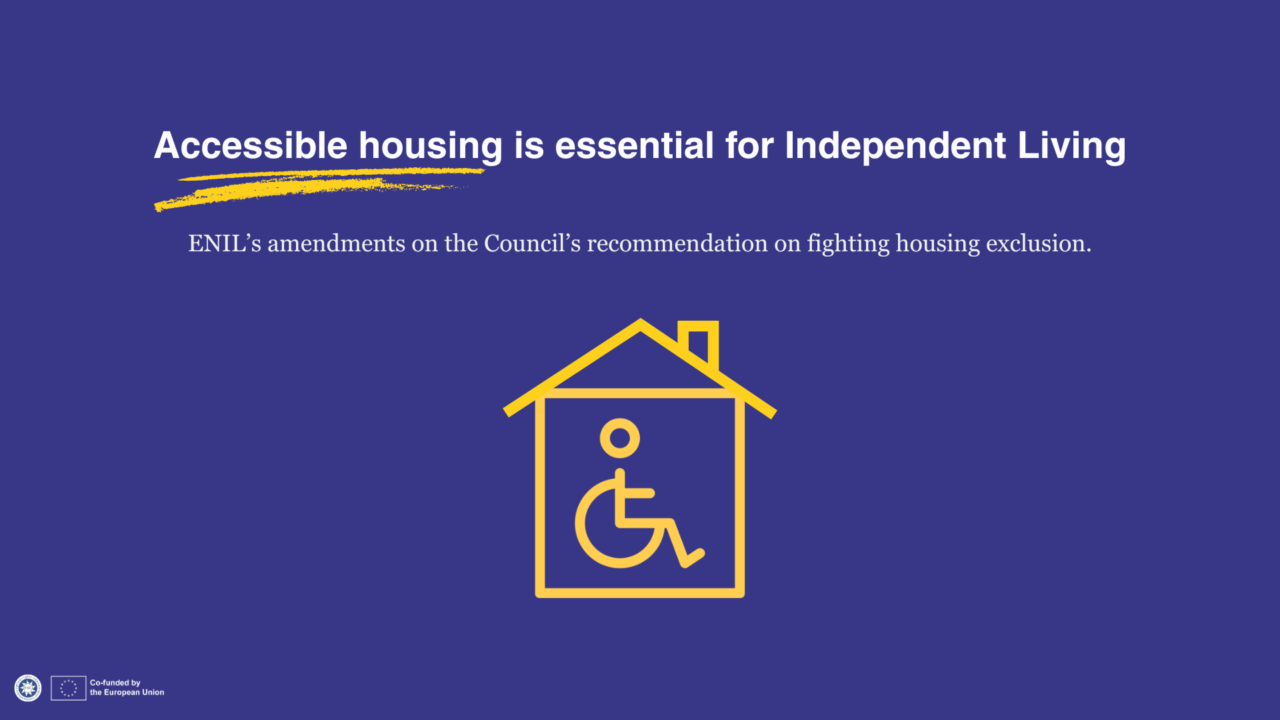
ENIL Calls for Stronger Disability Inclusion in the Council Recommendation on Fighting Housing Exclusion
ENIL welcomes the European Commission’s Proposal for a Council Recommendation on Fighting Housing Exclusion. At a time when housing costs continue to rise across Europe and homelessness is increasing, the initiative represents an important opportunity to strengthen the right to adequate housing and ensure that no one is left behind.
However, while the proposal recognises that certain groups are disproportionately affected by housing exclusion and homelessness, it does not sufficiently address the barriers faced by persons with disabilities. As a result, the Recommendation risks overlooking one of the groups most affected by inaccessible and unaffordable housing.
Housing and Independent Living cannot be separated
Access to affordable and accessible housing is a prerequisite for exercising the right to live independently and be included in the community, as recognised by Article 19 of the UNCRPD. Yet many disabled people continue to face housing exclusion due to a lack of accessible housing and community-based support services.
Housing policies that fail to address accessibility and support needs will not effectively reach those most at risk of exclusion.
EU obligations under the UNCRPD
As a State Party to the UNCRPD, the European Union is required to promote independent living, accessibility and equal access to adequate housing. ENIL therefore calls for stronger references throughout the Recommendation to the right to independent living and the role of affordable and accessible housing in making this right a reality.
The Recommendation should also recognise that inaccessible housing and the absence of community-based support services can contribute to segregation and institutionalisation.
Accessibility must become a core principle
The shortage of accessible housing remains one of the main barriers to independent living across Europe. ENIL calls on Member States to ensure that new and renovated housing, including social and publicly funded housing, complies with accessibility requirements and universal design principles.
Housing policies must support deinstitutionalisation
People leaving hospitals, psychiatric facilities and residential care settings should have access to affordable and accessible housing alongside personalised community-based support services. Without these measures, many remain at risk of homelessness, social exclusion and re-institutionalisation.
A Housing and Support First approach
ENIL supports a Housing and Support First approach that combines access to permanent housing with community-based support tailored to individual needs. Public and EU funding should support accessible housing arrangements and must not contribute to institutional or segregated settings.
Looking ahead
The Council Recommendation on Fighting Housing Exclusion provides an important opportunity to ensure that housing policies fully respect the rights of persons with disabilities. ENIL calls on Member States and EU institutions to strengthen the Recommendation accordingly and ensure policies to tackle housing exclusion leave no one behind.
Read the full amendments: https://enil.eu/wp-content/uploads/2026/06/Amedments-for-Council-recommendations-to-fighting-housing-exclusion-3.docx