“A young disabled person doesn’t fall out of education and employment by accident or by their own limitations. They are pushed out case by case.“
Independent Living Pillar 9 says disabled people must have access to inclusive education and training. In order to truly live an independent life, you should have access to the same level of education as your peers, with no barriers preventing you from succeeding.
Formal education is the system most people picture when they hear the word “education”: this of course includes schools, exams, a fixed curriculum, progression measured by grades and attendance. When it works, it has the ability to give young people the essential skills to navigate life. When it fails young disabled people in particular, it can be catastrophic, with knock-on effects that last a lifetime. Its rigid structure can be a barrier for disabled people through discrimination, accessibility failures or outdated beliefs that disabled people can’t cope in academic spaces.
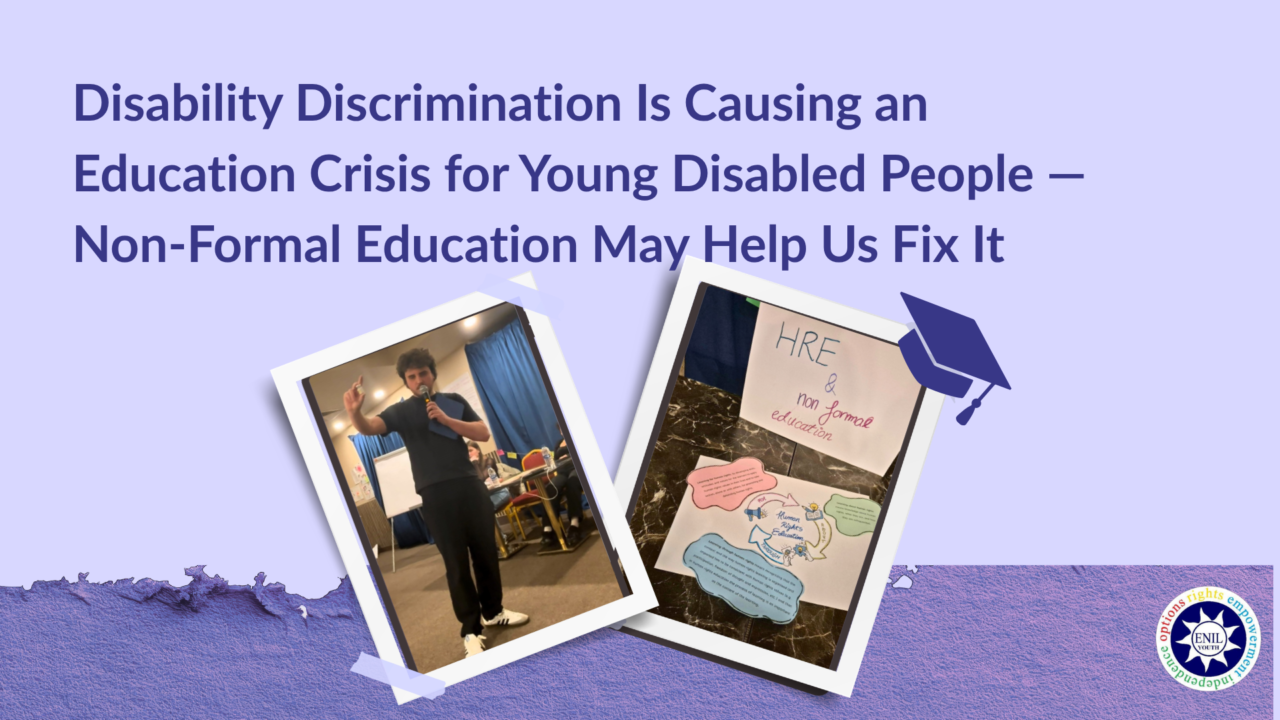
Non-formal education is a fundamentally different model. The Council of Europe defines it as planned, structured learning that happens outside the formal curriculum, often through youth organisations, built on voluntary participation and open to anyone regardless of background. Its inclusiveness comes from its mechanics rather than its intentions. It doesn’t measure value on archaic, competitive systems. Instead, it creates an environment where a collective learning experience can be fostered, and the only real measure of success is effort, and usually a tangible outcome.
Article 24 of the UN CRPD mandates that governments provide an inclusive education system, ensuring people with disabilities have access to quality, free education on an equal basis, sitting under the wider Article 19: The right to live independently and be included in the community. None of that means anything if a young disabled person can be pushed out of education.
In 2024, 44.2% of disabled 18- to 24-year-olds in the EU left education and training early, against 8.0% of their non-disabled peers, more than five times the rate. Among 15- to 29-year-olds, 54.7% of disabled people were NEET, “not in education, employment or training,” against 10.0% of those without a disability.
I personally was discriminated against by one of the top performing schools in my region, because of assumptions about my disability. It took three years and a tribunal case just to get that basic right to education recognised. The school faced no penalty once the tribunal found in my favour. I was the one left carrying it.
Out of context it looked just like a gap in my education and employment history, which meant I had access to far fewer opportunities because of it. Doors that should have been open to me closed, one after another, each one closed by what the discrimination had already taken from me. Discrimination, particularly in formal education, can compound and impact you for years.
I found non-formal education by accident, and only after formal education had already done its damage. With nothing in my life actually different after the tribunal, I applied for anything, and was rejected for the same reason each time: gaps in my education and gaps in my work history – the exact gaps formal education had created.
Independent (Living) Media’s “Crip, Cut, Rewrite,” Summer School, an ENIL Youth non-formal education course in Bosnia and Herzegovina, was the first place that didn’t ask me to explain any of those gaps. I worked with a team of young people from across Europe until together we produced the Guidelines on Media Representation of Persons with Disabilities. Since then, I’ve done more non-formal education, and I’m even training with the Council of Europe Compass programme to become an accredited trainer in non-formal education.
My experience of discrimination is only one story in millions, but the pattern it follows is the same one the EU’s own figures, cited at the start of this piece, show repeating across the continent. Assumptions were weaponised against me, over and over, rather than evidence, and that is exactly what produces those figures at scale.
A young disabled person doesn’t fall out of education and employment by accident or by their own limitations. They are pushed out case by case. The numbers are simply the sum of all those individual pushes.
Non-formal education can deliver on parts of Pillar 9 of Independent Living because it judges people on effort and outcome rather than the same broken system that otherwise constantly fails young disabled people.
Funding is NFE’s major obstacle: It has to move away from short-term project grants that dry up quickly, toward multi-year funding lines specifically for disability-inclusive non-formal education, on the same footing as mainstream vocational and youth programmes instead of as a smaller add-on within them.
Recognition matters just as much: a young person can complete a rigorous non-formal education programme, produce a genuine outcome, the way we produced the Guidelines in Bosnia, and still have nothing a university or an employer might recognise as a qualification. For that to change, there needs to be more awareness of what Non-Formal Education is and how it develops skills, as well as formal accreditation frameworks that let non-formal education sit alongside formal qualifications, on equal footing, so the skills it builds actually count on a CV or an application form.
None of this replaces the deeper fix, which is formal education itself becoming genuinely inclusive: ending discriminatory practices against disabled people. But while that fix is overdue, non-formal education deserves policy and funding as a legitimate education route in its own right.
Luke McLaughlin
ENIL Youth Board Member and Founder of The Haemophilia Rights Project
This article is an opinion piece by the author. The opinions and attitudes in it do not necessarily represent the official positions of ENIL, or any other institutions mentioned.
Sources
1. ENIL, Independent Living Pillars: https://enil.eu/independent-living/
2. UN Convention on the Rights of Persons with Disabilities, Article 19 (Living independently and being included in the community) and Article 24 (Education): https://www.un.org/development/desa/disabilities/convention-on-the-rights-of-persons-with-disabilities/convention-on-the-rights-of-persons-with-disabilities-2.html
3. Council of Europe, European Youth Foundation, thematic resource on non-formal education: https://www.coe.int/en/web/european-youth-foundation/non-formal-education
4. Eurostat, “Disability statistics – access to education and training” (2024 data on early leavers, NEET rate, adult education participation and educational attainment by disability status): https://ec.europa.eu/eurostat/statistics-explained/index.php?title=Disability_statistics_-_access_to_education_and_training