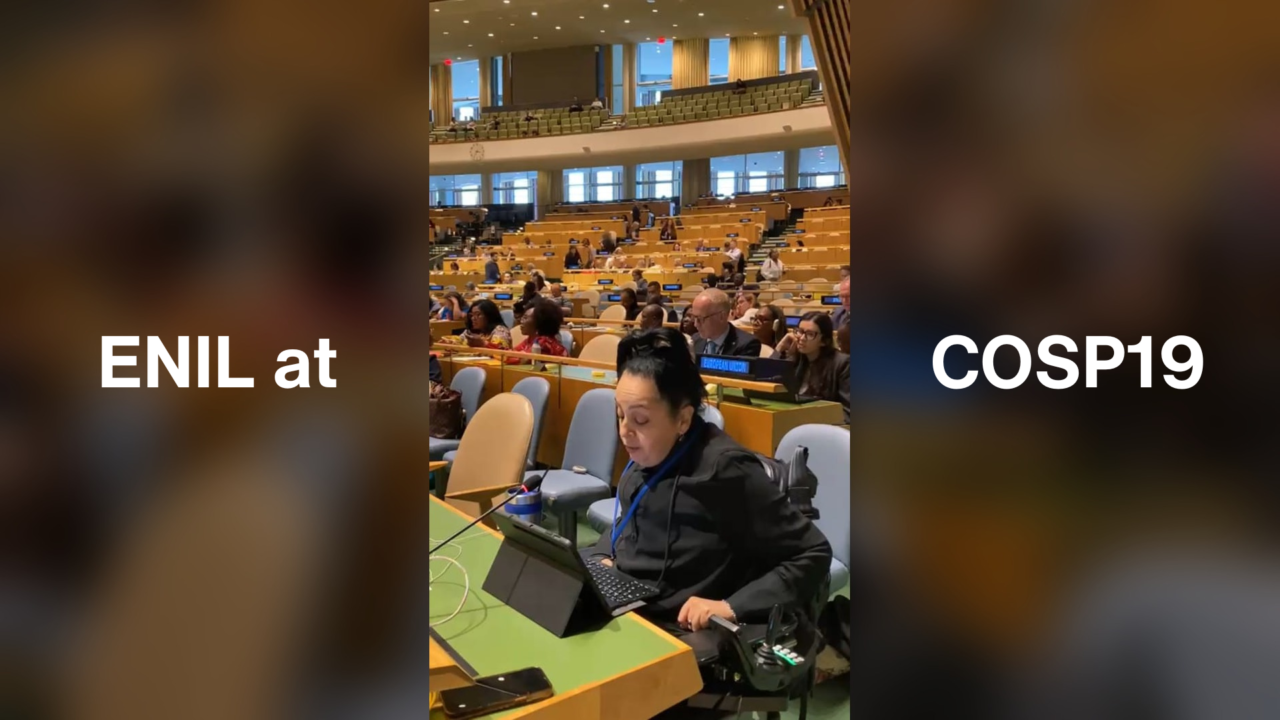
At the 19th session of the Conference of States Parties to the CRPD, ENIL and GRIP vzw co-organised a side event asking a direct question:
Twenty years after the adoption of the UN Convention on the Rights of Persons with Disabilities, are we any closer to Independent Living for all?
The event focused on Article 19 of the CRPD, which recognises the right of disabled people to live independently and be included in the community. For ENIL, Article 19 is one of the most important parts of the Convention. It is also one of the most difficult to implement.
Opening the event, ENIL Co-Chair Nadia Hadad reminded participants that Independent Living is not only about where someone lives. It is about self-representation, self-determination, choice and control, and freedom from institutions and all segregating settings. It also requires a holistic approach across housing, transport, personal assistance, education, employment, healthcare, legal capacity, supported decision-making and peer support.
Speakers agreed that the CRPD has changed the way disability rights are understood. Disability is now more clearly recognised as a human rights issue, not a matter of charity or welfare. But they also warned that legal recognition is not enough. Across the world, too many disabled people are still denied the support they need to live in the community.
H.E. Bart De Wolf, Deputy Permanent Representative of Belgium to the United Nations, underlined Belgium’s commitment to Article 19 and to moving from care to support. He said that support should improve autonomy and enable disabled people to make their own choices. He also highlighted the need for reforms to be developed in dialogue with disabled people and their organisations.
Markus Schefer, member of the CRPD Committee, gave an overview of the state of implementation of Article 19. He pointed to some positive developments, including countries that have reduced large institutions or expanded personal assistance. But he also warned about serious gaps: lack of accessible housing, restrictions on personal assistance, public funding still going to institutions, and the absence of clear, time-bound deinstitutionalisation strategies. His message was clear: the CRPD has had an impact, but we are still far from where we should be.
Jarrod Clyne, from the International Disability Alliance, brought a strong personal and political perspective. He spoke about the ongoing institutionalisation of persons with psychosocial and intellectual disabilities, and the fear, stigma and lack of political will that continue to drive segregation. He stressed that awareness-raising must not be treated as a soft issue. It is part of the deeper social change needed to challenge the ideas that keep disabled people excluded.
Costa Rica shared an example of legal reform linked to personal autonomy. Roberto Avedaño Sancho presented Costa Rica’s law on the promotion of personal autonomy of persons with disabilities, adopted in 2016. He highlighted personal assistance, legal autonomy and inclusive employment as key parts of turning CRPD rights into reality. He also stressed that the success of the Convention will not be measured by laws alone, but by whether disabled people can decide where to live, how to participate and how to shape their own future.
Jessica Podesva, from the National Council on Independent Living in the United States, brought the discussion back to the roots of the Independent Living movement. She explained the role of Centers for Independent Living as user-led organisations run by and for disabled people. These centres provide peer support, advocacy, information, independent living skills training and support to leave institutions. But she also warned that many centres face unstable funding, political pressure and lack of legal recognition.
From the Flemish experience, Nadia Hadad presented personal budgets as an important tool for choice and control. In Flanders, disability support can follow the person, rather than going directly to institutions. This can allow disabled people to choose personal assistance, home support, transport and other services. However, she also warned that budgets alone are not enough. Waiting lists, restrictive rules and underfunding can still prevent people from living independently. Real Independent Living requires a full ecosystem of support.
Rio Hada, from the Office of the United Nations High Commissioner for Human Rights, placed Independent Living within the wider human rights agenda. He described Independent Living as both a right in itself and an enabler of other rights, including education, employment, family life, public participation and community life. He warned that new care and support systems can reproduce institutionalisation if they are not built around choice, legal capacity, autonomy and participation.
During the discussion, participants raised several key concerns. These included the lack of global data on institutionalisation, the continued funding of institutions, the risk of closing institutions without building real community support, and the need to involve disabled people in reforms that affect their lives.
The debate showed that there is no simple answer to the question of whether we are closer to Independent Living for all.
There has been progress. The CRPD has changed laws, language and expectations. More governments now recognise that disabled people have the right to live in the community. Good practices exist, and there are stronger movements demanding change.
But the gap between rights and reality remains too wide.
Twenty years after the adoption of the CRPD, disabled people are still placed in institutions, denied personal assistance, excluded from mainstream services, and left without the housing, income, transport and support needed to live freely in the community.
The event ended with a clear message: the next phase of CRPD implementation must move from recognition to action. States must stop funding segregation and invest in community-based support. Reforms must be designed with disabled people and their organisations. Independent Living must be treated as a political priority, not an optional service.
As Nadia Hadad said in closing, the fight for Independent Living is not over. The movement has won important battles, but the right to live independently and be included in the community is still not a reality for all disabled people.
ENIL will continue working with members, partners and allies to make Article 19 real in practice — everywhere, and for everyone.