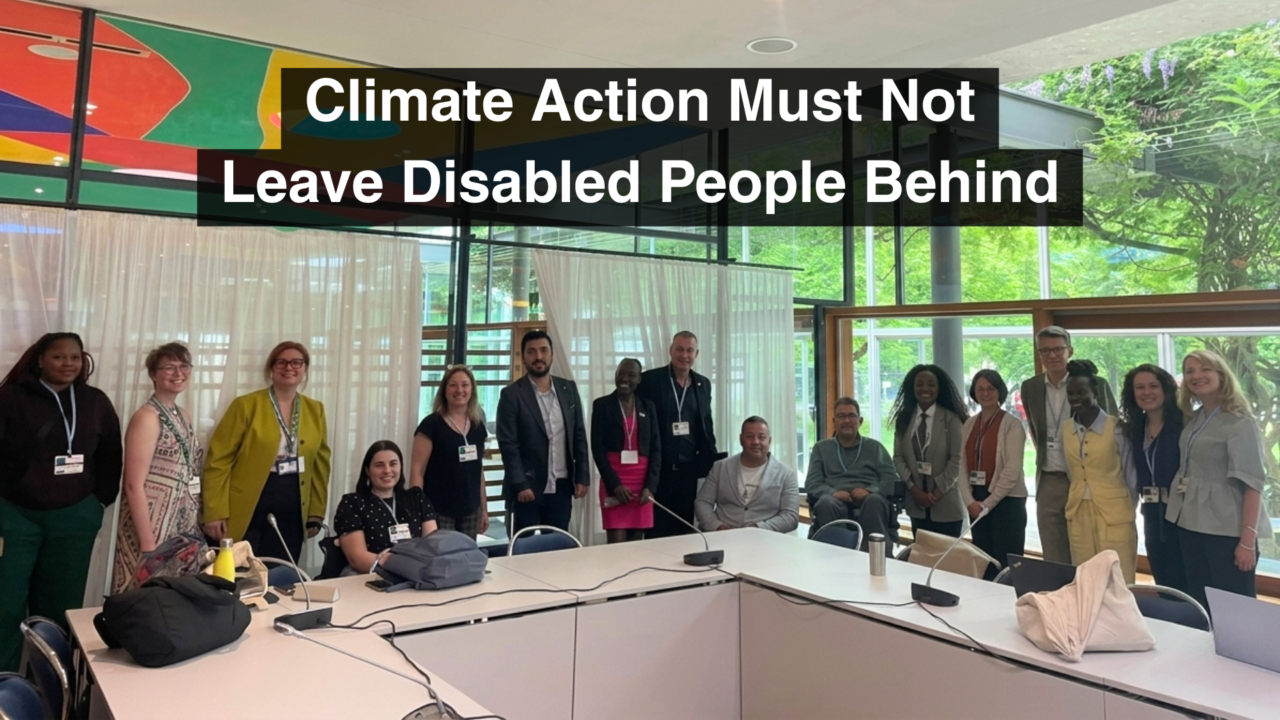
From 8 to 10 June 2026, ENIL member Elena Rațoi participated in the SB64 Climate Conference in Bonn, Germany, as part of a broader delegation coordinated by the International Disability Alliance (IDA).
During the conference, Elena took part in the 2026 Action for Climate Empowerment (ACE) Dialogue and Technical Workshop, as well as in the Expert Dialogue on Gender- and Age-Disaggregated Data and Gender Analysis. These events brought together government representatives, civil society organisations, experts and other stakeholders to discuss inclusive approaches to climate action and the implementation of the Paris Agreement.
Action for Climate Empowerment, established under the United Nations Framework Convention on Climate Change (UNFCCC), provides an important framework for strengthening public engagement, education, training, capacity-building and knowledge-sharing on climate action. In this respect, at the ACE Dialogue and Technical Workshop, participants reviewed progress in implementing the current ACE Action Plan and discussed priorities for the development of a new action plan. During the working group discussions, Elena advocated for the systematic mainstreaming of disability inclusion and accessibility across all ACE pillars and climate action processes.
The better disability inclusion in the new ACE Action Plan is extremely important. Climate change and disaster risks disproportionately affect persons with disabilities. Despite representing at least 16 per cent of the global population, persons with disabilities continue to face significant barriers to participation in climate policymaking, access to information, and education and training initiatives related to climate resilience. These barriers increase exposure to risk during disasters and limit opportunities for persons with disabilities to contribute to climate solutions.
During the conference, Elena also had the opportunity to engage with members of the Disability Climate Caucus and other disability advocates from around the world. Disability advocacy within the UNFCCC has evolved significantly in recent years, growing from informal engagement into a coordinated global movement led by Organisations of Persons with Disabilities (OPDs) and their allies. In 2026, the UNFCCC formally recognised the Disability Climate Caucus as an Informal Stakeholder Group. However, the Caucus is still advocating for the formal recognition as a full UNFCCC Constituency. This status would reduce structural barriers to participation by improving access to information, coordination and engagement modalities, and would align with obligations under the Convention on the Rights of Persons with Disabilities.
As a conclusion, persons with disabilities must not only be included in climate discussions but must also play a leadership role in shaping climate policies and solutions. Without their meaningful participation, climate responses risk overlooking the specific needs, experiences and contributions of more than one billion people worldwide.
Organisations interested in joining the Disability Climate Caucus can submit an application here: https://docs.google.com/forms/d/e/1FAIpQLScApoi2qL-iLXND6frZoVn14TSBRU3R23BrYxTQ2L5A_6-aGg/viewform