ENIL recently participated in the SURE Experience Exchange Conference on Strategic Litigation Using EU Law and the EU Charter of Fundamental Rights. The event brought together practitioners and organisations exploring how EU law can be used as a tool to advance fundamental rights across Europe.
At the conference, ENIL reflected on one of the most significant cases in its advocacy history: Case T-613/19, which challenged the use of EU funds to finance institutionalisation in Bulgaria.
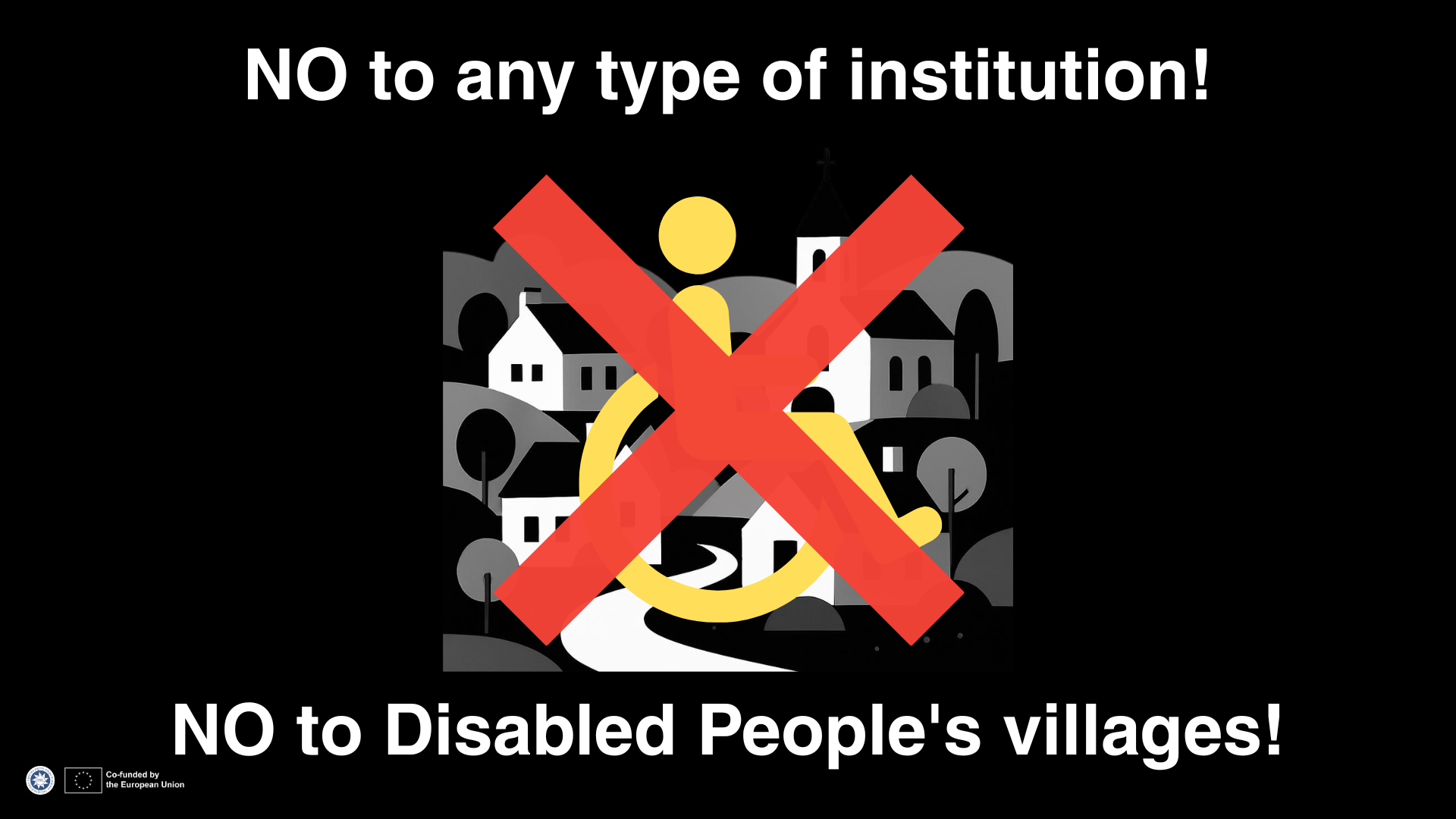
Between 2014 and 2020, Bulgaria used EU Cohesion Funds under the “Regions in Growth” programme to finance what was labelled as “deinstitutionalisation”. In practice, however, these projects funded the construction of new small-scale residential institutions — smaller buildings, but the same segregation.
This directly contradicted Article 19 of the UN Convention on the Rights of Persons with Disabilities (CRPD), which guarantees the right to live independently and be included in the community. As the UN CRPD Committee had already clarified, moving people from large institutions into smaller ones is not deinstitutionalisation. It is simply redesigning segregation.
When national authorities failed to act, ENIL, together with Validity Foundation and the Center for Independent Living Sofia, turned to the European Commission. The argument was simple: EU funds must not finance discrimination.
In May 2019, the Commission refused to intervene. That refusal became the basis of Case T-613/19 before the General Court of the European Union.
In September 2020, the Court dismissed the case as inadmissible. The applicants were found to lack standing, and the Commission’s letter was not considered a challengeable act.
Formally, the case was lost.
Substantively, it exposed a structural accountability gap at the heart of EU funding under shared management. Member States claim that “Brussels approved the projects.” The Commission responds that implementation lies with the Member State. In the end, no institution is held accountable — while people remain institutionalised.
Although declared inadmissible, the case shifted the conversation at European level. It exposed the risks of EU funds being used to perpetuate segregation under the language of reform and contributed to growing scrutiny of how Cohesion Funds and other EU financial instruments are implemented.
In the 2021–2027 programming period, compliance with the CRPD and the EU Charter of Fundamental Rights became more central in discussions on conditionality, monitoring and fundamental rights safeguards.
For ENIL, this was not the end of a legal chapter, but the beginning of a broader strategy. It inspired the FURI project (Funding for Rights), which gathered data on EU-funded institutionalisation across Europe; strengthened engagement in LITI-GATE, focused on building strategic litigation capacity; and feeds directly into StratAGEic, which uses the EU Charter and EU law to challenge systemic discrimination, including ageism and institutionalisation.
Beyond its legal outcome, the case reinforced a crucial principle: deinstitutionalisation is not about architecture — it is about freedom, autonomy and equal participation.
Case T-613/19 was not only a legal action. It was a warning: EU funds must not entrench discrimination under the guise of reform.
Strategic litigation is not only about winning cases. It is about exposing structural failures, clarifying responsibilities and ensuring that fundamental rights are not optional — even in complex systems of shared management.
The accountability gap revealed by this case remains a challenge. If no one has standing to challenge the misuse of EU funds when fundamental rights are at stake, how can the promise of the EU Charter become a lived reality?
At ENIL, we continue working to ensure that inclusion is not reduced to infrastructure projects or policy language — but becomes an irreversible legal and social commitment across Europe.