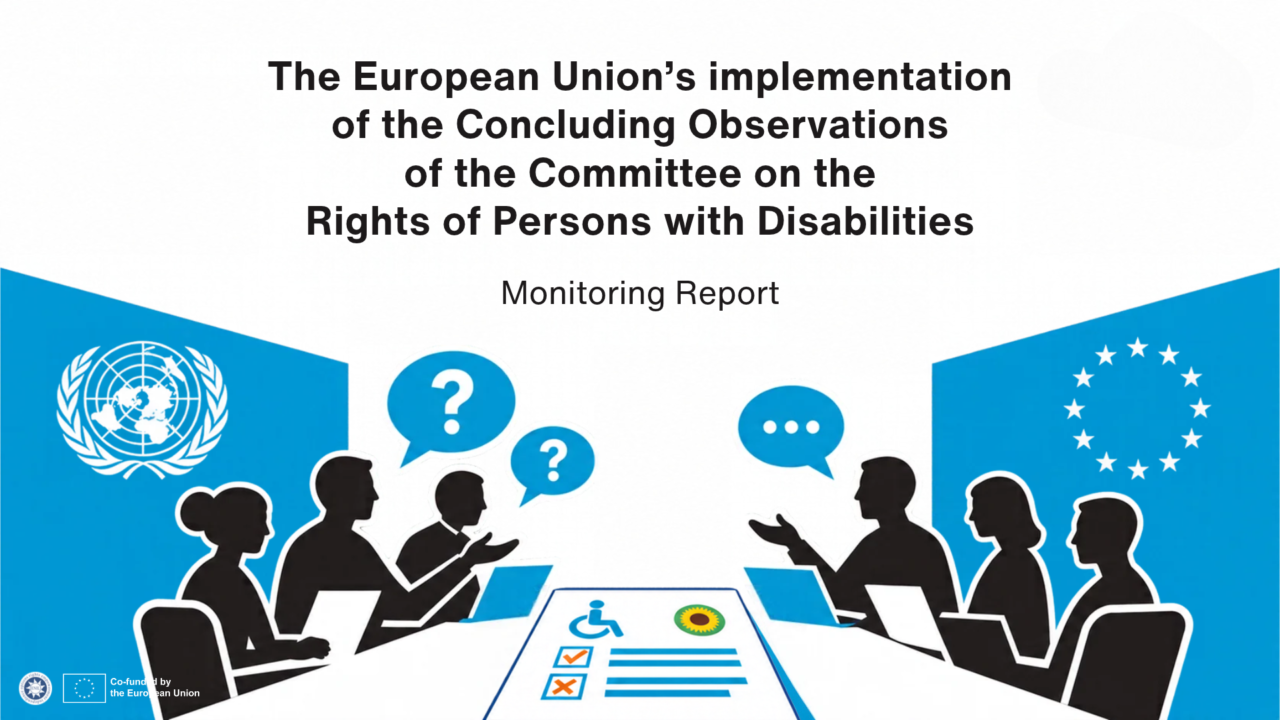
ENIL has published a new report evaluating the EUs` performance in implementing the UN CRPD. The report is available in pdf.
On the 18th of March 2025, the UN Committee for the Rights of Persons with Disabilities published its Concluding Observations on the EU’s combined second and third periodic reports.
More than a year has passed. To what extent has the EU been implementing the recommendations?
Barriers and challenges
There are several factors that hinder the implementation of the UN CRPD in EU legislation:
- In 2014 the European Court of Justice ruled that the UNCRPD cannot have direct effect on EU legislation
- The EU has not clarified that it accepts the UN general comments as authoritative
- The EU has failed to conduct a comprehensive review of its legislation, to ensure CRPD compliance
Actions which would be needed
There is a pressing need to scale up the commitment towards Independent Living and to ensure pending legislation is compliant with the CRPD obligations.
ENIL has been asking the EU to:
- Coordinate the abolishment of guardianship and protection registers in favor of supported decision making
- Redirect funding away from sheltered workshops into supported employment programmes
- Make the EU guidelines on Independent Living a binding document to take the EU’s commitment towards Independent Living to a new level
One year on, the EU progress falls short
Despite the EU’s ratification of the UN CRPD, it has failed to translate its commitment into meaningful legislative change.
In the last year, the EU has taken actions which significantly impact disabled citizens.
ENIL urges the EU to ensure that these initiatives do not reinforce exclusion and discrimination. It is essential that these actions follow a disability inclusive approach.
1. The Regulation on the protection of adults
The original commission proposal on the regulation on the protection of vulnerable adults in cross border situations completely disregarded article 12 of the UN CRPD, which establishes the right of disabled adults to have their legal capacity recognized in an equal basis with others
We have called on the EU to adopt a regulation on the protection of adults that:
- Bans the establishment of protection registers
- Bans the establishment of guardianship regimes
- Bans cross-border placement in institutions
Our advocacy work brought significant progress:
- Articles mentioning protection registers were removed; supported decision-making introduced. Unfortunately, guardianship regimes and cross-border placement in institutions remain options in the final legislative text
2. Guidance on Independent Living and Inclusion in the community
The guidance on Independent Living and inclusion in the community for persons with disabilities is an important step forward towards ensuring the rights of disabled Europeans.
We call on the EU to turn the guidance into a legally binding document to ensure it will have real, positive impacts in the lives of disabled citizens.
3. Employment on the open labour market
EU state aid and public procurement legislation crucially neglects the right of persons with disabilities to work in the open labour market.
We call on the EU to:
- Prohibit state aid for segregated employment
- Amend directive 2014/23/EU on concession contracts and directive 2014/24/EU on public procurement to eliminate all provisions authorizing public funding of sheltered workshops
- repeal article 34(2)(f) of the general block exemption regulation on the financing of sheltered workshops
Towards stronger EU action
The EU has taken insufficient action to fulfill its CRPD obligations. At present, it has produced one document tackling Independent Living. While this is a significant step forward, it remains a non-binding document with very limited legal and political effects for disabled people.
At the same time, the European commission continues to put forward legislative proposals and funding activities that directly contradict the CRPD.
It is not enough to promote good practices for Independent Living. The European Commission should produce legislation that will contribute to reducing the barriers that disabled people face every day.
Design these policies with us, not about us.