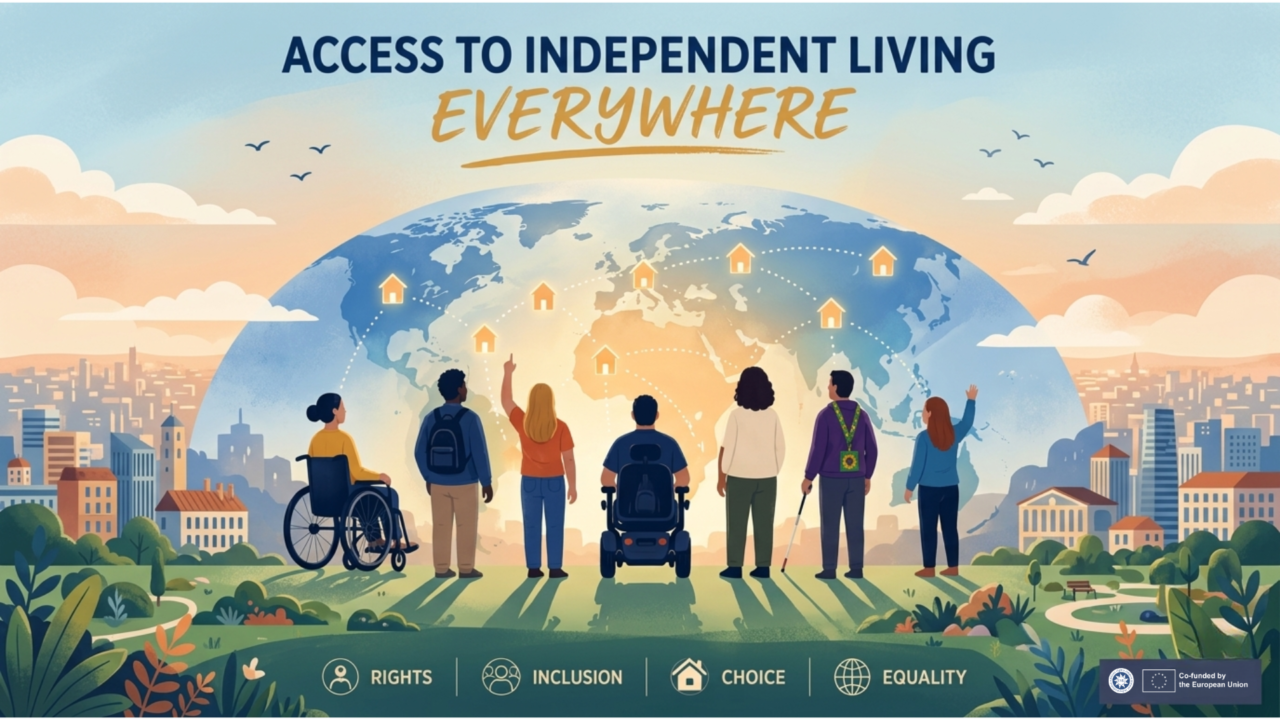
Today the EUFunds4IL Coalition is launching detailed amendments to the Global Europe Programme. The complete amendments can be downloaded in pdf here and in word here.
Global Europe is the EUs` funding programme for:
– accession and neighbourhood countries
– the Middle East, North Africa and the Gulf;
– Sub-Saharan Africa;
– Asia and the Pacific;
– Americas and the Caribbean;
– Global.
From 2028 to 2034 it will have approximately EUR 200 billion at its disposal.
The organisations of the EUFunds4IL Coalition are recommending changes to Global Europe. You want to know more about the coalition and maybe join? All information is available here.
We ask all parties involved to effectuate the following modifications:
1. Turn Global Europe into a programme that strongly supports the rights of persons with disabilities
A key objective of Global Europe is to promote our values which are rooted in our commitment to human rights.
The United Nations Convention on the Rights of Persons with Disabilities (UN CRPD) is one of the major international thematic human rights treaties. The European Union is a party to the UNCRPD which is part of the Unions’ legal order. The UN CRPD is the only international human rights treaty the EU is party to.
The ratification of the UN CRPD by the EU and all its member states shows that the rights of persons with disabilities are an intrinsic part of our values.
Articles 21 and 26 of the EU Charter of Fundamental Rights and article 19 of the Treaty of the Functioning of the European Union commit the EU to the pursuit of the equal treatment and social inclusion of persons with disabilities.
Given this inexorable commitment, we recommend giving the promotion of the rights of persons with disabilities a stronger role.
We recommend:
Amend article 4, 1b “Objectives of the instrument” and include the United Nations Convention on the Rights of Persons with Disabilities (UN CRPD)
Article 4, 1b states that Global Europe should contribute to the promotion of multilateralism and lists various international agreements the EU has concluded and whose implementation the programme should support. The UN CRPD is not listed. That is a missed opportunity which should be corrected.
Amend Article 9 (4) “General Principles” and list “equal treatment and social inclusion”, “Independent Living”, “personal assistance” and “deinstitutionalisation” as actions to be promoted
We welcome the reference to persons with disabilities. To ensure Global Europe generates investments that make a difference, we recommend adding precision by listing some of the objectives that should be pursued and actions to be financed.
Amend article 10 “Mainstreaming” and add “equal treatment and inclusion of persons with disabilities” to the list of topics
We welcome the mainstreaming of the fight against climate change, environmental protection, and gender equality. The equal treatment and social inclusion of persons with disabilities have a high standing in EU primary and secondary law and in EU policy making and thus should be directly mentioned among the topics to be mainstreamed.
Amend Article 23 “Implementation and forms of Union funding” and add a reference to the rights of persons with disabilities.
2. Ensure Global Europe takes into account the specific needs of women with disabilities
Persons with disabilities are a heavily marginalised group worldwide. Women with disabilities are more strongly affected by all the barriers persons with disabilities encounter. Women with disabilities are more frequently institutionalised and when in those settings at a high risk of forced sterilisation, depriving them of their reproductive rights. Women with disabilities who are mothers are doubly affected by the widespread unavailability of person-centred services to support them with their disabilities and of adequate childcare services, in particular when the child has a disability too.
In the fight for Gender Equality, the specific needs of women with disabilities are usually not taken into account.
We recommend:
Amend articles 9 – General Principles – 5 and 6 and add references to women with disabilities
3. Ensure organisations of persons with disabilities can participate in the programme
The empowerment of persons with disabilities to act as self-advocates is one of the key principles of the UN CRPD. Persons with disabilities shall no longer be seen as objects, a group decision are taken about but as subjects, a group that takes decisions about itself.
Organisations of persons with disabilities are controlled, run and staffed by persons with disabilities and play a key role in bringing this objective to live. Across the globe, such organisations are small, marginalised and struggle to be heard. A special awareness for their situation and needs is required, specific support needed.
We recommend:
Amend Article 2 – Definitions (8) and list the self-representation of persons with disabilities as entities which are distinct from civil society actors.
Amend Article 9 “General Principles” 3 and 9, Article 13 “General programming approach” 2 and Article 14 “Geographic programming principles” and add references to organisations of persons with disabilities.
About the European Network on Independent Living
The European Network on Independent Living (ENIL) is a disabled-led, cross-disability network of disabled people and their representative organisations. ENIL promotes the right to independent living, as set out in Article 19 of the UN Convention on the Rights of Persons with Disabilities (CRPD), its General Comments and the Guidelines on deinstitutionalisation, including in emergencies. ENIL’s work is guided by the CRPD and the Independent Living principles, enshrined in the Independent Living Pillars. ENIL is active at the European level, and internationally, through cooperation with Centres for Independent Living from around the globe. ENIL’s actions and activities are based on the social and the human rights models of disability, and on the principles of inclusive equality, self-determination, solidarity and intersectionality.
ENIL has participatory status with the Council of Europe (i.e. is a member of the Conference of INGOs) and consultative status with ECOSOC.
Contact us
European Network on Independent Living (ENIL)
4thFloor – Mundo J
Rue de l’Industrie 10
1000 Brussels
Belgium
E-mail: secretariat@enil.eu
Website: www.enil.eu
Written by: Florian Sanden
© European Network on Independent Living, 2025

Co-funded by the European Union. Views and opinions expressed are however those of the author(s) only and do not necessarily reflect those of the European Union or the European Commission. Neither the European Union nor the granting authority can be held responsible for them.