Written by Antonella Candiago – ENIL Policy Officer
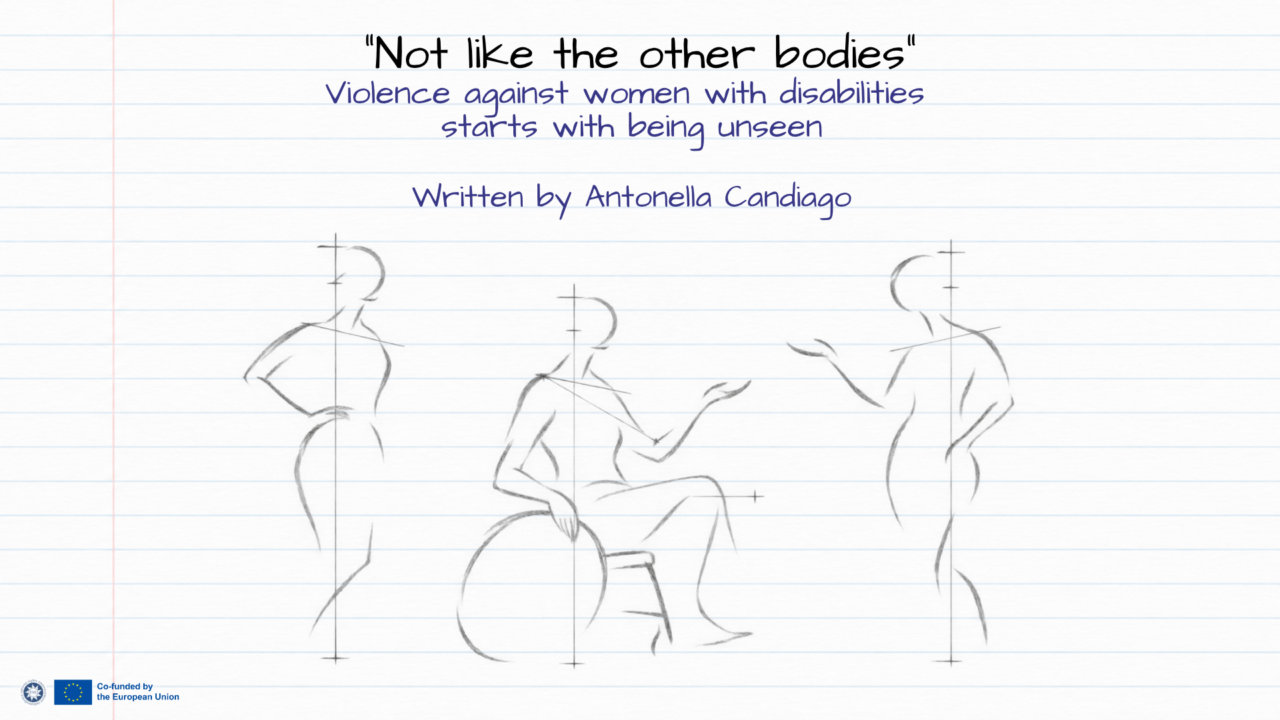
Every year, 25 November, the International Day for the Elimination of Violence against Women, invites us to reflect on the violence women face and on who is still left out of that conversation. Too often, disabled women are. This article asks where that violence begins: in invisibility, in stereotypes, and in the denial of our right to decide about our own bodies and lives. It is written from personal experience, because policy changes only when we understand the lives behind the figures.
Like many disabled people, I spent my whole adolescence surrounded by bodies that were not like mine. Disabled bodies were missing from magazines, from screens, from sex education classes, from every picture of what a desirable woman looks like. The message was never spoken aloud, but it was constant: I was not what “normal” looked like, and I never would be.
It took me years to love my body, and to break away from internalised ableism. It took me even longer to explore my own pleasure without shame. Learning to feel at ease in our own body should not take years of unlearning. This is not only a personal story. It is where violence begins to take root.
Invisibility and hyper-sexualisation: two faces of the same denial
Disabled women are consistently perceived as asexual, as somehow falling outside conventional notions of womanhood, and as people who are not expected to experience desire, intimacy, relationships or romantic love. This denial of our sexuality is so deeply rooted that some disabled women and girls have expressed wishing to be catcalled, not because they desire harassment, but because even this unwanted attention can seem to offer a form of recognition that is otherwise denied to them (Cuollo and Righetti, Abilismo in ‘Anche questo è femminismo’, Bossy, 2021). This is a disturbing reflection of how thoroughly disabled women’s bodies and desires are erased from dominant understandings of femininity and sexuality.
At the other extreme, disabled women can also experience hypersexualisation, objectification and unwanted advances, with our boundaries and refusals disregarded. Both forms of treatment, seemingly opposite, stem from the same underlying assumption: disabled women’s bodies and sexuality are not theirs to define. Whether desexualised or hypersexualised, we are denied the space to express our own desires, establish our own boundaries and freely make our own choices. We are still far from recognising disabled women’s full autonomy and their right to experience intimacy, desire and sexuality on our own terms.
A stranger once tried to kiss me without my consent, as though my body were public property. People have touched my wheelchair without asking, disregarding the fact that it is an extension of my personal space and an integral part of my everyday life. I have also been asked by people I barely knew whether I could have sex and, if so, how.
Each time, the message was the same: my body is open to other people’s curiosity, comments and unwanted contact, regardless of my consent. These acts are often dismissed as awkwardness or good intentions. They are violations of bodily autonomy, and they sit on the same continuum as the violence that the statistics below describe.
Another intrusion is quieter. People have asked my mother whether I can have children. They ask her, not me, as if my body and my future were a family matter.
I do not even ask myself that question, because having children presupposes security: accessible community-based services, personal assistance, adequate social benefits, and a society that supports disabled parents rather than doubting them. Without these, the question is not about desire or ability. Reality is what it is, and for many of us the basic conditions do not exist. Even being able to ask oneself whether one wants to have children cannot be taken for granted. The privilege lies not only in being able to have children, but also in being able to consider parenthood a genuine possibility and a choice in the first place.
This is a rights issue. Article 23 of the UN Convention on the Rights of Persons with Disabilities recognises our right to found a family and to decide freely on the number and spacing of our children. That right means little without the support to exercise it.
What the data tells us
The evidence is limited, because data on the intersection of gender and disability is still lacking in too many countries. But what exists is clear:
- Disabled women and girls in the EU are two to five times more likely to face violence than other women (European Parliament resolution of 29 November 2018 on the situation of women with disabilities).
- 34% of women with a health problem or disability have experienced physical or sexual violence from a partner in their lifetime, compared with 19% of women without disabilities. 61% have experienced sexual harassment since the age of 15, compared with 54% of women overall (FRA, Violence against women: an EU-wide survey, 2014, based on 2012 data).
- The latest EU-wide data confirm the gap: 17.0% of disabled women have experienced sexual violence from an intimate partner in their lifetime, compared with 6.6% of non-disabled women. For physical violence the figures are 19.1% and 10.6% (EU gender-based violence survey, Eurostat, FRA and EIGE, in-depth report published in 2026).
The violence is not limited to what is usually named. It also includes forced abortion, forced sterilisation and forced contraception. Forced sterilisation of persons with disabilities is still legal in at least 12 EU Member States (European Disability Forum, updated 2024), and it disproportionately affects women and girls.
Not believed, not protected
When disabled women do speak up, they are too often not believed. We do not fit the stereotyped image of a “victim” held by police, courts, families and services. Where ableism combines with racism or homophobia and transphobia, victim-blaming and secondary victimisation become even more likely. The same stereotypes that desexualise and infantilise us make reporting harder and perpetrators more confident that nothing will happen.
Intersectional discrimination is not an abstract concept for me. When I was younger, but confident enough to start exploring dating, I went on what was one of my first dates, with a guy I had enjoyed talking to for hours. Then his attitude changed. He began asking how I would run after him if he left, and how I would defend myself if he attacked me. I went cold and felt unsafe. He then asked intrusive questions about my body and, standing over me, remarked that it was “funny” to talk to me from up there. He kept trying to get closer and to be physical with me, ignoring how uncomfortable and unsafe I felt. When I asked him to leave, he could not understand why the evening had turned “weird”. This is what everyday sexism and ableism look like when they meet: contempt dressed up as curiosity, turning into intimidation and unwanted closeness, with no awareness of the harm done.
When the person who hurts you is the person who cares for you
Many disabled people, especially women, are forced to rely on someone else for daily support: a partner, a parent, another relative. When the same person provides both care and violence, reporting becomes a very complex question. How do you report the person who is hurting you but also helps you get up, wash, eat or get to work? Who will support you tomorrow if they are arrested, or if you are believed? Too often the alternative is an institution, or no support at all, so many are forced to stay silent.
Economic dependence makes it worse. In many countries a marriage penalty also applies: when a disabled person marries, they can lose their disability benefits and become financially dependent on a non-disabled partner, which can create very dangerous situations. Dependence is a risk factor for women in general: women who depend economically on their current partner experience physical and/or sexual violence at a rate of 10.4%, compared with 3.4% for financially independent women (FRA and EIGE, 2026).
The answer is not to ask women to endure, but to make leaving possible. Countries must provide community-based services and other support so that disabled people can live independently, such as affordable, accessible housing and personal assistance, as Article 19 of the UN Convention on the Rights of Persons with Disabilities requires. Without them, protection from violence exists on paper only.
Why sexuality education is a prevention measure
Most of us never received inclusive, comprehensive sexuality education. Without it, we educate ourselves with whatever we can find, and mainstream pornography offers either a narrow ideal of non-disabled bodies or content that fetishises disability. Neither helps us understand our desires, set our boundaries, or recognise when they are crossed.
Sexuality education is not a luxury. It is how a young woman learns what consent is, that her body belongs to her, and that she has the right to say no and to be heard. Women with disabilities, who are told from an early age to be grateful for any attention, need it more than anyone.
But education cannot be addressed to disabled women alone. Violence is overwhelmingly committed by men, so prevention must also educate boys, men and non-disabled people in general about consent, respect and the equality of disabled people. A “no” must be understood as a complete answer, and the myths of disabled women as asexual, grateful or easy targets must lose their hold.
The man on that date did not invent his questions. He had learned, from a society that rarely shows disabled women as desirable, equal and capable partners, that he could ask them. Education is where that changes, alongside the law.
What needs to change
The European Network on Independent Living works from a simple principle: nothing about us without us. On 25 November, and every other day, that means the following demands.
- Ban forced sterilisation, forced abortion and forced contraception in all EU Member States, and treat them as the forms of gender-based violence they are.
- Guarantee legal capacity so that women with disabilities decide for themselves about their bodies, their health and their relationships, in line with Articles 12 and 23 of the UN Convention on the Rights of Persons with Disabilities (CRPD).
- Make protection and support accessible: shelters, helplines, police stations, courts and health services must be accessible in their physical environment, communication and information, and must be able to support women who use personal assistance, including by providing assistance themselves where needed.
- Fund independent living and personal assistance, together with affordable, accessible housing and community-based services, so that women are not forced to depend on an abuser or an institution because there is no alternative. End the marriage penalty, which makes disabled people lose their benefits when they marry.
- Train police, judges, social workers and health professionals on disability and gender, and on how to take disabled women’s testimonies seriously.
- Collect disaggregated data on violence by gender, disability and other grounds, so that the problem can no longer be ignored.
- Introduce inclusive, comprehensive sexuality education for all students, that represents disabled bodies, teaches consent, boundaries and rights, and challenges the attitudes of boys, men and non-disabled people that sustain violence.
- Ensure disabled women’s organisations are at the table when laws and policies on violence against women are designed, implemented and evaluated.
A message to women and girls with disabilities
We did not create the stigma we absorbed, and we should not blame ourselves for it. Be patient with yourselves. Take time to explore your body and your needs, and look for support from professionals who understand disability and intersectional discrimination, because those who do not can leave us feeling misunderstood.
To decision-makers: a woman who knows her own body, believes in her rights and is believed when she speaks is harder to silence and harder to harm. Ending violence against women with disabilities starts by making us visible.