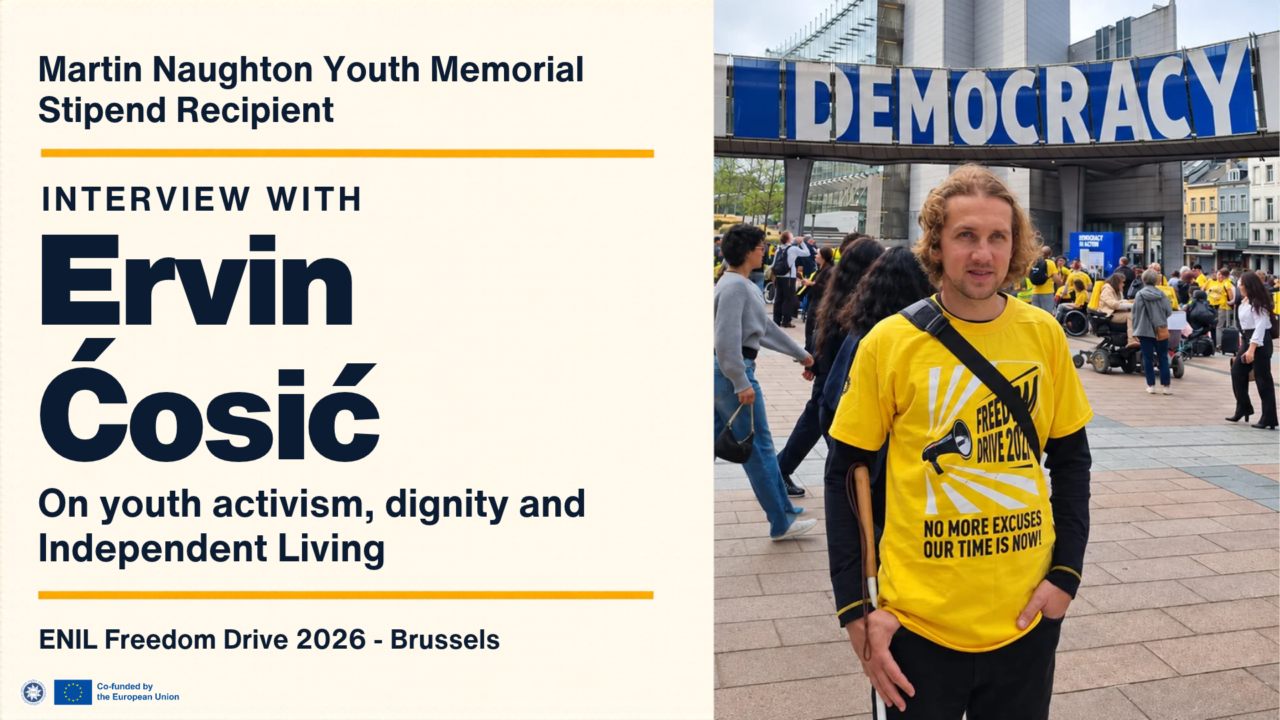
Ervin is one of the two young people who received the Martin Naughton Youth Memorial Stipend to attend the 2026 ENIL Freedom Drive in Brussels. After the event, the ENIL Youth Network Board wanted to learn what this experience meant for him, discuss his advocacy and give you an opportunity to get to know him. Ervin provided valuable insights and reflections on youth activism in Europe and how we respond to contemporary challenges. Read what he shared with us!
- What motivated you to apply for the Martin Naughton Youth Memorial Stipend?
The main motivation for my application was a strong desire to network with organizations and activists from the European Union and other countries. I believe that exchanging experiences and good practices is key to strengthening the independent living movement, and this fellowship provides a unique opportunity to learn and acquire new knowledge that I can directly apply in my work with young activists in my country.
Additionally, this fellowship holds a deeply personal dimension for me. As someone who lives an independent life every day, I am motivated to continue the fight for the advocacy and promotion of the independent living philosophy, so that we can create better conditions and equal opportunities for all young people with disabilities.
- What does Independent Living mean to you personally — beyond its formal definition?
For me, independent living goes beyond a mere formal definition or physical independence; it represents the freedom of decision-making and a way of living without unnecessary limitations and restraints. It means having equal opportunities and possibilities to learn, to freely make my own mistakes, and to bear responsibility for them myself, as that is an integral part of growing up and personal development.
To me, independent living brings dignity and respect within the community I live in, enabling me to be politically active and involved in relevant social developments. The essence lies in being an active member of society in my local community — someone who contributes to positive change through their work, rather than just being a passive recipient of assistance.
- Was there a particular moment or experience that made you realise you wanted to become involved in disability activism?
The key turning point occurred at the age of 21, at a critical phase when a young person should be pursuing higher education and building a career, when I lost my sight. Although I did not lose the desire to continue my education and progress, I encountered serious resistance within the community along that path. Issues with inaccessible literature, as well as complete architectural and information inaccessibility, created additional obstacles.
However, instead of letting this discourage me, these injustices ignited a desire within me to resist the inert system. I began advocating for a better position in society and fighting for the rights of those who might not be strong enough at that moment to raise their own voice. I believe that activism is not just a role, but a lifestyle that all young people should live, so that together we can fight for a fairer status and a dignified life for every individual.
- What is one thing you wish you had known when you first started advocating for disability rights?
I wish I had known at the very beginning that this fight is not a solo game and that this marathon can only be successfully finished as a team. To achieve real results, it is important to know how to act and to target efforts at key segments of the system. Today, with the valuable experience I have, I am surrounded by great people with whom I work and act, and I realize how much easier, more meaningful, and more powerful it is when we fight together to achieve our rights.
- What is the biggest barrier young disabled people face when they want to become activists or leaders?
Apart from deep-rooted prejudices that still prevail in society, the biggest barrier is that young people with disabilities still lack sufficient opportunities where genuine trust is placed in them to assume important roles. Furthermore, an inadequate education system, a lack of information accessibility, and the non-existence of personal assistance services represent key factors that hinder the process of achieving independence. Without these basic conditions, it is significantly harder for young people to build the skills, self-confidence, and leadership potential necessary to drive real change.
- Do you think young disabled people are genuinely listened to in decision-making spaces, or are they sometimes only invited to “tick the inclusion box”?
I believe that young people with disabilities are most often invited to events, guest appearances, and hearings merely to formally justify inclusion. Unfortunately, it is not uncommon for us to serve as a backdrop for certain structures, such as political parties during election campaigns, where persons with disabilities are used to attract public attention, fulfill quotas, or create an illusion of numbers.
Not to paint everything in a completely dark light, there are bright examples where young people with disabilities have managed to win the space to truly be heard and respected. However, these remain exceptions rather than the rule — it is a long and thorny road that a movement must travel to reach a level of equality and a position where its voice is genuinely taken into account when making decisions.
- What is one stereotype about disabled young people that you would most like to challenge?
I wish there were only one, as that would mean we had addressed the root of the problem, but unfortunately, a large number of prejudices persist in society. However, if I had to single one out, it would be the stereotype of passivity and dependency. The notion that young people with disabilities are exclusively dependent on others’ help, that they are passive and helpless, has crossed all bounds. Young people with disabilities are more than capable of working, creating, and making an invaluable contribution to society — they simply need what belongs to everyone: a fair opportunity and the motivation to show their full potential.
- How do you balance activism with your personal life, studies, work, or simply having time to be a young person?
I admit that sometimes it can be overwhelming and the schedule is often overbooked due to a large number of projects and side activities. Alongside work obligations, I strive to maintain the household entirely on my own — tidying up the apartment, cleaning, doing laundry, and cooking meals — all of which takes time and drains energy.
Yet, through it all, I always find a way to recharge my batteries with new energy by drawing strength from nature and spending relaxing moments in company. The key is that when you do what you love and firmly believe in, strength and energy are easier to find, and balance is established through small, beautiful moments that make life fulfilling.
- Where is the line between activism and work? Should disability activism always be paid, and how does money change the way we think about activism?
The line lies in the transition from pure passion and an inner sense of justice to professional responsibilities. Activism indeed begins from volunteerism, but when it grows into managing complex projects, writing analyses, legal advocacy, and daily work, it naturally becomes professional work requiring time, skills, and energy.
- If you could change one thing in your country tomorrow to improve the lives of young disabled people, what would it be?
If I could change just one thing, it would without a doubt be the establishment of systemic support for independent living, with a special emphasis on the legal and stable financing of personal assistance services. Without this, young people with disabilities are often fully dependent on their families or environmental barriers, without a real opportunity to make their own decisions. By ensuring stable personal assistance, we would enable full autonomy, freedom of movement, and the chance for young people to live with dignity as equal members of society.
- What would you like to achieve with the opportunities, connections, or experience that come with the Martin Naughton Youth Memorial Stipend?
Through this fellowship, I would like to achieve the implementation of successful European practices and models in advocating for personal assistance in our country. Also, it is extremely important for me to leverage the network of acquaintances and contacts with European organizations to exchange experiences and open new doors for cooperation. I plan to directly direct the acquired knowledge toward providing mentorship and transferring skills to young people in local communities, in order to build a broader, stronger, and louder network of future leaders.
Likewise, I believe activism should not be based exclusively on volunteerism and unpaid labor. Inadequate valuation of effort leads to activist burnout and instability. On the other hand, when work is adequately paid, it provides activists with financial stability and additional motivation for long-term, dedicated, and high-quality work toward achieving the movement’s goals.
- If disability activism disappeared tomorrow because we had achieved everything we are fighting for, what would you want to do with all that time and energy instead?
Although that is a big question, I believe I would still spend my time creating and building something useful and healthy. I would direct all my energy toward quality of life, spending significantly more time in nature, devoted to growing and tending my garden and flowerbed. Also, I would dedicate myself to a calmer life and spending time with dear people, friends, and family — spending quality, unburdened time without constant phone calls and deadline pressures. Additionally, I would use that time for continuous education and self-improvement, learning new skills and hobby activities for which I simply do not have enough time today due to an overbooked schedule.