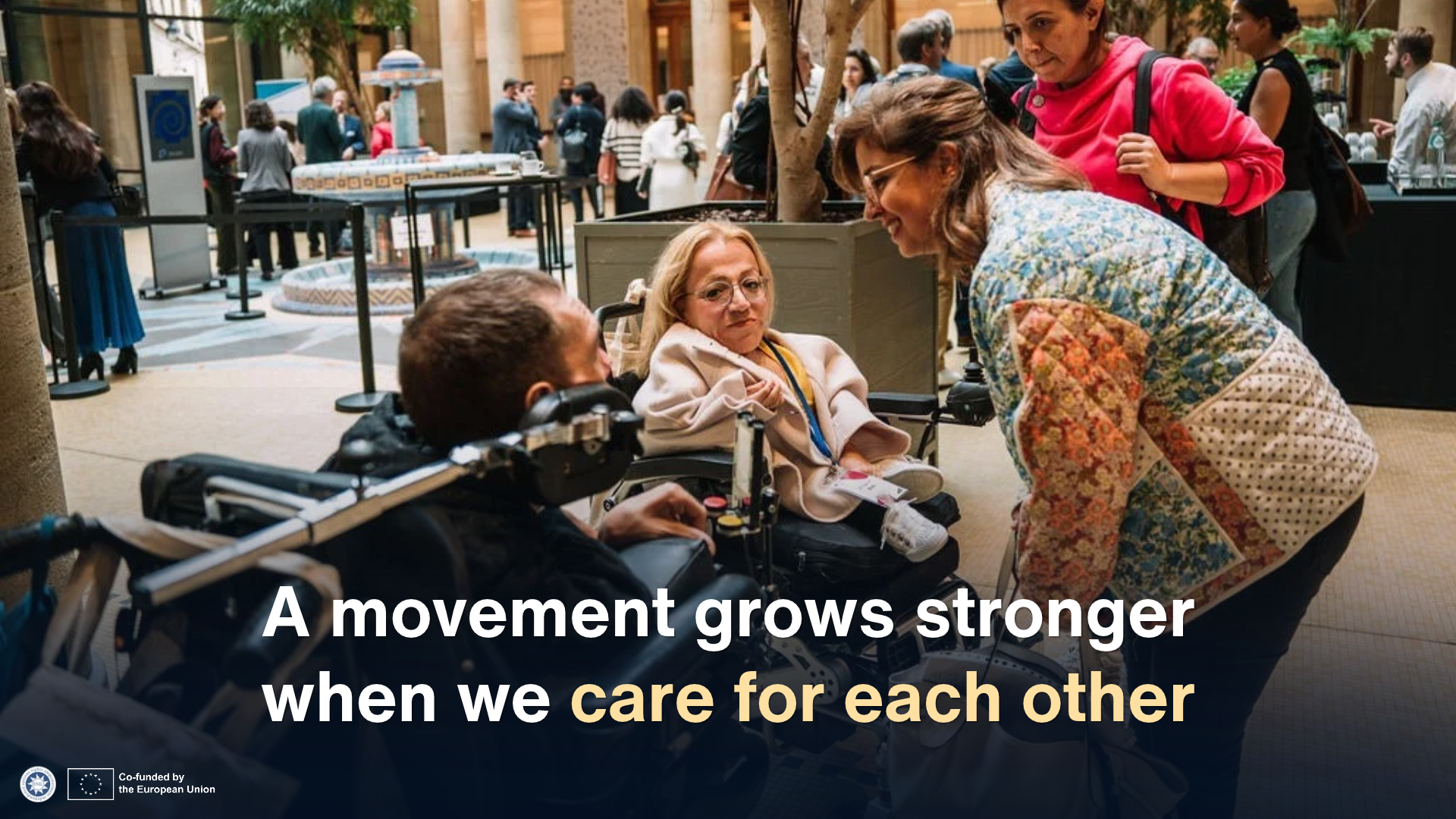
On Tuesday, 17 March, ENIL delivered a presentation on the right to independent living and inclusive employment, at an event organised by the National Observatory of Neurodivergences in Spain together with Teamworkz — an organisation committed to promoting inclusive employment opportunities for persons with psychosocial disabilities in Spain.
The session brought together more than 30 participants, including professionals, employers and stakeholders interested in advancing more inclusive labour market practices.
From rights to practice: employment as a pillar of independent living
The presentation focused on the link between Article 19 (right to independent living) and Article 27 (right to work and employment) of the UN Convention on the Rights of Persons with Disabilities (CRPD). It highlighted how access to meaningful employment is not only an economic issue, but a fundamental component of autonomy, dignity and full participation in society.
Special attention was given to the need to move away from segregated forms of employment and towards models that support persons with disabilities in accessing the open labour market.
Understanding different employment models
The session explored the main models currently used across Europe:
· Sheltered employment, where people with disabilities work in segregated environments, often with limited labour rights and low wages;
· Social or integration enterprises, which represent a step forward by promoting more inclusive environments, although they may still operate within disability-specific structures;
· Supported employment, which enables persons with disabilities to access and remain in the open labour market through personalised support.
Supported employment was presented as the model most aligned with the CRPD, as it focuses on individual choice, autonomy and participation in mainstream society.
What works: examples from across Europe
To move beyond theory, the presentation showcased practical examples of supported employment initiatives across Europe, including:
· DiversiCom (Belgium), which supports both jobseekers with disabilities and employers through job coaching, workplace adaptations and training;
· Work Assistance (Austria – NEBA), a large-scale public system providing support from career assessment to job integration;
· EmployAbility (Ireland), offering continuous support before and after job placement through a nationwide network;
· Targeted placements (Italy), including innovative practices such as job carving to adapt roles to individual skills.
These examples demonstrate that inclusive employment is not only possible, but already being implemented successfully in different national contexts.
Inclusive employment as an investment
A key message of the session was that inclusive employment should be understood as an investment rather than a cost. When persons with disabilities are supported to access the open labour market, they can contribute their skills, increase their independence and participate more fully in society.
This contrasts with segregated models, which often require long-term public expenditure without generating the same social and economic benefits.
The role of reasonable accommodation
The presentation also addressed the importance of reasonable accommodation as a legal and practical tool to ensure equal access to employment. Providing adjustments in the workplace is not an optional measure, but a legal obligation under EU and international law.
Examples of reasonable accommodation included flexible working hours, adapted tasks, assistive technologies and support from job coaches.
Legal developments reinforcing inclusive employment
The presentation also highlighted recent developments in Spanish and European case law, reinforcing the obligation to ensure inclusive employment in practice.
In Spain, the Constitutional Court has recognised that the failure to assess and provide reasonable accommodation may amount to discrimination on the grounds of disability. This marks an important step in ensuring that employers actively consider the needs of workers with disabilities.
At EU level, the Court of Justice of the European Union has clarified that employers must take appropriate measures to enable persons with disabilities to access and remain in employment, unless this would impose a disproportionate burden.
Together, these legal developments strengthen the shift from a medical and segregated approach to a rights-based model of employment.
Moving forward
The discussion highlighted the need for policymakers, employers and service providers to work together to create systems that truly support inclusion. This includes investing in supported employment services, strengthening legal protections and promoting a shift in attitudes towards disability and work.
The event provided a valuable space for exchange and reflection, reinforcing the importance of sharing good practices and building more inclusive labour markets across Europe.