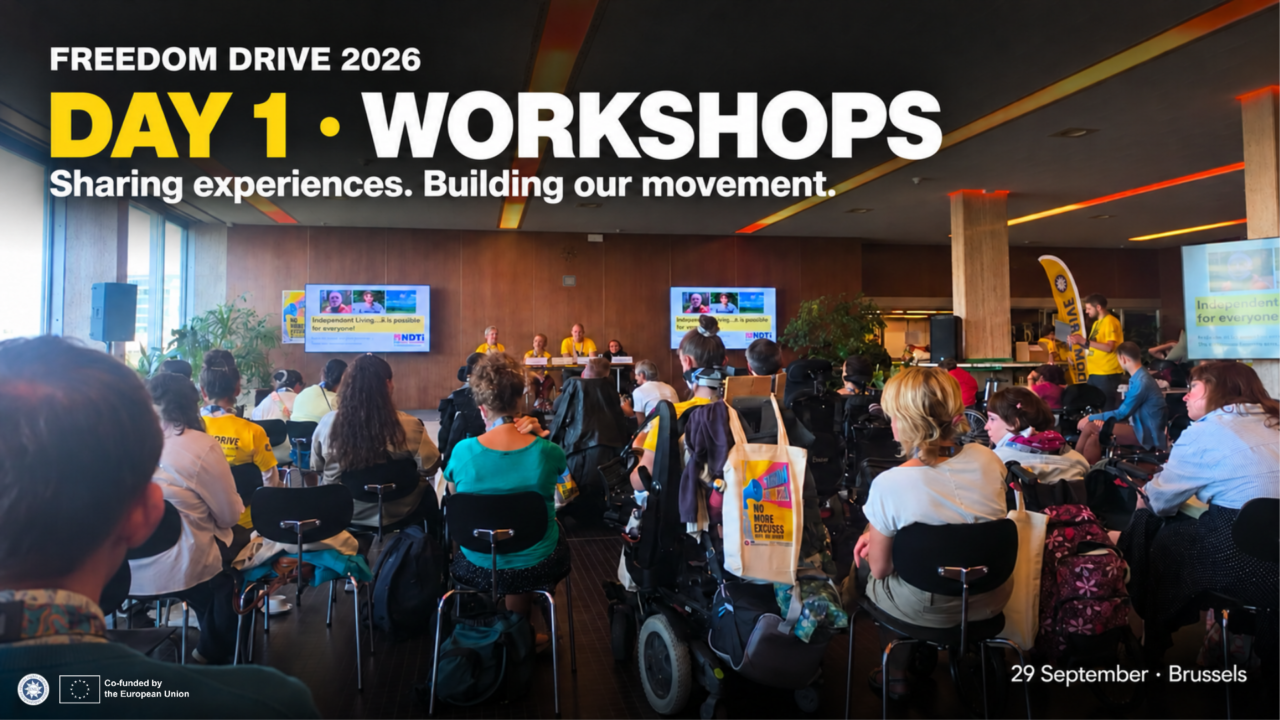
Disabled people and allies gathered at KBR in Brussels on 29 September for the first day of ENIL Freedom Drive 2026. Through workshops on personal assistance, deinstitutionalisation, advocacy, sexuality and organising, participants explored what it takes to make Independent Living a reality for everyone.
The day brought together lived experience, research and practical approaches from different countries. Across the presentations, a recurring question emerged: what does choice mean when the support, resources and opportunities needed to exercise it are missing?
From directing personal assistance to choosing where to live, accessing education or enjoying relationships, the workshops addressed the everyday decisions that disabled people are still too often denied. They also offered ways forward through peer support, collective organising, legal action and cooperation across borders.
Personal assistance: making choice work in everyday life
The personal assistance workshop brought together experiences from Denmark, Iceland, Switzerland and Spain, showing both what assistance makes possible and the barriers that remain.
Jesper Mathiesen’s presentation on the Danish model focused on the difference that personally controlled assistance makes. Choosing assistants, setting routines and having support that follows the person can open up opportunities for work, friendships, travel and participation. He also highlighted challenges, including differences between municipalities, the responsibilities of managing an assistance team, and balancing privacy at home with assistants’ working conditions.
Simone Leuenberger examined Switzerland’s assistance contribution and employer model. While direct payments and individual needs assessments can support control, complicated administration, eligibility restrictions and funding gaps leave people excluded. Her presentation raised an important question: what support must the system provide so that directing assistance does not depend on someone’s ability to navigate complex administrative requirements?
Cristian Lago Rodríguez presented developments making round-the-clock assistance possible for certain people with intensive support needs in Spain, subject to assessment and regional implementation. He connected these changes to collective advocacy while drawing attention to continuing geographical inequalities. His own arrangement illustrated how a person can choose assistants and direct their support while an organisation manages the service.
The presentation on the Nordic Competence Centre on Personal Assistance added a regional perspective. Sharing research, lived experience and information about policy changes can strengthen advocacy when organisations face common pressures, including reduced assistance allocations, recruitment difficulties and an increasing focus on costs.
Across these contributions, the practical test was clear: funding and reforms must translate into sufficient, reliable assistance that people control.
Independent Living is for everyone
The deinstitutionalisation workshop challenged arguments used to justify segregation, including the claim that some people’s support needs are too complex for Independent Living.
Nic Crosby’s presentation emphasised the importance of a home of one’s own, relationships, community connections and support built around the person. Its central message was that nobody should be excluded from Independent Living because they are considered “too complicated”.
Dorothy Gould brought the perspective of people with psychosocial disabilities. Drawing on her own experience and the work of Liberation and Transforming Communities for Inclusion, she challenged involuntary psychiatric detention and forced treatment. She called for community resources rooted in people’s choices and rights, including support to make decisions.
Jose Smits examined the gap between the language of choice and the options available in practice. Her presentation combined criticism of systems that favour institutional provision with a family experience of making Independent Living possible for someone requiring continuous assistance. It also raised the question of sustainability when arrangements depend heavily on relatives.
Together with the workshop’s discussion and role play, these perspectives provided arguments for changing how support is organised and ensuring that people with different support needs can live in the community.
Using law to challenge exclusion
The strategic litigation workshop explored how an individual injustice can reveal a wider pattern of discrimination—and how legal action can form part of a strategy to change it.
Steven Allen’s presentation began with the person and the injustice they face. Before deciding whether to go to court, advocates need to identify the system behind the problem, the change they want to achieve and the risks for the person involved. Litigation can then work alongside campaigning, evidence gathering, communications and policy advocacy.
Nuria Frei illustrated these questions through a Swiss case concerning a child’s access to mainstream education. Her presentation showed both the potential and the difficulty of strategic litigation: interim measures can make an immediate difference to someone’s life, while longer proceedings can expose deeply rooted resistance to inclusion.
The case also highlighted the emotional and practical demands on families. A wider campaign must remain attentive to the wishes and interests of the person whose case is being brought.
A separate workshop on inclusive education examined how the movement can strengthen advocacy and work with others affected by segregation, including Roma communities and children from migrant backgrounds.
Building organisations that people can shape
The workshop on starting a Centre for Independent Living focused on organisations led by and for disabled people, with peer support, choice and collective advocacy at their heart.
Contributions from Sweden, Bosnia and Herzegovina and the United States explored how to build a team, identify local needs, develop support and involve younger disabled people.
The material from Disabled Refugees Welcome brought particular attention to whose experiences are missing from the movement. Rahel Abebaw Atnafu and Ashraf Frugh emphasised that inclusion requires people facing additional barriers to help shape organisations from the beginning.
The workshop encouraged participants to consider practical first steps in their own communities: who needs to be involved, which services are most urgent, and how to create an organisation that people feel belongs to them.
Intimacy, sexuality and the freedom to choose
The workshop on intimacy, sexuality and pleasure addressed an essential part of Independent Living that is frequently overlooked.
Carmen Yau’s presentation explored how ableist assumptions, poverty, surveillance and a lack of privacy can restrict disabled people’s intimate lives. She connected sexual autonomy with the ability to define one’s own desires, boundaries and relationships.
Catarina Vitorino highlighted the experiences of queer disabled people and the relationship between accessibility and sexual citizenship. Accessible housing, transport and social spaces affect whether people can meet others, enjoy privacy and build intimate connections.
The session also created different ways to raise questions, including speaking, writing and submitting them privately. Its themes extended beyond access to services to the freedom to experience pleasure, connection and a full personal life.
Discussing autonomy and the conditions for genuine choice
The assisted dying workshop provided space to examine different perspectives on autonomy, disability rights and social responsibility.
Peter Kearns’s contribution, presenting the perspective of Independent Living Movement Ireland, asked how choices are shaped by access to personal assistance, housing, healthcare, income and community support. He stressed the need to examine the circumstances in which decisions are made and the influence of ableist assumptions about disabled people’s lives.
The workshop approached a difficult subject through discussion and ethical scenarios. It raised questions about how to protect autonomy while addressing the inequalities and lack of support that can limit people’s options.
Defending rights and putting change into practice
The day also addressed Independent Living during humanitarian crises, including conflict, displacement and disasters. The workshop focused on protecting choice and community inclusion through accessible evacuation, shelter, information and support, while preventing further segregation.
Another session considered Independent Living activism as democratic rights come under pressure. Teodor Mladenov and Miro Griffiths introduced the idea of “prefiguration”: putting the future we want into practice through the way we organise today.
Drawing on the early Centre for Independent Living in Berkeley, their presentation explored experimentation, learning with peers, developing shared principles and creating practical alternatives. It invited participants to recognise these approaches in their own activism.
From workshops to action
Alongside the discussions, participants prepared banners for the Freedom Drive protest. The day offered opportunities to exchange ideas, question assumptions and make connections across countries and experiences.
The presentations showed why Independent Living requires action across many areas at once: assistance, housing, education, relationships, legal rights and access to community life. They also demonstrated the knowledge and experience that disabled people bring to changing these systems.
ENIL thanks the speakers, participants, personal assistants, volunteers and everyone who supported the first day.
The programme continues with a conference on housing and Independent Living on 30 September. On Thursday 1 October, Freedom Drivers will take their demands to the streets of Brussels and to the European Parliament.
No more excuses—our time is now!